Accelerating Saccadic Response through Spatial and Temporal Cross-Modal Misalignments
Jiménez Navarro, Daniel ; Peng, Xi ; Zhang, Yunxiang ; Myszkowski, Karol ; Seidel, Hans-Peter ; Sun, Qi ; Serrano, Ana (Universidad de Zaragoza)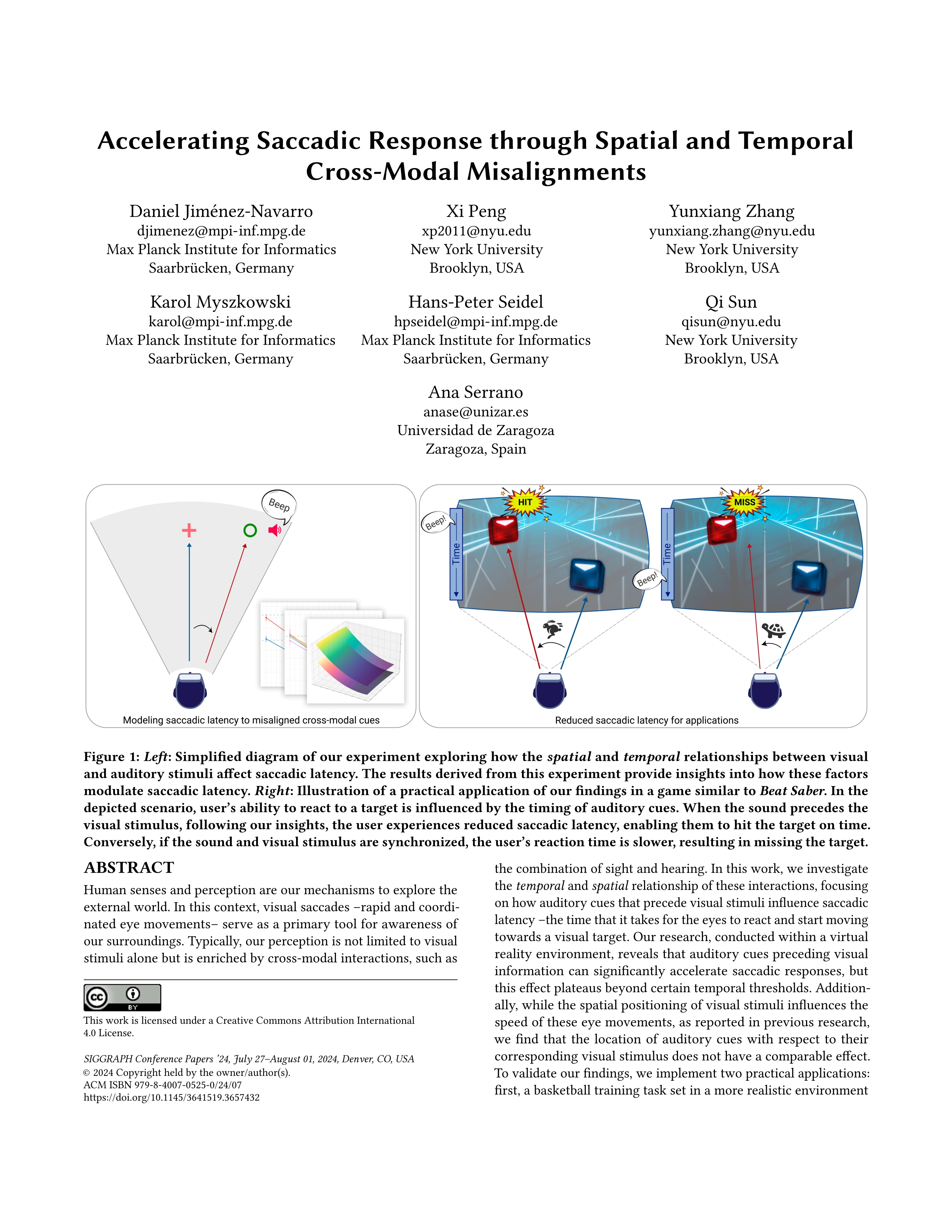
Resumen: Human senses and perception are our mechanisms to explore the external world. In this context, visual saccades –rapid and coordinated eye movements– serve as a primary tool for awareness of our surroundings. Typically, our perception is not limited to visual stimuli alone but is enriched by cross-modal interactions, such as the combination of sight and hearing. In this work, we investigate the temporal and spatial relationship of these interactions, focusing on how auditory cues that precede visual stimuli influence saccadic latency –the time that it takes for the eyes to react and start moving towards a visual target. Our research, conducted within a virtual reality environment, reveals that auditory cues preceding visual information can significantly accelerate saccadic responses, but this effect plateaus beyond certain temporal thresholds. Additionally, while the spatial positioning of visual stimuli influences the speed of these eye movements, as reported in previous research, we find that the location of auditory cues with respect to their corresponding visual stimulus does not have a comparable effect. To validate our findings, we implement two practical applications: first, a basketball training task set in a more realistic environment with complex audiovisual signals, and second, an interactive farm game that explores previously untested values of our key factors. Lastly, we discuss various potential applications where our model could be beneficial.
Idioma: Inglés
DOI: 10.1145/3641519.3657432
Año: 2024
Publicado en: Proceedings of ACM SIGGRAPH 129 (2024), [12 pp.]
ISSN: 2376-1180
Financiación: info:eu-repo/grantAgreement/ES/MICIU/PID2022-141766OB-I00
Tipo y forma: Artículo (Versión definitiva)
Área (Departamento): Área Lenguajes y Sistemas Inf. (Dpto. Informát.Ingenie.Sistms.)
 Debe reconocer adecuadamente la autoría, proporcionar un enlace a la licencia e indicar si se han realizado cambios. Puede hacerlo de cualquier manera razonable, pero no de una manera que sugiera que tiene el apoyo del licenciador o lo recibe por el uso que hace.
Exportado de SIDERAL (2026-01-16-14:54:33)
Visitas y descargas
Idioma: Inglés
DOI: 10.1145/3641519.3657432
Año: 2024
Publicado en: Proceedings of ACM SIGGRAPH 129 (2024), [12 pp.]
ISSN: 2376-1180
Financiación: info:eu-repo/grantAgreement/ES/MICIU/PID2022-141766OB-I00
Tipo y forma: Artículo (Versión definitiva)
Área (Departamento): Área Lenguajes y Sistemas Inf. (Dpto. Informát.Ingenie.Sistms.)
Debe reconocer adecuadamente la autoría, proporcionar un enlace a la licencia e indicar si se han realizado cambios. Puede hacerlo de cualquier manera razonable, pero no de una manera que sugiera que tiene el apoyo del licenciador o lo recibe por el uso que hace. Exportado de SIDERAL (2026-01-16-14:54:33)
Enlace permanente:
Visitas y descargas
Este artículo se encuentra en las siguientes colecciones:
Artículos > Artículos por área > Lenguajes y Sistemas Informáticos
Registro creado el 2026-01-16, última modificación el 2026-01-16