Written corrective feedback at university: detection of errors by teachers and impact of different forms of feedback
Birello, Marilisa ; Comajoan-Colomé, Llorenç ; Salguero, Tania ; Sorolla, Natxo (Universidad de Zaragoza)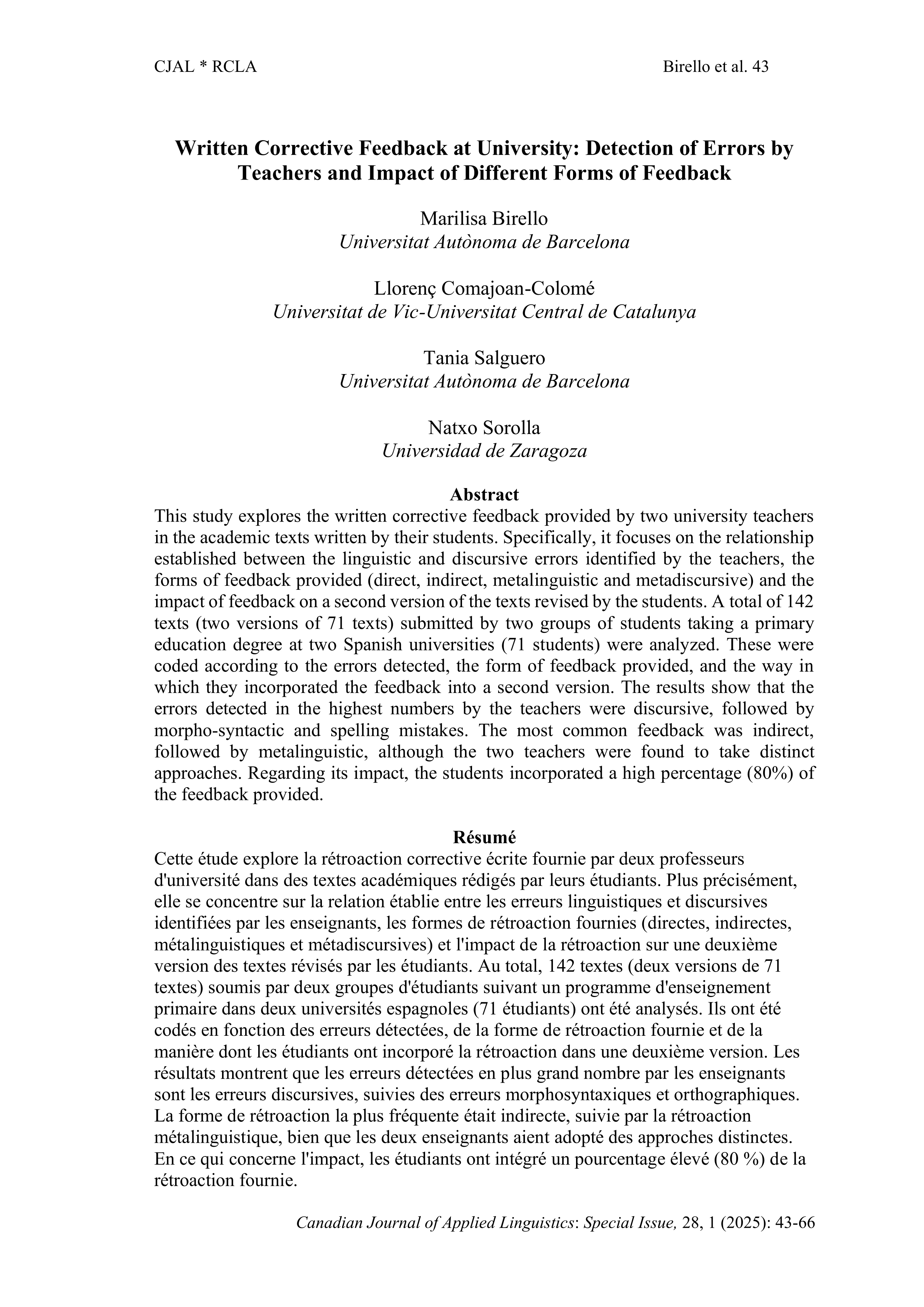
Resumen: This study explores the written corrective feedback provided by two university teachers in the academic texts written by their students. Specifically, it focuses on the relationship established between the linguistic and discursive errors identified by the teachers, the forms of feedback provided (direct, indirect, metalinguistic and metadiscursive) and the impact of feedback on a second version of the texts revised by the students. A total of 142 texts (two versions of 71 texts) submitted by two groups of students taking a primary education degree at two Spanish universities (71 students) were analyzed. These were coded according to the errors detected, the form of feedback provided, and the way in which they incorporated the feedback into a second version. The results show that the errors detected in the highest numbers by the teachers were discursive, followed by morpho-syntactic and spelling mistakes. The most common feedback was indirect, followed by metalinguistic, although the two teachers were found to take distinct approaches. Regarding its impact, the students incorporated a high percentage (80%) of the feedback provided.
Cette étude explore la rétroaction corrective écrite fournie par deux professeurs d'université dans des textes académiques rédigés par leurs étudiants. Plus précisément,
elle se concentre sur la relation établie entre les erreurs linguistiques et discursives identifiées par les enseignants, les formes de rétroaction fournies (directes, indirectes, métalinguistiques et métadiscursives) et l'impact de la rétroaction sur une deuxième version des textes révisés par les étudiants. Au total, 142 textes (deux versions de 71 textes) soumis par deux groupes d'étudiants suivant un programme d'enseignement primaire dans deux universités espagnoles (71 étudiants) ont été analysés. Ils ont été codés en fonction des erreurs détectées, de la forme de rétroaction fournie et de la manière dont les étudiants ont incorporé la rétroaction dans une deuxième version. Les résultats montrent que les erreurs détectées en plus grand nombre par les enseignants sont les erreurs discursives, suivies des erreurs morphosyntaxiques et orthographiques. La forme de rétroaction la plus fréquente était indirecte, suivie par la rétroaction métalinguistique, bien que les deux enseignants aient adopté des approches distinctes. En ce qui concerne l'impact, les étudiants ont intégré un pourcentage élevé (80 %) de la rétroaction fournie.
Idioma: Inglés
DOI: 10.37213/cjal.2025.34455
Año: 2025
Publicado en: Canadian journal of applied linguistics 28, 1 (2025), 43-66
ISSN: 1481-868X
Tipo y forma: Article (Published version)
Área (Departamento): Área Sociología (Dpto. Psicología y Sociología)
Exportado de SIDERAL (2026-01-16-14:54:46)
Visitas y descargas
Cette étude explore la rétroaction corrective écrite fournie par deux professeurs d'université dans des textes académiques rédigés par leurs étudiants. Plus précisément,
elle se concentre sur la relation établie entre les erreurs linguistiques et discursives identifiées par les enseignants, les formes de rétroaction fournies (directes, indirectes, métalinguistiques et métadiscursives) et l'impact de la rétroaction sur une deuxième version des textes révisés par les étudiants. Au total, 142 textes (deux versions de 71 textes) soumis par deux groupes d'étudiants suivant un programme d'enseignement primaire dans deux universités espagnoles (71 étudiants) ont été analysés. Ils ont été codés en fonction des erreurs détectées, de la forme de rétroaction fournie et de la manière dont les étudiants ont incorporé la rétroaction dans une deuxième version. Les résultats montrent que les erreurs détectées en plus grand nombre par les enseignants sont les erreurs discursives, suivies des erreurs morphosyntaxiques et orthographiques. La forme de rétroaction la plus fréquente était indirecte, suivie par la rétroaction métalinguistique, bien que les deux enseignants aient adopté des approches distinctes. En ce qui concerne l'impact, les étudiants ont intégré un pourcentage élevé (80 %) de la rétroaction fournie.
Idioma: Inglés
DOI: 10.37213/cjal.2025.34455
Año: 2025
Publicado en: Canadian journal of applied linguistics 28, 1 (2025), 43-66
ISSN: 1481-868X
Tipo y forma: Article (Published version)
Área (Departamento): Área Sociología (Dpto. Psicología y Sociología)
Exportado de SIDERAL (2026-01-16-14:54:46)
Permalink:
Visitas y descargas
Este artículo se encuentra en las siguientes colecciones:
articulos > articulos-por-area > sociologia
Notice créée le 2026-01-16, modifiée le 2026-01-16