Pyrolysis effects during high-temperature vaporization of alkane droplets
Muelas, Álvaro (Universidad de Zaragoza) ; Carpio, Jaime ; Ballester, Javier (Universidad de Zaragoza) ; Sánchez, Antonio L. ; Williams, Forman A.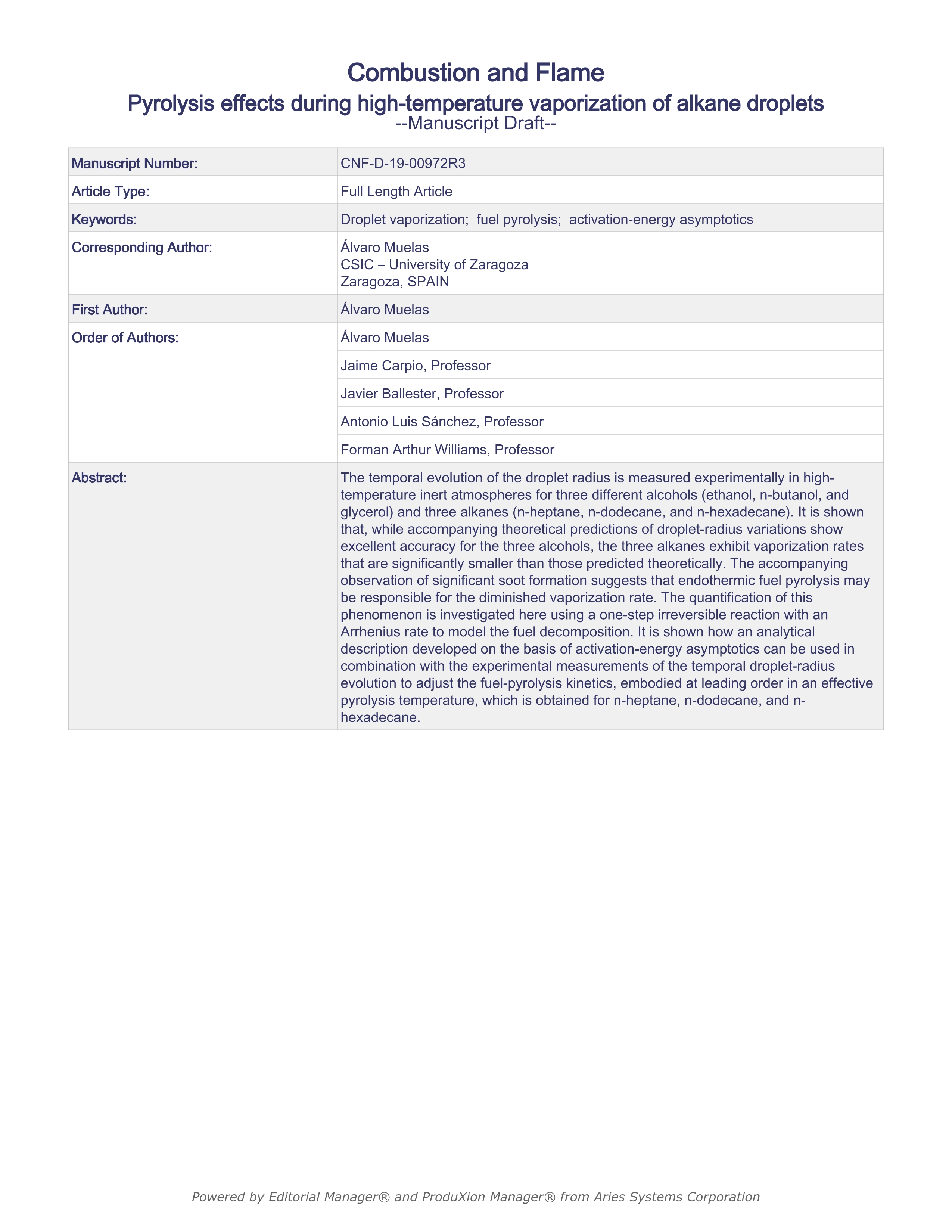
Resumen: The temporal evolution of the droplet radius is measured experimentally in high-temperature inert atmospheres for three different alcohols (ethanol, n-butanol, and glycerol) and three alkanes (n-heptane, n-dodecane, and n-hexadecane). It is shown that, while accompanying theoretical predictions of droplet-radius variations show excellent accuracy for the three alcohols, the three alkanes exhibit vaporization rates that are significantly smaller than those predicted theoretically. The accompanying observation of significant soot formation suggests that endothermic fuel pyrolysis may be responsible for the diminished vaporization rate. The quantification of this phenomenon is investigated here using a one-step irreversible reaction with an Arrhenius rate to model the fuel decomposition. It is shown how an analytical description developed on the basis of activation-energy asymptotics can be used in combination with the experimental measurements of the temporal droplet-radius evolution to adjust the fuel-pyrolysis kinetics, embodied at leading order in an effective pyrolysis temperature, which is obtained for n-heptane, n-dodecane, and n-hexadecane.
Idioma: Inglés
DOI: 10.1016/j.combustflame.2020.03.033
Año: 2020
Publicado en: Combustion and Flame 217 (2020), 38-47
ISSN: 0010-2180
Factor impacto JCR: 4.185 (2020)
Categ. JCR: ENGINEERING, MECHANICAL rank: 24 / 133 = 0.18 (2020) - Q1 - T1
Categ. JCR: THERMODYNAMICS rank: 9 / 60 = 0.15 (2020) - Q1 - T1
Categ. JCR: ENGINEERING, MULTIDISCIPLINARY rank: 17 / 90 = 0.189 (2020) - Q1 - T1
Categ. JCR: ENGINEERING, CHEMICAL rank: 44 / 143 = 0.308 (2020) - Q2 - T1
Categ. JCR: ENERGY & FUELS rank: 52 / 114 = 0.456 (2020) - Q2 - T2
Factor impacto SCIMAGO: 1.89 - Chemical Engineering (miscellaneous) (Q1) - Chemistry (miscellaneous) (Q1) - Physics and Astronomy (miscellaneous) (Q1) - Fuel Technology (Q1) - Energy Engineering and Power Technology (Q1)
Financiación: info:eu-repo/grantAgreement/ES/MEC/FPU15-01866
Financiación: info:eu-repo/grantAgreement/ES/MINECO-FEDER/ENE2016-76436-R
Tipo y forma: Artículo (PostPrint)
Área (Departamento): Área Mecánica de Fluidos (Dpto. Ciencia Tecnol.Mater.Fl.)
 Debe reconocer adecuadamente la autoría, proporcionar un enlace a la licencia e indicar si se han realizado cambios. Puede hacerlo de cualquier manera razonable, pero no de una manera que sugiera que tiene el apoyo del licenciador o lo recibe por el uso que hace. No puede utilizar el material para una finalidad comercial. Si remezcla, transforma o crea a partir del material, no puede difundir el material modificado.
Exportado de SIDERAL (2026-01-22-16:07:13)
Visitas y descargas
Idioma: Inglés
DOI: 10.1016/j.combustflame.2020.03.033
Año: 2020
Publicado en: Combustion and Flame 217 (2020), 38-47
ISSN: 0010-2180
Factor impacto JCR: 4.185 (2020)
Categ. JCR: ENGINEERING, MECHANICAL rank: 24 / 133 = 0.18 (2020) - Q1 - T1
Categ. JCR: THERMODYNAMICS rank: 9 / 60 = 0.15 (2020) - Q1 - T1
Categ. JCR: ENGINEERING, MULTIDISCIPLINARY rank: 17 / 90 = 0.189 (2020) - Q1 - T1
Categ. JCR: ENGINEERING, CHEMICAL rank: 44 / 143 = 0.308 (2020) - Q2 - T1
Categ. JCR: ENERGY & FUELS rank: 52 / 114 = 0.456 (2020) - Q2 - T2
Factor impacto SCIMAGO: 1.89 - Chemical Engineering (miscellaneous) (Q1) - Chemistry (miscellaneous) (Q1) - Physics and Astronomy (miscellaneous) (Q1) - Fuel Technology (Q1) - Energy Engineering and Power Technology (Q1)
Financiación: info:eu-repo/grantAgreement/ES/MEC/FPU15-01866
Financiación: info:eu-repo/grantAgreement/ES/MINECO-FEDER/ENE2016-76436-R
Tipo y forma: Artículo (PostPrint)
Área (Departamento): Área Mecánica de Fluidos (Dpto. Ciencia Tecnol.Mater.Fl.)
Debe reconocer adecuadamente la autoría, proporcionar un enlace a la licencia e indicar si se han realizado cambios. Puede hacerlo de cualquier manera razonable, pero no de una manera que sugiera que tiene el apoyo del licenciador o lo recibe por el uso que hace. No puede utilizar el material para una finalidad comercial. Si remezcla, transforma o crea a partir del material, no puede difundir el material modificado.Exportado de SIDERAL (2026-01-22-16:07:13)
Enlace permanente:
Visitas y descargas
Este artículo se encuentra en las siguientes colecciones:
Artículos > Artículos por área > Mecánica de Fluidos
Registro creado el 2026-01-22, última modificación el 2026-01-22