Atmosphere Composition Effects on Burlat Cherry Colour During Cold Storage
Remon, S. (Universidad de Zaragoza) ; Ferrer, A. (Universidad de Zaragoza) ; Lopez Buesa, P. (Universidad de Zaragoza) ; Oria, R. (Universidad de Zaragoza)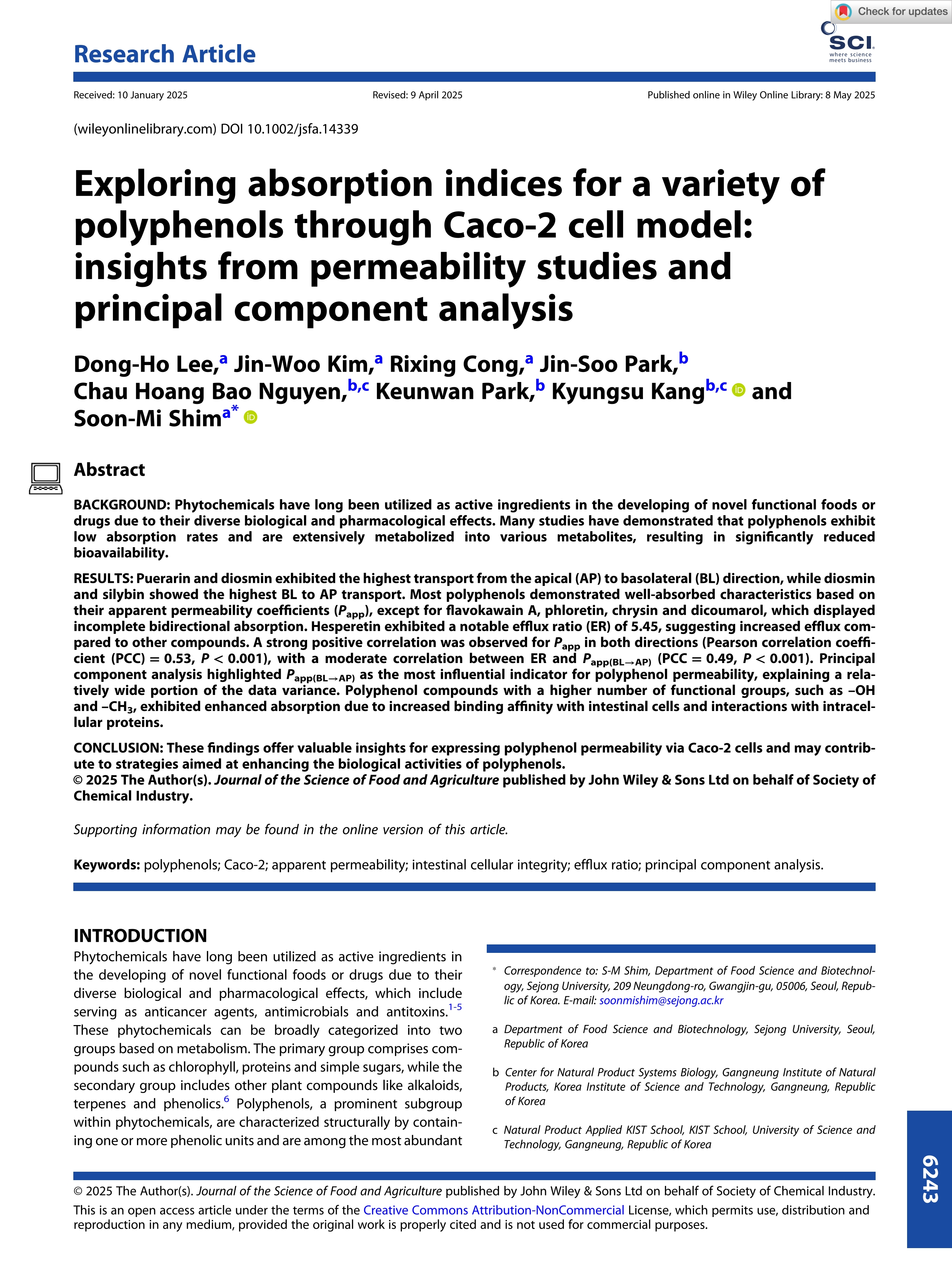
Resumen: BACKGROUND
Phytochemicals have long been utilized as active ingredients in the developing of novel functional foods or drugs due to their diverse biological and pharmacological effects. Many studies have demonstrated that polyphenols exhibit low absorption rates and are extensively metabolized into various metabolites, resulting in significantly reduced bioavailability.
RESULTS
Puerarin and diosmin exhibited the highest transport from the apical (AP) to basolateral (BL) direction, while diosmin and silybin showed the highest BL to AP transport. Most polyphenols demonstrated well-absorbed characteristics based on their apparent permeability coefficients (Papp), except for flavokawain A, phloretin, chrysin and dicoumarol, which displayed incomplete bidirectional absorption. Hesperetin exhibited a notable efflux ratio (ER) of 5.45, suggesting increased efflux compared to other compounds. A strong positive correlation was observed for Papp in both directions (Pearson correlation coefficient (PCC) = 0.53, P < 0.001), with a moderate correlation between ER and Papp(BL→AP) (PCC = 0.49, P < 0.001). Principal component analysis highlighted Papp(BL→AP) as the most influential indicator for polyphenol permeability, explaining a relatively wide portion of the data variance. Polyphenol compounds with a higher number of functional groups, such as –OH and –CH3, exhibited enhanced absorption due to increased binding affinity with intestinal cells and interactions with intracellular proteins.
CONCLUSION
These findings offer valuable insights for expressing polyphenol permeability via Caco-2 cells and may contribute to strategies aimed at enhancing the biological activities of polyphenols. © 2025 The Author(s). Journal of the Science of Food and Agriculture published by John Wiley & Sons Ltd on behalf of Society of Chemical Industry.
Idioma: Inglés
DOI: 10.1002/jsfa
Año: 2004
Publicado en: Journal of the science of food and agriculture 84, 2 (2004), 140-146
ISSN: 0022-5142
Factor impacto JCR: 0.871 (2004)
Categ. JCR: AGRICULTURE, MULTIDISCIPLINARY rank: 4 / 28 = 0.143 (2004) - Q1 - T1
Categ. JCR: CHEMISTRY, APPLIED rank: 26 / 56 = 0.464 (2004) - Q2 - T2
Categ. JCR: FOOD SCIENCE & TECHNOLOGY rank: 37 / 93 = 0.398 (2004) - Q2 - T2
Tipo y forma: Artículo (Versión definitiva)
Área (Departamento): Área Tecnología de Alimentos (Dpto. Produc.Animal Cienc.Ali.)
 Debe reconocer adecuadamente la autoría, proporcionar un enlace a la licencia e indicar si se han realizado cambios. Puede hacerlo de cualquier manera razonable, pero no de una manera que sugiera que tiene el apoyo del licenciador o lo recibe por el uso que hace. No puede utilizar el material para una finalidad comercial.
Exportado de SIDERAL (2026-01-26-14:50:11)
Visitas y descargas
Phytochemicals have long been utilized as active ingredients in the developing of novel functional foods or drugs due to their diverse biological and pharmacological effects. Many studies have demonstrated that polyphenols exhibit low absorption rates and are extensively metabolized into various metabolites, resulting in significantly reduced bioavailability.
RESULTS
Puerarin and diosmin exhibited the highest transport from the apical (AP) to basolateral (BL) direction, while diosmin and silybin showed the highest BL to AP transport. Most polyphenols demonstrated well-absorbed characteristics based on their apparent permeability coefficients (Papp), except for flavokawain A, phloretin, chrysin and dicoumarol, which displayed incomplete bidirectional absorption. Hesperetin exhibited a notable efflux ratio (ER) of 5.45, suggesting increased efflux compared to other compounds. A strong positive correlation was observed for Papp in both directions (Pearson correlation coefficient (PCC) = 0.53, P < 0.001), with a moderate correlation between ER and Papp(BL→AP) (PCC = 0.49, P < 0.001). Principal component analysis highlighted Papp(BL→AP) as the most influential indicator for polyphenol permeability, explaining a relatively wide portion of the data variance. Polyphenol compounds with a higher number of functional groups, such as –OH and –CH3, exhibited enhanced absorption due to increased binding affinity with intestinal cells and interactions with intracellular proteins.
CONCLUSION
These findings offer valuable insights for expressing polyphenol permeability via Caco-2 cells and may contribute to strategies aimed at enhancing the biological activities of polyphenols. © 2025 The Author(s). Journal of the Science of Food and Agriculture published by John Wiley & Sons Ltd on behalf of Society of Chemical Industry.
Idioma: Inglés
DOI: 10.1002/jsfa
Año: 2004
Publicado en: Journal of the science of food and agriculture 84, 2 (2004), 140-146
ISSN: 0022-5142
Factor impacto JCR: 0.871 (2004)
Categ. JCR: AGRICULTURE, MULTIDISCIPLINARY rank: 4 / 28 = 0.143 (2004) - Q1 - T1
Categ. JCR: CHEMISTRY, APPLIED rank: 26 / 56 = 0.464 (2004) - Q2 - T2
Categ. JCR: FOOD SCIENCE & TECHNOLOGY rank: 37 / 93 = 0.398 (2004) - Q2 - T2
Tipo y forma: Artículo (Versión definitiva)
Área (Departamento): Área Tecnología de Alimentos (Dpto. Produc.Animal Cienc.Ali.)
Debe reconocer adecuadamente la autoría, proporcionar un enlace a la licencia e indicar si se han realizado cambios. Puede hacerlo de cualquier manera razonable, pero no de una manera que sugiera que tiene el apoyo del licenciador o lo recibe por el uso que hace. No puede utilizar el material para una finalidad comercial.Exportado de SIDERAL (2026-01-26-14:50:11)
Enlace permanente:
Visitas y descargas
Este artículo se encuentra en las siguientes colecciones:
Artículos > Artículos por área > Tecnología de Alimentos
Registro creado el 2026-01-26, última modificación el 2026-01-26