Levels and sources of polycyclic aromatic hydrocarbons (PAHs) near hospitals and schools using leaves and barks of Sambucus nigra and Acacia melanoxylon
Alexandrino, Katiuska (Universidad de Zaragoza) ; Sánchez, Nazly E. ; Viteri, Fausto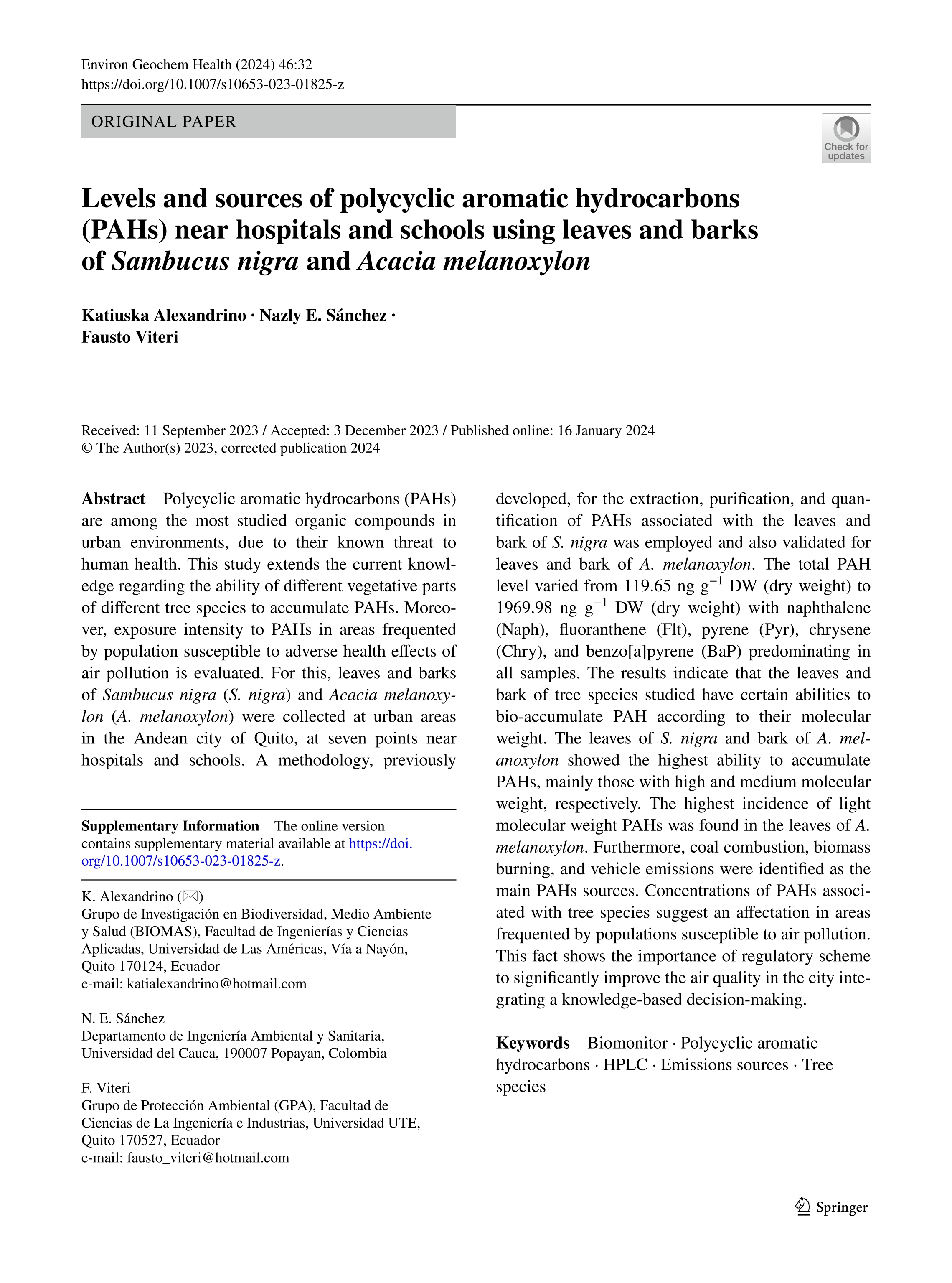
Resumen: Polycyclic aromatic hydrocarbons (PAHs) are among the most studied organic compounds in urban environments, due to their known threat to human health. This study extends the current knowledge regarding the ability of diferent vegetative parts of diferent tree species to accumulate PAHs. Moreover, exposure intensity to PAHs in areas frequented by population susceptible to adverse health efects of air pollution is evaluated. For this, leaves and barks of Sambucus nigra (S. nigra) and Acacia melanoxylon (A. melanoxylon) were collected at urban areas in the Andean city of Quito, at seven points near hospitals and schools. A methodology, previously developed, for the extraction, purifcation, and quantifcation of PAHs associated with the leaves and bark of S. nigra was employed and also validated for leaves and bark of A. melanoxylon. The total PAH level varied from 119.65 ng g−1 DW (dry weight) to 1969.98 ng g−1 DW (dry weight) with naphthalene (Naph), fuoranthene (Flt), pyrene (Pyr), chrysene (Chry), and benzo[a]pyrene (BaP) predominating in all samples. The results indicate that the leaves and bark of tree species studied have certain abilities to bio-accumulate PAH according to their molecular weight. The leaves of S. nigra and bark of A. melanoxylon showed the highest ability to accumulate PAHs, mainly those with high and medium molecular weight, respectively. The highest incidence of light molecular weight PAHs was found in the leaves of A. melanoxylon. Furthermore, coal combustion, biomass burning, and vehicle emissions were identifed as the main PAHs sources. Concentrations of PAHs associated with tree species suggest an afectation in areas frequented by populations susceptible to air pollution. This fact shows the importance of regulatory scheme to signifcantly improve the air quality in the city integrating a knowledge-based decision-making.
Idioma: Inglés
DOI: 10.1007/s10653-023-01825-z
Año: 2024
Publicado en: ENVIRONMENTAL GEOCHEMISTRY AND HEALTH 46 (2024), 32 [14 pp.]
ISSN: 0269-4042
Factor impacto JCR: 3.8 (2024)
Categ. JCR: PUBLIC, ENVIRONMENTAL & OCCUPATIONAL HEALTH rank: 65 / 421 = 0.154 (2024) - Q1 - T1
Categ. JCR: WATER RESOURCES rank: 33 / 132 = 0.25 (2024) - Q1 - T1
Categ. JCR: ENVIRONMENTAL SCIENCES rank: 143 / 376 = 0.38 (2024) - Q2 - T2
Categ. JCR: ENGINEERING, ENVIRONMENTAL rank: 43 / 83 = 0.518 (2024) - Q3 - T2
Factor impacto CITESCORE: 7.2 - Water Science and Technology (Q1) - Environmental Science (all) (Q1) - Geochemistry and Petrology (Q1) - Environmental Engineering (Q2) - Environmental Chemistry (Q2)
Factor impacto SCIMAGO: 0.871 - Environmental Science (miscellaneous) (Q1) - Water Science and Technology (Q1) - Environmental Engineering (Q1) - Medicine (miscellaneous) (Q2) - Geochemistry and Petrology (Q2) - Environmental Chemistry (Q2)
Tipo y forma: Article (Published version)
Área (Departamento): Área Tecnologi. Medio Ambiente (Dpto. Ing.Quím.Tecnol.Med.Amb.)
Exportado de SIDERAL (2026-02-17-20:49:16)
Visitas y descargas
Idioma: Inglés
DOI: 10.1007/s10653-023-01825-z
Año: 2024
Publicado en: ENVIRONMENTAL GEOCHEMISTRY AND HEALTH 46 (2024), 32 [14 pp.]
ISSN: 0269-4042
Factor impacto JCR: 3.8 (2024)
Categ. JCR: PUBLIC, ENVIRONMENTAL & OCCUPATIONAL HEALTH rank: 65 / 421 = 0.154 (2024) - Q1 - T1
Categ. JCR: WATER RESOURCES rank: 33 / 132 = 0.25 (2024) - Q1 - T1
Categ. JCR: ENVIRONMENTAL SCIENCES rank: 143 / 376 = 0.38 (2024) - Q2 - T2
Categ. JCR: ENGINEERING, ENVIRONMENTAL rank: 43 / 83 = 0.518 (2024) - Q3 - T2
Factor impacto CITESCORE: 7.2 - Water Science and Technology (Q1) - Environmental Science (all) (Q1) - Geochemistry and Petrology (Q1) - Environmental Engineering (Q2) - Environmental Chemistry (Q2)
Factor impacto SCIMAGO: 0.871 - Environmental Science (miscellaneous) (Q1) - Water Science and Technology (Q1) - Environmental Engineering (Q1) - Medicine (miscellaneous) (Q2) - Geochemistry and Petrology (Q2) - Environmental Chemistry (Q2)
Tipo y forma: Article (Published version)
Área (Departamento): Área Tecnologi. Medio Ambiente (Dpto. Ing.Quím.Tecnol.Med.Amb.)
Exportado de SIDERAL (2026-02-17-20:49:16)
Permalink:
Visitas y descargas
Este artículo se encuentra en las siguientes colecciones:
articulos > articulos-por-area > tecnologias_del_medio_ambiente
Notice créée le 2026-01-28, modifiée le 2026-02-17