Double-Decker Platinum Complexes: From Visible to NIR-II Luminescence
Melendo, Irene ; Borja, Pilar ; Fuertes, Sara ; Martín, Antonio ; Sicilia, Violeta (Universidad de Zaragoza)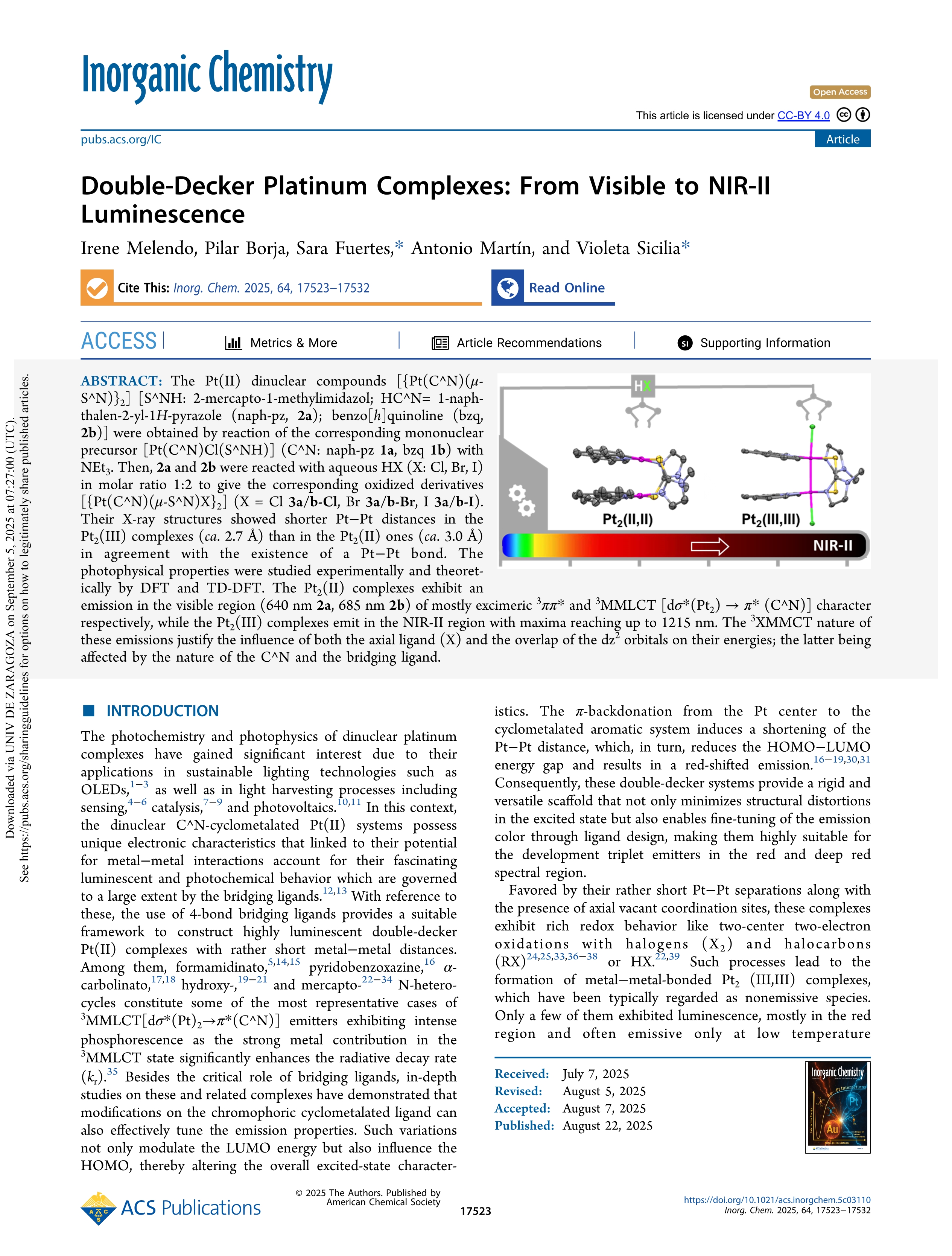
Resumen: The Pt(II) dinuclear compounds [{Pt(C^N)(μ-S^N)}2] [S^NH: 2-mercapto-1-methylimidazol; HC^N= 1-naphthalen-2-yl-1H-pyrazole (naph-pz, 2a); benzo[h]quinoline (bzq, 2b)] were obtained by reaction of the corresponding mononuclear precursor [Pt(C^N)Cl(S^NH)] (C^N: naph-pz 1a, bzq 1b) with NEt3. Then, 2a and 2b were reacted with aqueous HX (X: Cl, Br, I) in molar ratio 1:2 to give the corresponding oxidized derivatives [{Pt(C^N)(μ-S^N)X}2] (X = Cl 3a/b-Cl, Br 3a/b-Br, I 3a/b-I). Their X-ray structures showed shorter Pt–Pt distances in the Pt2(III) complexes (ca. 2.7 Å) than in the Pt2(II) ones (ca. 3.0 Å) in agreement with the existence of a Pt–Pt bond. The photophysical properties were studied experimentally and theoretically by DFT and TD-DFT. The Pt2(II) complexes exhibit an emission in the visible region (640 nm 2a, 685 nm 2b) of mostly excimeric 3ππ* and 3MMLCT [dσ*(Pt2) → π* (C^N)] character respectively, while the Pt2(III) complexes emit in the NIR-II region with maxima reaching up to 1215 nm. The 3XMMCT nature of these emissions justify the influence of both the axial ligand (X) and the overlap of the dz2 orbitals on their energies; the latter being affected by the nature of the C^N and the bridging ligand.
Idioma: Inglés
DOI: 10.1021/acs.inorgchem.5c03110
Año: 2025
Publicado en: Inorganic Chemistry 64, 34 (2025), 17523-17532
ISSN: 0020-1669
Financiación: info:eu-repo/grantAgreement/ES/DGA/E17-23R
Financiación: info:eu-repo/grantAgreement/ES/MICINN/PID2021-122869NB-I00
Tipo y forma: Article (Published version)
Área (Departamento): Área Química Inorgánica (Dpto. Química Inorgánica)
Exportado de SIDERAL (2026-01-30-12:20:32)
Visitas y descargas
Idioma: Inglés
DOI: 10.1021/acs.inorgchem.5c03110
Año: 2025
Publicado en: Inorganic Chemistry 64, 34 (2025), 17523-17532
ISSN: 0020-1669
Financiación: info:eu-repo/grantAgreement/ES/DGA/E17-23R
Financiación: info:eu-repo/grantAgreement/ES/MICINN/PID2021-122869NB-I00
Tipo y forma: Article (Published version)
Área (Departamento): Área Química Inorgánica (Dpto. Química Inorgánica)
Exportado de SIDERAL (2026-01-30-12:20:32)
Permalink:
Visitas y descargas
Este artículo se encuentra en las siguientes colecciones:
articulos > articulos-por-area > quimica_inorganica
Notice créée le 2026-01-30, modifiée le 2026-01-30