Melatonin mitigates autophagy: unlocking conditional resilience in sheep trophoblast cells exposed to a hypoxic environment
Viola, Irene ; Accornero, Paolo ; Quarati, Elisa ; Manenti, Isabella ; Miretti, Silvia ; Canto, Francisco ; Abecia, José Alfonso (Universidad de Zaragoza) ; Toschi, Paola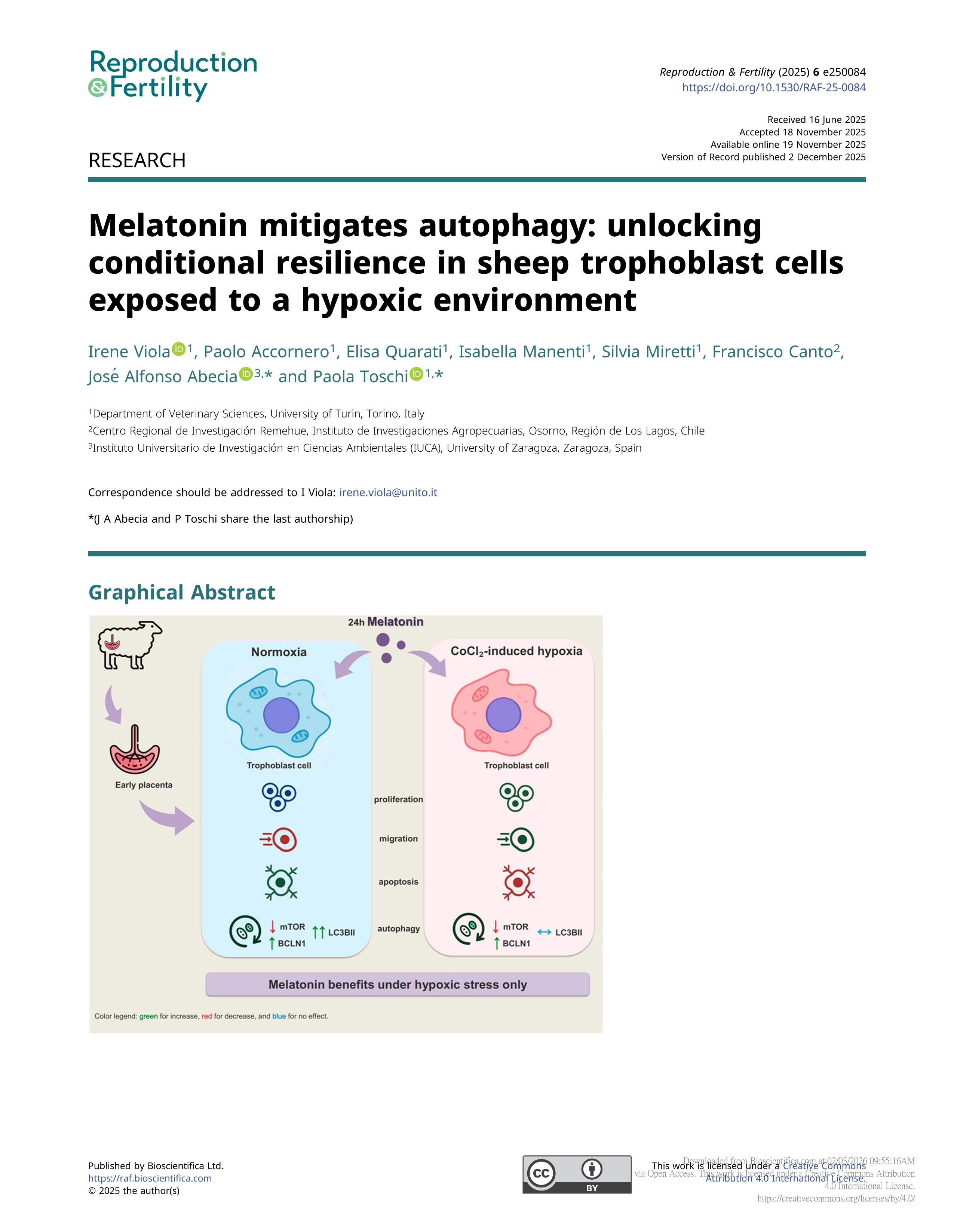
Resumen: Melatonin is a key molecule in supporting pregnancy success in sheep, particularly under suboptimal conditions. In humans, melatonin is also known for its antioxidant properties. In addition, it has recently been reported that melatonin differentially drives cell fate in normal vs altered trophoblast cells. Given that, we hypothesize that melatonin is a potential partner for trophoblasts to overcome a hypoxic environment during the early stage of pregnancy. Here, we explore the effect of melatonin on early trophoblast cell behavior and its potential mitigating effect in CoCl2-induced hypoxia. Cell functionality and autophagy modulation were studied on ovine primary trophoblast cells (oTCs) 24 h treated with 250 µM melatonin with/without 200 µM CoCl2. First, melatonin exerts its antioxidant effects by reducing H2O2 levels under hypoxic cellular conditions (P < 0.0001). CoCl2 suppressed cell proliferation and migration (P < 0.0001); however, melatonin supplementation partially restored oTCs functionality (P < 0.05). Melatonin-mediated cytoprotective effects are manifested even through the modulation of cell fate mechanisms, particularly autophagy and apoptosis. Increased protein expression of autophagic markers (BCLN1 and LC3BII/LC3BI ratio) in concomitance with a decreased phosphorylation of mTOR was observed in CoCl2-treated cells (P < 0.01), while a reduced rate of autophagy was detected following melatonin co-treatment (P < 0.01). Similarly, melatonin attenuates the CoCl2-induced increase in apoptosis when administered concurrently (5.5 vs 1.8%, P < 0.01). These findings suggest that melatonin promotes autophagy over apoptosis, indicating a shift toward cell survival mechanisms. In addition, melatonin enhances cell functionality under hypoxia, suggesting the conceptus benefits from melatonin, particularly when it is forced to grow in a suboptimal environment.
Idioma: Inglés
DOI: 10.1530/RAF-25-0084
Año: 2025
Publicado en: Reproduction & fertility 6, 4 (2025), e250084 [12 pp.]
ISSN: 2633-8386
Tipo y forma: Article (Published version)
Área (Departamento): Área Producción Animal (Dpto. Produc.Animal Cienc.Ali.)
 You must give appropriate credit, provide a link to the license, and indicate if changes were made. You may do so in any reasonable manner, but not in any way that suggests the licensor endorses you or your use.
Exportado de SIDERAL (2026-02-04-13:14:42)
Visitas y descargas
Idioma: Inglés
DOI: 10.1530/RAF-25-0084
Año: 2025
Publicado en: Reproduction & fertility 6, 4 (2025), e250084 [12 pp.]
ISSN: 2633-8386
Tipo y forma: Article (Published version)
Área (Departamento): Área Producción Animal (Dpto. Produc.Animal Cienc.Ali.)
You must give appropriate credit, provide a link to the license, and indicate if changes were made. You may do so in any reasonable manner, but not in any way that suggests the licensor endorses you or your use. Exportado de SIDERAL (2026-02-04-13:14:42)
Permalink:
Visitas y descargas
Este artículo se encuentra en las siguientes colecciones:
Articles > Artículos por área > Producción Animal
Record created 2026-02-04, last modified 2026-02-04