Advanced footwear technology in well-trained athletes: methodological insights from outdoor running
Muñiz-Pardos, Borja (Universidad de Zaragoza) ; Angeloudis, Konstantinos ; Zelenkova, Irina ; Guppy, Fergus M. ; Marco-Contreras, Luis A. ; Gomez-Bruton, Alejandro (Universidad de Zaragoza) ; Lozano-Berges, Gabriel (Universidad de Zaragoza) ; Pitsiladis, Yannis ; Casajus, Jose A. (Universidad de Zaragoza)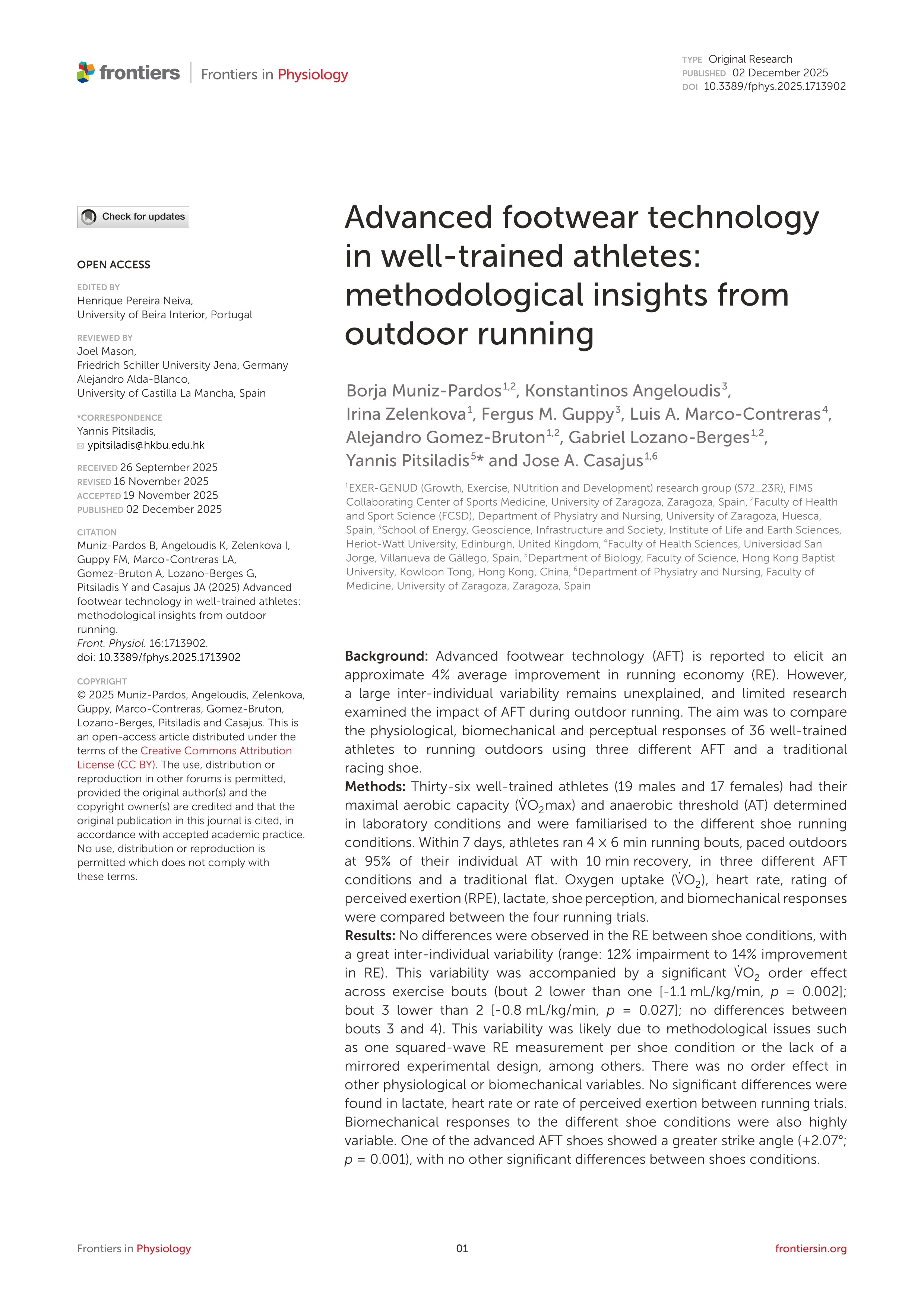
Resumen: Background: Advanced footwear technology (AFT) is reported to elicit an approximate 4% average improvement in running economy (RE). However, a large inter-individual variability remains unexplained, and limited research examined the impact of AFT during outdoor running. The aim was to compare the physiological, biomechanical and perceptual responses of 36 well-trained athletes to running outdoors using three different AFT and a traditional racing shoe.
Methods: Thirty-six well-trained athletes (19 males and 17 females) had their maximal aerobic capacity (
˙
V
O2max) and anaerobic threshold (AT) determined in laboratory conditions and were familiarised to the different shoe running conditions. Within 7 days, athletes ran 4 × 6 min running bouts, paced outdoors at 95% of their individual AT with 10 min recovery, in three different AFT conditions and a traditional flat. Oxygen uptake (
˙
V
O2), heart rate, rating of perceived exertion (RPE), lactate, shoe perception, and biomechanical responses were compared between the four running trials.
Results: No differences were observed in the RE between shoe conditions, with a great inter-individual variability (range: 12% impairment to 14% improvement in RE). This variability was accompanied by a significant
˙
V
O2 order effect across exercise bouts (bout 2 lower than one [-1.1 mL/kg/min, p = 0.002]; bout 3 lower than 2 [-0.8 mL/kg/min, p = 0.027]; no differences between bouts 3 and 4). This variability was likely due to methodological issues such as one squared-wave RE measurement per shoe condition or the lack of a mirrored experimental design, among others. There was no order effect in other physiological or biomechanical variables. No significant differences were found in lactate, heart rate or rate of perceived exertion between running trials. Biomechanical responses to the different shoe conditions were also highly variable. One of the advanced AFT shoes showed a greater strike angle (+2.07°; p = 0.001), with no other significant differences between shoes conditions.
Conclusion: The large variability in the physiological response to AFT may be explained by methodological considerations. A minimum of two-bout RE measurements, the use of a mirrored order, a sufficient familiarisation with shoes and experimental designs, among other considerations, seem crucial to enhance the ecological validity and reduce data variability.
Idioma: Inglés
DOI: 10.3389/fphys.2025.1713902
Año: 2025
Publicado en: Frontiers in physiology 16 (2025), [14 pp.]
ISSN: 1664-042X
Financiación: info:eu-repo/grantAgreement/ES/DGA/S72-23R
Tipo y forma: Artículo (Versión definitiva)
Área (Departamento): Área Educación Física y Depor. (Dpto. Fisiatría y Enfermería)
 Debe reconocer adecuadamente la autoría, proporcionar un enlace a la licencia e indicar si se han realizado cambios. Puede hacerlo de cualquier manera razonable, pero no de una manera que sugiera que tiene el apoyo del licenciador o lo recibe por el uso que hace.
Exportado de SIDERAL (2026-02-04-13:15:08)
Visitas y descargas
Methods: Thirty-six well-trained athletes (19 males and 17 females) had their maximal aerobic capacity (
˙
V
O2max) and anaerobic threshold (AT) determined in laboratory conditions and were familiarised to the different shoe running conditions. Within 7 days, athletes ran 4 × 6 min running bouts, paced outdoors at 95% of their individual AT with 10 min recovery, in three different AFT conditions and a traditional flat. Oxygen uptake (
˙
V
O2), heart rate, rating of perceived exertion (RPE), lactate, shoe perception, and biomechanical responses were compared between the four running trials.
Results: No differences were observed in the RE between shoe conditions, with a great inter-individual variability (range: 12% impairment to 14% improvement in RE). This variability was accompanied by a significant
˙
V
O2 order effect across exercise bouts (bout 2 lower than one [-1.1 mL/kg/min, p = 0.002]; bout 3 lower than 2 [-0.8 mL/kg/min, p = 0.027]; no differences between bouts 3 and 4). This variability was likely due to methodological issues such as one squared-wave RE measurement per shoe condition or the lack of a mirrored experimental design, among others. There was no order effect in other physiological or biomechanical variables. No significant differences were found in lactate, heart rate or rate of perceived exertion between running trials. Biomechanical responses to the different shoe conditions were also highly variable. One of the advanced AFT shoes showed a greater strike angle (+2.07°; p = 0.001), with no other significant differences between shoes conditions.
Conclusion: The large variability in the physiological response to AFT may be explained by methodological considerations. A minimum of two-bout RE measurements, the use of a mirrored order, a sufficient familiarisation with shoes and experimental designs, among other considerations, seem crucial to enhance the ecological validity and reduce data variability.
Idioma: Inglés
DOI: 10.3389/fphys.2025.1713902
Año: 2025
Publicado en: Frontiers in physiology 16 (2025), [14 pp.]
ISSN: 1664-042X
Financiación: info:eu-repo/grantAgreement/ES/DGA/S72-23R
Tipo y forma: Artículo (Versión definitiva)
Área (Departamento): Área Educación Física y Depor. (Dpto. Fisiatría y Enfermería)
Debe reconocer adecuadamente la autoría, proporcionar un enlace a la licencia e indicar si se han realizado cambios. Puede hacerlo de cualquier manera razonable, pero no de una manera que sugiera que tiene el apoyo del licenciador o lo recibe por el uso que hace. Exportado de SIDERAL (2026-02-04-13:15:08)
Enlace permanente:
Visitas y descargas
Este artículo se encuentra en las siguientes colecciones:
Artículos > Artículos por área > Educación Física y Deportiva
Registro creado el 2026-02-04, última modificación el 2026-02-04