Enhancing social entrepreneurship education through digital educational escape rooms: a literature review
Martina, Richard ; Webb, Kristin ; Pessoa-de-Oliveira, Ana Katarina (Universidad de Zaragoza)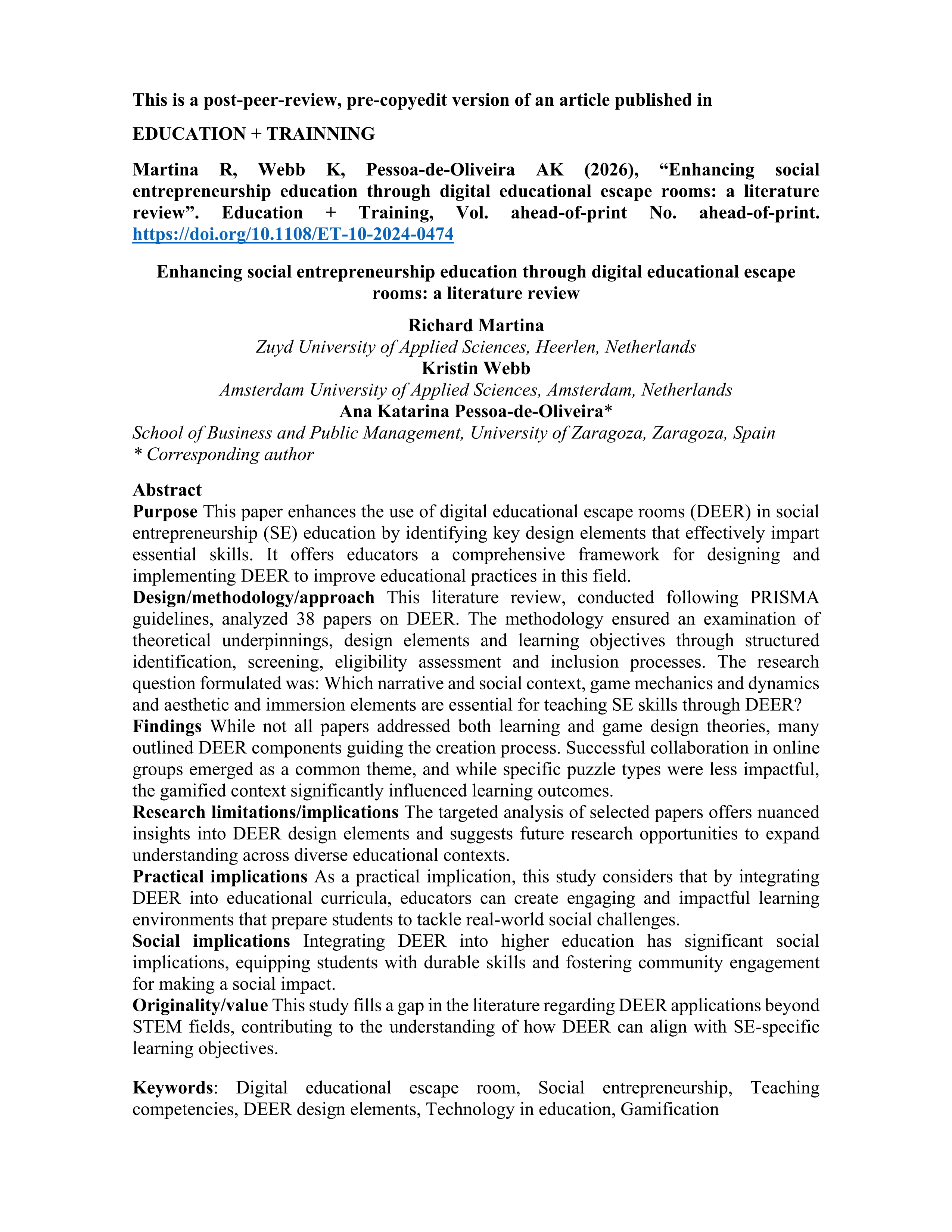
Resumen: Purpose
This paper enhances the use of digital educational escape rooms (DEER) in social entrepreneurship (SE) education by identifying key design elements that effectively impart essential skills. It offers educators a comprehensive framework for designing and implementing DEER to improve educational practices in this field.
Design/methodology/approach
This literature review, conducted following PRISMA guidelines, analyzed 38 papers on DEER. The methodology ensured an examination of theoretical underpinnings, design elements and learning objectives through structured identification, screening, eligibility assessment and inclusion processes. The research question formulated was: Which narrative and social context, game mechanics and dynamics and aesthetic and immersion elements are essential for teaching SE skills through DEER?
Findings
While not all papers addressed both learning and game design theories, many outlined DEER components guiding the creation process. Successful collaboration in online groups emerged as a common theme, and while specific puzzle types were less impactful, the gamified context significantly influenced learning outcomes.
Research limitations/implications
The targeted analysis of selected papers offers nuanced insights into DEER design elements and suggests future research opportunities to expand understanding across diverse educational contexts.
Practical implications
As a practical implication, this study considers that by integrating DEER into educational curricula, educators can create engaging and impactful learning environments that prepare students to tackle real-world social challenges.
Social implications
Integrating DEER into higher education has significant social implications, equipping students with durable skills and fostering community engagement for making a social impact.
Originality/value
This study fills a gap in the literature regarding DEER applications beyond STEM fields, contributing to the understanding of how DEER can align with SE-specific learning objectives.
Idioma: Inglés
DOI: 10.1108/ET-10-2024-0474
Año: 2026
Publicado en: EDUCATION AND TRAINING 68, 2 (2026), 271-294
ISSN: 0040-0912
Originalmente disponible en: Texto completo de la revista
Tipo y forma: Article (PostPrint)
Área (Departamento): Área Organización de Empresas (Dpto. Direcc.Organiza.Empresas)
Exportado de SIDERAL (2026-03-02-14:50:04)
Visitas y descargas
This paper enhances the use of digital educational escape rooms (DEER) in social entrepreneurship (SE) education by identifying key design elements that effectively impart essential skills. It offers educators a comprehensive framework for designing and implementing DEER to improve educational practices in this field.
Design/methodology/approach
This literature review, conducted following PRISMA guidelines, analyzed 38 papers on DEER. The methodology ensured an examination of theoretical underpinnings, design elements and learning objectives through structured identification, screening, eligibility assessment and inclusion processes. The research question formulated was: Which narrative and social context, game mechanics and dynamics and aesthetic and immersion elements are essential for teaching SE skills through DEER?
Findings
While not all papers addressed both learning and game design theories, many outlined DEER components guiding the creation process. Successful collaboration in online groups emerged as a common theme, and while specific puzzle types were less impactful, the gamified context significantly influenced learning outcomes.
Research limitations/implications
The targeted analysis of selected papers offers nuanced insights into DEER design elements and suggests future research opportunities to expand understanding across diverse educational contexts.
Practical implications
As a practical implication, this study considers that by integrating DEER into educational curricula, educators can create engaging and impactful learning environments that prepare students to tackle real-world social challenges.
Social implications
Integrating DEER into higher education has significant social implications, equipping students with durable skills and fostering community engagement for making a social impact.
Originality/value
This study fills a gap in the literature regarding DEER applications beyond STEM fields, contributing to the understanding of how DEER can align with SE-specific learning objectives.
Idioma: Inglés
DOI: 10.1108/ET-10-2024-0474
Año: 2026
Publicado en: EDUCATION AND TRAINING 68, 2 (2026), 271-294
ISSN: 0040-0912
Originalmente disponible en: Texto completo de la revista
Tipo y forma: Article (PostPrint)
Área (Departamento): Área Organización de Empresas (Dpto. Direcc.Organiza.Empresas)
Exportado de SIDERAL (2026-03-02-14:50:04)
Permalink:
Visitas y descargas
Este artículo se encuentra en las siguientes colecciones:
articulos > articulos-por-area > organizacion_de_empresas
Notice créée le 2026-02-09, modifiée le 2026-03-02