Experimental study on prototype optimisation algorithms for prototype-based classification in vector spaces
Lozano, M. (Universidad de Zaragoza) ; Sotoca, JM. ; Sánchez, JS. ; Pla, F. ; Pekalska, E. ; Duin, RPW.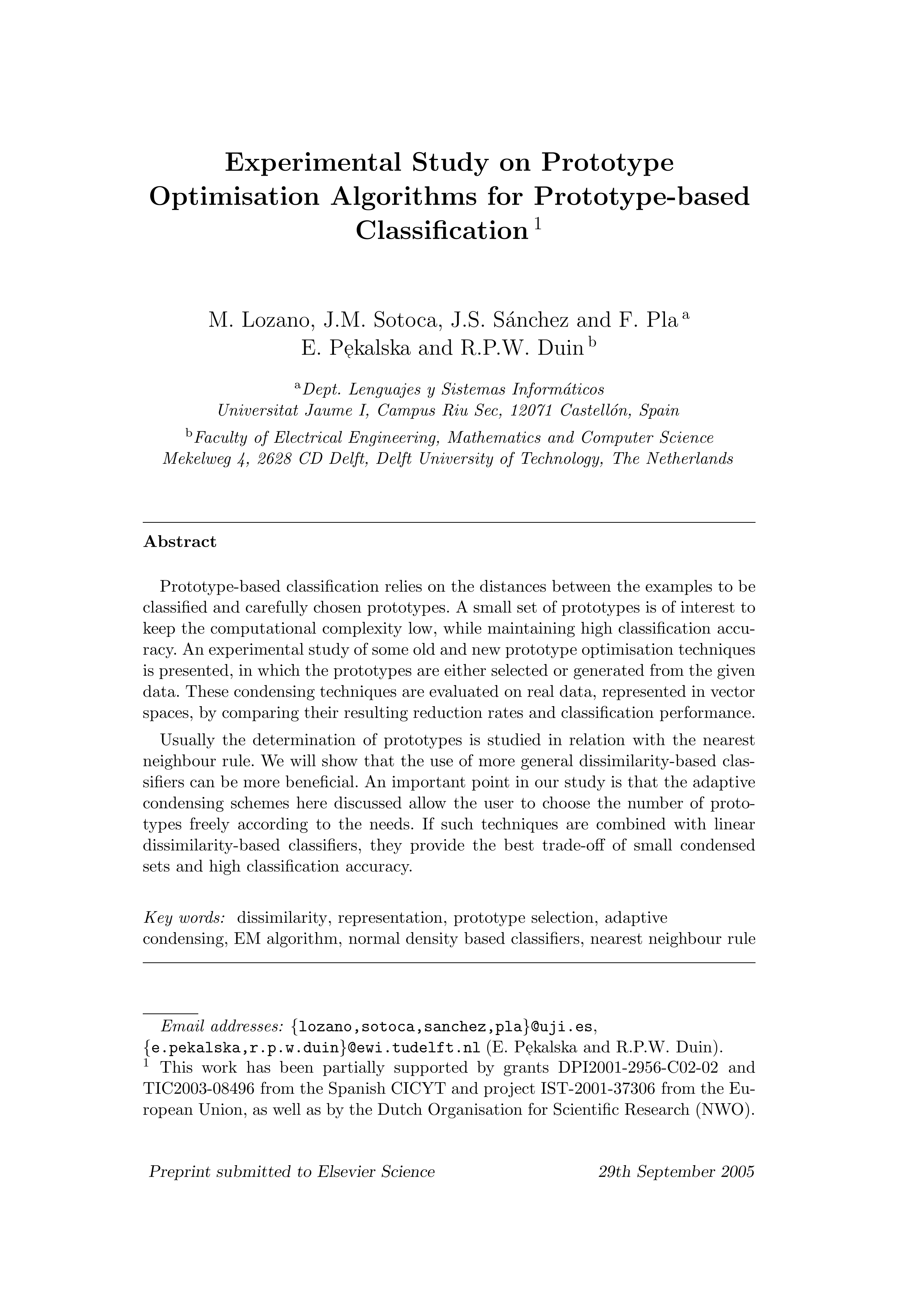
Resumen: Prototype-based classification relies on the distances between the examples to be classified and carefully chosen prototypes. A small set of prototypes is of interest to keep the computational complexity low, while maintaining high classification accuracy. An experimental study of some old and new prototype optimisation techniques is presented, in which the prototypes are either selected or generated from the given data. These condensing techniques are evaluated on real data, represented in vector spaces, by comparing their resulting reduction rates and classification performance. Usually the determination of prototypes is studied in relation with the nearest neighbour rule. We will show that the use of more general dissimilarity-based classifiers can be more beneficial. An important point in our study is that the adaptive condensing schemes
here discussed allow the user to choose the number of prototypes freely according to the needs. If such techniques are combined with linear dissimilarity-based classifiers, they provide the best trade-off of small condensed sets and high classification accuracy
Idioma: Inglés
DOI: 10.1016/j.patcog.2006.04.005
Año: 2006
Publicado en: Pattern Recognition 39 (2006), 1827-1838
ISSN: 0031-3203
Factor impacto JCR: 1.822 (2006)
Categ. JCR: ENGINEERING, ELECTRICAL & ELECTRONIC rank: 28 / 205 = 0.137 (2006) - Q1 - T1
Categ. JCR: COMPUTER SCIENCE, ARTIFICIAL INTELLIGENCE rank: 18 / 85 = 0.212 (2006) - Q1 - T1
Tipo y forma: Article (PrePrint)
Área (Departamento): Área Lenguajes y Sistemas Inf. (Dpto. Informát.Ingenie.Sistms.)
 You must give appropriate credit, provide a link to the license, and indicate if changes were made. You may do so in any reasonable manner, but not in any way that suggests the licensor endorses you or your use. You may not use the material for commercial purposes. If you remix, transform, or build upon the material, you may not distribute the modified material.
Exportado de SIDERAL (2026-02-25-14:59:56)
Visitas y descargas
here discussed allow the user to choose the number of prototypes freely according to the needs. If such techniques are combined with linear dissimilarity-based classifiers, they provide the best trade-off of small condensed sets and high classification accuracy
Idioma: Inglés
DOI: 10.1016/j.patcog.2006.04.005
Año: 2006
Publicado en: Pattern Recognition 39 (2006), 1827-1838
ISSN: 0031-3203
Factor impacto JCR: 1.822 (2006)
Categ. JCR: ENGINEERING, ELECTRICAL & ELECTRONIC rank: 28 / 205 = 0.137 (2006) - Q1 - T1
Categ. JCR: COMPUTER SCIENCE, ARTIFICIAL INTELLIGENCE rank: 18 / 85 = 0.212 (2006) - Q1 - T1
Tipo y forma: Article (PrePrint)
Área (Departamento): Área Lenguajes y Sistemas Inf. (Dpto. Informát.Ingenie.Sistms.)
You must give appropriate credit, provide a link to the license, and indicate if changes were made. You may do so in any reasonable manner, but not in any way that suggests the licensor endorses you or your use. You may not use the material for commercial purposes. If you remix, transform, or build upon the material, you may not distribute the modified material. Exportado de SIDERAL (2026-02-25-14:59:56)
Permalink:
Visitas y descargas
Este artículo se encuentra en las siguientes colecciones:
Articles > Artículos por área > Lenguajes y Sistemas Informáticos
Record created 2026-02-09, last modified 2026-02-25