Stress in dermatology patients: A multicenter observational study of 8295 outpatients and controls from 22 European clinics
Balieva, Flora ; Schut, Christina ; Szabó, Csanád ; Sampogna, Francesca ; Dalgard, Florence J. ; Altunay, Ilknur K. ; Bewley, Anthony ; Ferreira, Bárbara Roque ; Finlay, Andrew Y. ; Gieler, Uwe ; Gracia-Cazaña, Tamara (Universidad de Zaragoza) ; Grivcheva-Panovska, Vesna ; Jemec, Gregor B. ; Legat, Franz J. ; Lien, Lars ; Lvov, Andrey ; Marron, Servando E. (Universidad de Zaragoza) ; Misery, Laurent ; Reich, Adam ; Romanov, Dmitry ; Koulil, Saskia Spillekom-van ; Ständer, Sonja ; Svensson, Ake ; Szepietowski, Jacek C. ; Thompson, Andrew R. ; Titeca, Geraldine ; Tomás-Aragonés, Lucía ; Vulink, Nienke ; Zeidler, Claudia ; Kupfer, Jörg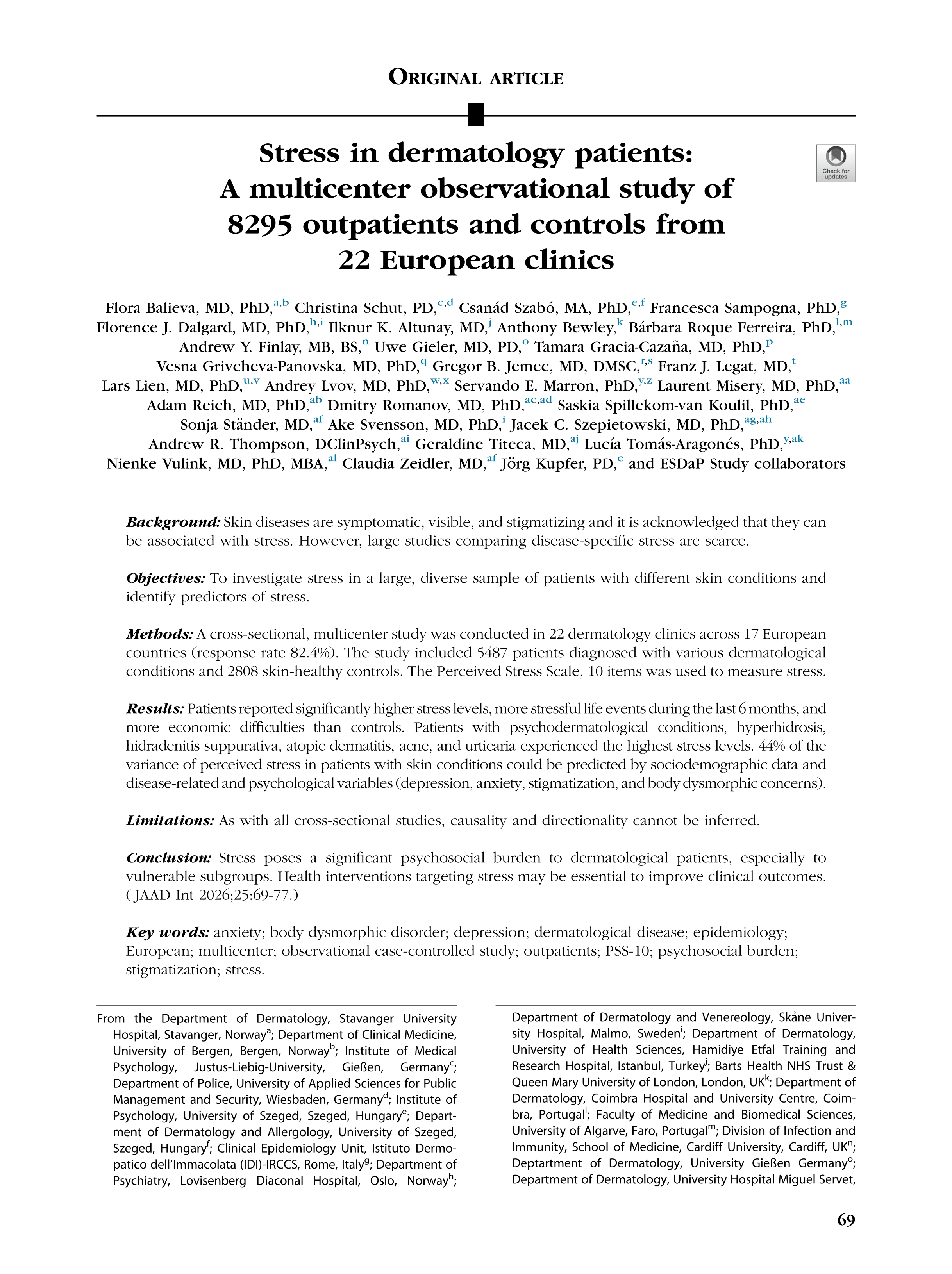
Resumen: Background
Skin diseases are symptomatic, visible, and stigmatizing and it is acknowledged that they can be associated with stress. However, large studies comparing disease-specific stress are scarce.
Objectives
To investigate stress in a large, diverse sample of patients with different skin conditions and identify predictors of stress.
Methods
A cross-sectional, multicenter study was conducted in 22 dermatology clinics across 17 European countries (response rate 82.4%). The study included 5487 patients diagnosed with various dermatological conditions and 2808 skin-healthy controls. The Perceived Stress Scale, 10 items was used to measure stress.
Results
Patients reported significantly higher stress levels, more stressful life events during the last 6 months, and more economic difficulties than controls. Patients with psychodermatological conditions, hyperhidrosis, hidradenitis suppurativa, atopic dermatitis, acne, and urticaria experienced the highest stress levels. 44% of the variance of perceived stress in patients with skin conditions could be predicted by sociodemographic data and disease-related and psychological variables (depression, anxiety, stigmatization, and body dysmorphic concerns).
Limitations
As with all cross-sectional studies, causality and directionality cannot be inferred.
Conclusion
Stress poses a significant psychosocial burden to dermatological patients, especially to vulnerable subgroups. Health interventions targeting stress may be essential to improve clinical outcomes.
Idioma: Inglés
DOI: 10.1016/j.jdin.2025.12.005
Año: 2025
Publicado en: JAAD International 25, 69-77 (2025), [9 pp.]
ISSN: 2666-3287
Tipo y forma: Article (Published version)
Área (Departamento): Área Dermatología (Dpto. Medicina, Psiqu. y Derm.)
 You must give appropriate credit, provide a link to the license, and indicate if changes were made. You may do so in any reasonable manner, but not in any way that suggests the licensor endorses you or your use.
Exportado de SIDERAL (2026-02-11-10:27:29)
Visitas y descargas
Skin diseases are symptomatic, visible, and stigmatizing and it is acknowledged that they can be associated with stress. However, large studies comparing disease-specific stress are scarce.
Objectives
To investigate stress in a large, diverse sample of patients with different skin conditions and identify predictors of stress.
Methods
A cross-sectional, multicenter study was conducted in 22 dermatology clinics across 17 European countries (response rate 82.4%). The study included 5487 patients diagnosed with various dermatological conditions and 2808 skin-healthy controls. The Perceived Stress Scale, 10 items was used to measure stress.
Results
Patients reported significantly higher stress levels, more stressful life events during the last 6 months, and more economic difficulties than controls. Patients with psychodermatological conditions, hyperhidrosis, hidradenitis suppurativa, atopic dermatitis, acne, and urticaria experienced the highest stress levels. 44% of the variance of perceived stress in patients with skin conditions could be predicted by sociodemographic data and disease-related and psychological variables (depression, anxiety, stigmatization, and body dysmorphic concerns).
Limitations
As with all cross-sectional studies, causality and directionality cannot be inferred.
Conclusion
Stress poses a significant psychosocial burden to dermatological patients, especially to vulnerable subgroups. Health interventions targeting stress may be essential to improve clinical outcomes.
Idioma: Inglés
DOI: 10.1016/j.jdin.2025.12.005
Año: 2025
Publicado en: JAAD International 25, 69-77 (2025), [9 pp.]
ISSN: 2666-3287
Tipo y forma: Article (Published version)
Área (Departamento): Área Dermatología (Dpto. Medicina, Psiqu. y Derm.)
You must give appropriate credit, provide a link to the license, and indicate if changes were made. You may do so in any reasonable manner, but not in any way that suggests the licensor endorses you or your use. Exportado de SIDERAL (2026-02-11-10:27:29)
Permalink:
Visitas y descargas
Este artículo se encuentra en las siguientes colecciones:
Articles > Artículos por área > Dermatología
Record created 2026-02-11, last modified 2026-02-11