The impact of lockdown on Aragonese children: a geographical analysis of childhood obesity pre- and post-lockdown
Gállego-Royo, Alba (Universidad de Zaragoza) ; Bentué-Martinez, Carmen (Universidad de Zaragoza) ; Zúñiga Antón, María (Universidad de Zaragoza) ; Gastón-Faci, Ana ; Val-Jimenez, Nuria (Universidad de Zaragoza) ; Marco-Gomez, Bárbara (Universidad de Zaragoza) ; Magallón-Botaya, Rosa (Universidad de Zaragoza)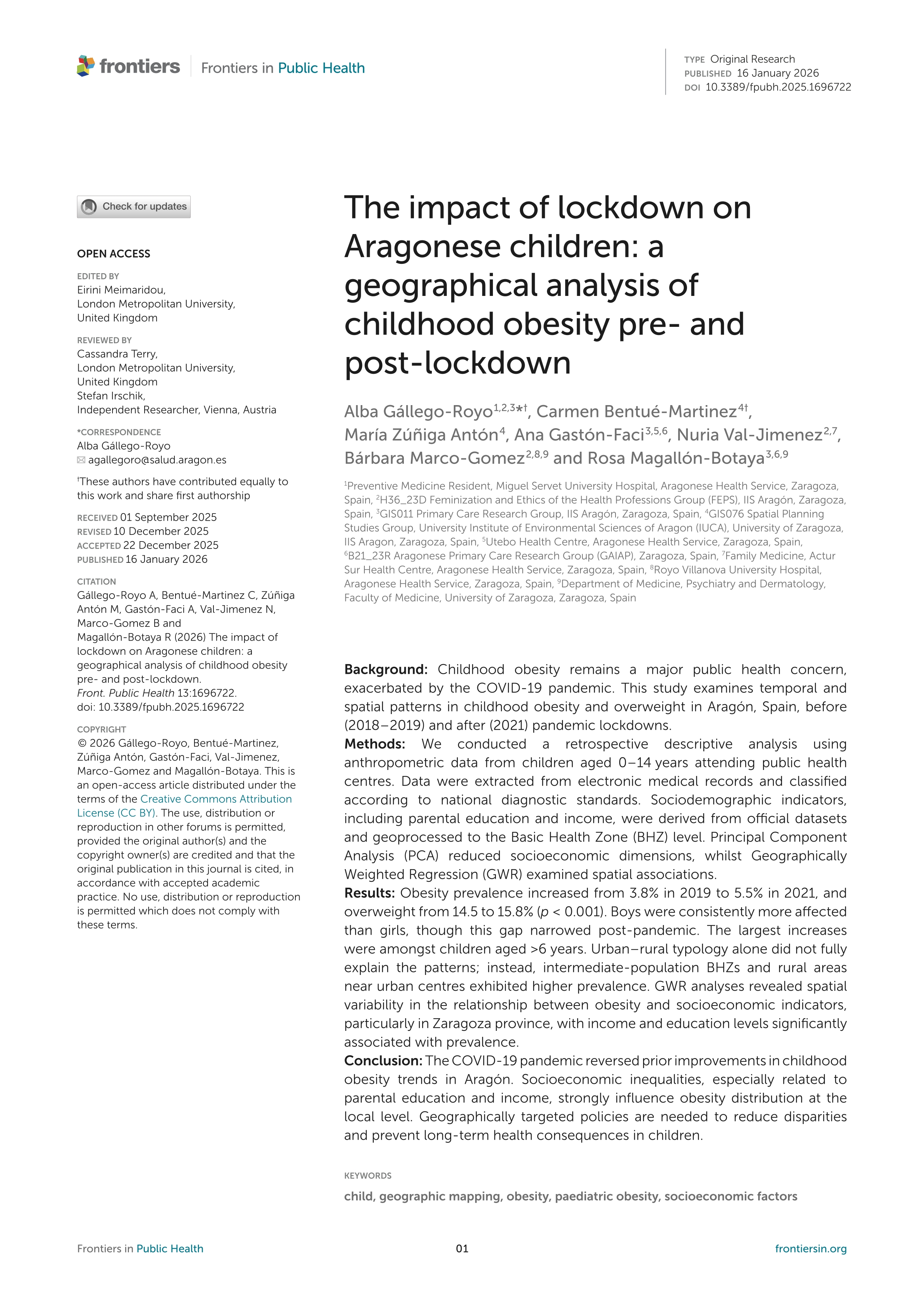
Resumen: Background: Childhood obesity remains a major public health concern, exacerbated by the COVID-19 pandemic. This study examines temporal and spatial patterns in childhood obesity and overweight in Aragón, Spain, before (2018–2019) and after (2021) pandemic lockdowns. Methods: We conducted a retrospective descriptive analysis using anthropometric data from children aged 0–14 years attending public health centres. Data were extracted from electronic medical records and classified according to national diagnostic standards. Sociodemographic indicators, including parental education and income, were derived from official datasets and geoprocessed to the Basic Health Zone (BHZ) level. Principal Component Analysis (PCA) reduced socioeconomic dimensions, whilst Geographically Weighted Regression (GWR) examined spatial associations. Results: Obesity prevalence increased from 3.8% in 2019 to 5.5% in 2021, and overweight from 14.5 to 15.8% (p < 0.001). Boys were consistently more affected than girls, though this gap narrowed post-pandemic. The largest increases were amongst children aged >6 years. Urban–rural typology alone did not fully explain the patterns; instead, intermediate-population BHZs and rural areas near urban centres exhibited higher prevalence. GWR analyses revealed spatial variability in the relationship between obesity and socioeconomic indicators,
particularly in Zaragoza province, with income and education levels significantly associated with prevalence. Conclusion: The COVID-19 pandemic reversed prior improvements in childhood obesity trends in Aragón. Socioeconomic inequalities, especially related to parental education and income, strongly influence obesity distribution at the local level. Geographically targeted policies are needed to reduce disparities and prevent long-term health consequences in children.
Idioma: Español
DOI: 10.3389/fpubh.2025.1696722
Año: 2026
Publicado en: Frontiers in public health 13 (2026)
ISSN: 2296-2565
Financiación: info:eu-repo/grantAgreement/ES/DGA/H36-23D
Financiación: info:eu-repo/grantAgreement/ES/ISCIII/RD24-0005/0004
Tipo y forma: Article (Published version)
Área (Departamento): Area Medicina (Dpto. Medicina, Psiqu. y Derm.)
Área (Departamento): Área Geografía Humana (Dpto. Geograf. Ordenac.Territ.)
Exportado de SIDERAL (2026-02-11-10:27:57)
Visitas y descargas
particularly in Zaragoza province, with income and education levels significantly associated with prevalence. Conclusion: The COVID-19 pandemic reversed prior improvements in childhood obesity trends in Aragón. Socioeconomic inequalities, especially related to parental education and income, strongly influence obesity distribution at the local level. Geographically targeted policies are needed to reduce disparities and prevent long-term health consequences in children.
Idioma: Español
DOI: 10.3389/fpubh.2025.1696722
Año: 2026
Publicado en: Frontiers in public health 13 (2026)
ISSN: 2296-2565
Financiación: info:eu-repo/grantAgreement/ES/DGA/H36-23D
Financiación: info:eu-repo/grantAgreement/ES/ISCIII/RD24-0005/0004
Tipo y forma: Article (Published version)
Área (Departamento): Area Medicina (Dpto. Medicina, Psiqu. y Derm.)
Área (Departamento): Área Geografía Humana (Dpto. Geograf. Ordenac.Territ.)
Exportado de SIDERAL (2026-02-11-10:27:57)
Permalink:
Visitas y descargas
Este artículo se encuentra en las siguientes colecciones:
articulos > articulos-por-area > geografia_fisica_geografia_humana
articulos > articulos-por-area > medicina
Notice créée le 2026-02-11, modifiée le 2026-02-11