The Impact of Ophthalmic Lens Power and Treatments on Eye Tracking Performance
Lacort-Beltrán, Marta ; Alejandre, Adrián ; Guillén, Sara ; Vilella, Marina (Universidad de Zaragoza) ; Pan, Xian ; Pueyo, Victoria (Universidad de Zaragoza) ; Ortin, Marta ; Esteban-Ibañez, Eduardo (Universidad de Zaragoza)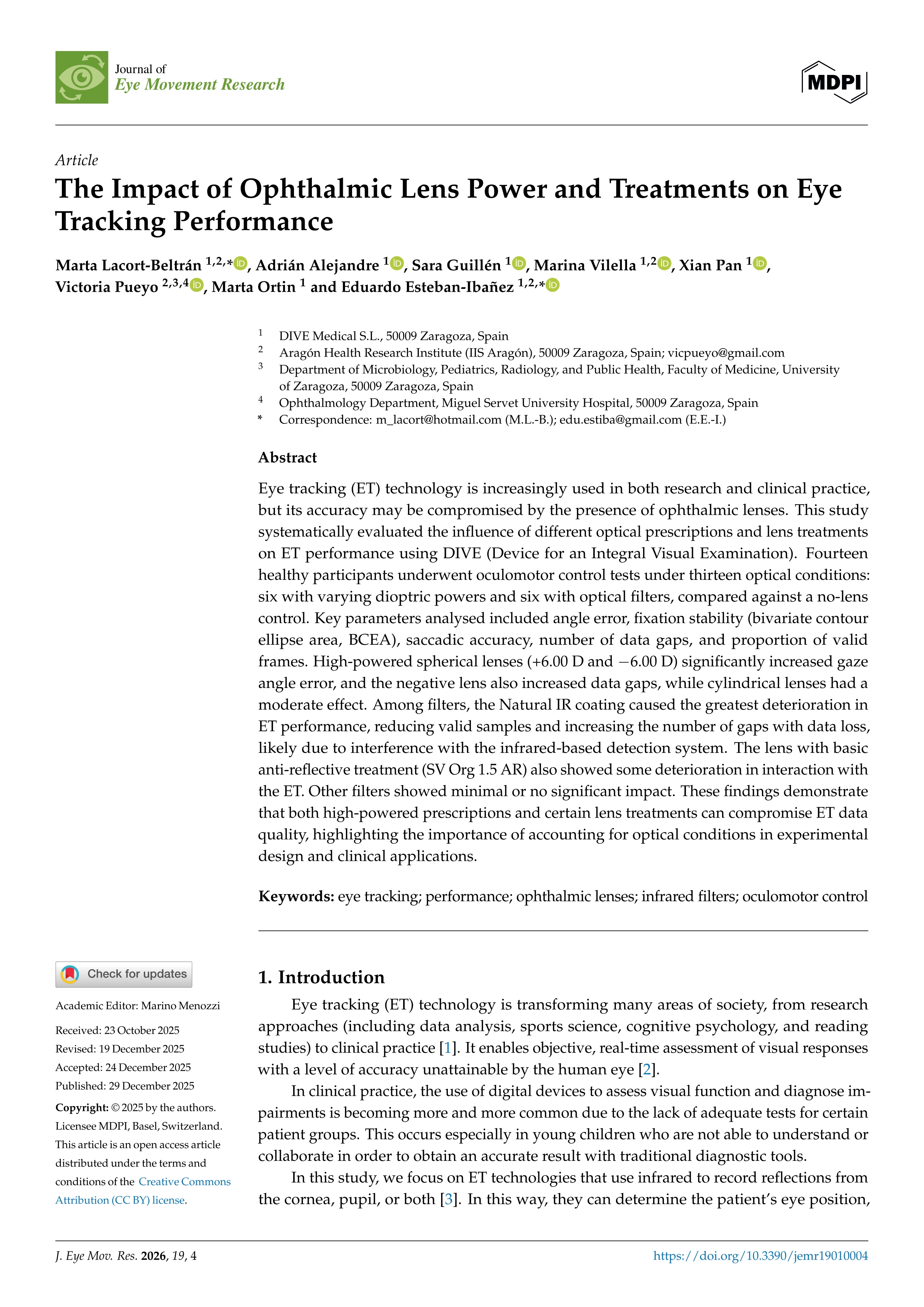
Resumen: Eye tracking (ET) technology is increasingly used in both research and clinical practice, but its accuracy may be compromised by the presence of ophthalmic lenses. This study systematically evaluated the influence of different optical prescriptions and lens treatments on ET performance using DIVE (Device for an Integral Visual Examination). Fourteen healthy participants underwent oculomotor control tests under thirteen optical conditions: six with varying dioptric powers and six with optical filters, compared against a no-lens control. Key parameters analysed included angle error, fixation stability (bivariate contour ellipse area, BCEA), saccadic accuracy, number of data gaps, and proportion of valid frames. High-powered spherical lenses (+6.00 D and −6.00 D) significantly increased gaze angle error, and the negative lens also increased data gaps, while cylindrical lenses had a moderate effect. Among filters, the Natural IR coating caused the greatest deterioration in ET performance, reducing valid samples and increasing the number of gaps with data loss, likely due to interference with the infrared-based detection system. The lens with basic anti-reflective treatment (SV Org 1.5 AR) also showed some deterioration in interaction with the ET. Other filters showed minimal or no significant impact. These findings demonstrate that both high-powered prescriptions and certain lens treatments can compromise ET data quality, highlighting the importance of accounting for optical conditions in experimental design and clinical applications.
Idioma: Inglés
DOI: 10.3390/jemr19010004
Año: 2025
Publicado en: Journal of eye movement research 19, 1 (2025), [16 pp.]
ISSN: 1995-8692
Financiación: nfo:eu-repo/grantAgreement/ES/MICIN/AEI/DIN2021-012296
Tipo y forma: Article (Published version)
Área (Departamento): Área Oftalmología (Dpto. Cirugía)
Área (Departamento): Área Medic.Prevent.Salud Públ. (Dpto. Microb.Ped.Radio.Sal.Pú.)
 You must give appropriate credit, provide a link to the license, and indicate if changes were made. You may do so in any reasonable manner, but not in any way that suggests the licensor endorses you or your use.
Exportado de SIDERAL (2026-02-12-20:38:30)
Visitas y descargas
Idioma: Inglés
DOI: 10.3390/jemr19010004
Año: 2025
Publicado en: Journal of eye movement research 19, 1 (2025), [16 pp.]
ISSN: 1995-8692
Financiación: nfo:eu-repo/grantAgreement/ES/MICIN/AEI/DIN2021-012296
Tipo y forma: Article (Published version)
Área (Departamento): Área Oftalmología (Dpto. Cirugía)
Área (Departamento): Área Medic.Prevent.Salud Públ. (Dpto. Microb.Ped.Radio.Sal.Pú.)
You must give appropriate credit, provide a link to the license, and indicate if changes were made. You may do so in any reasonable manner, but not in any way that suggests the licensor endorses you or your use. Exportado de SIDERAL (2026-02-12-20:38:30)
Permalink:
Visitas y descargas
Este artículo se encuentra en las siguientes colecciones:
Articles > Artículos por área > Medicina Preventiva y Salud Pública
Articles > Artículos por área > Oftalmología
Record created 2026-02-12, last modified 2026-02-12