Nursing students’ evaluations of the flipped classroom using the FLAS scale: a quantitative analysis
Gonzalez-Sanz, Juan D. ; Teresa-Morales, Cristina ; Rodríguez-Pérez, Margarita ; Torres-Enamorado, Dolores ; Feria-Ramírez, Carmen ; Urcola-Pardo, Fernando (Universidad de Zaragoza)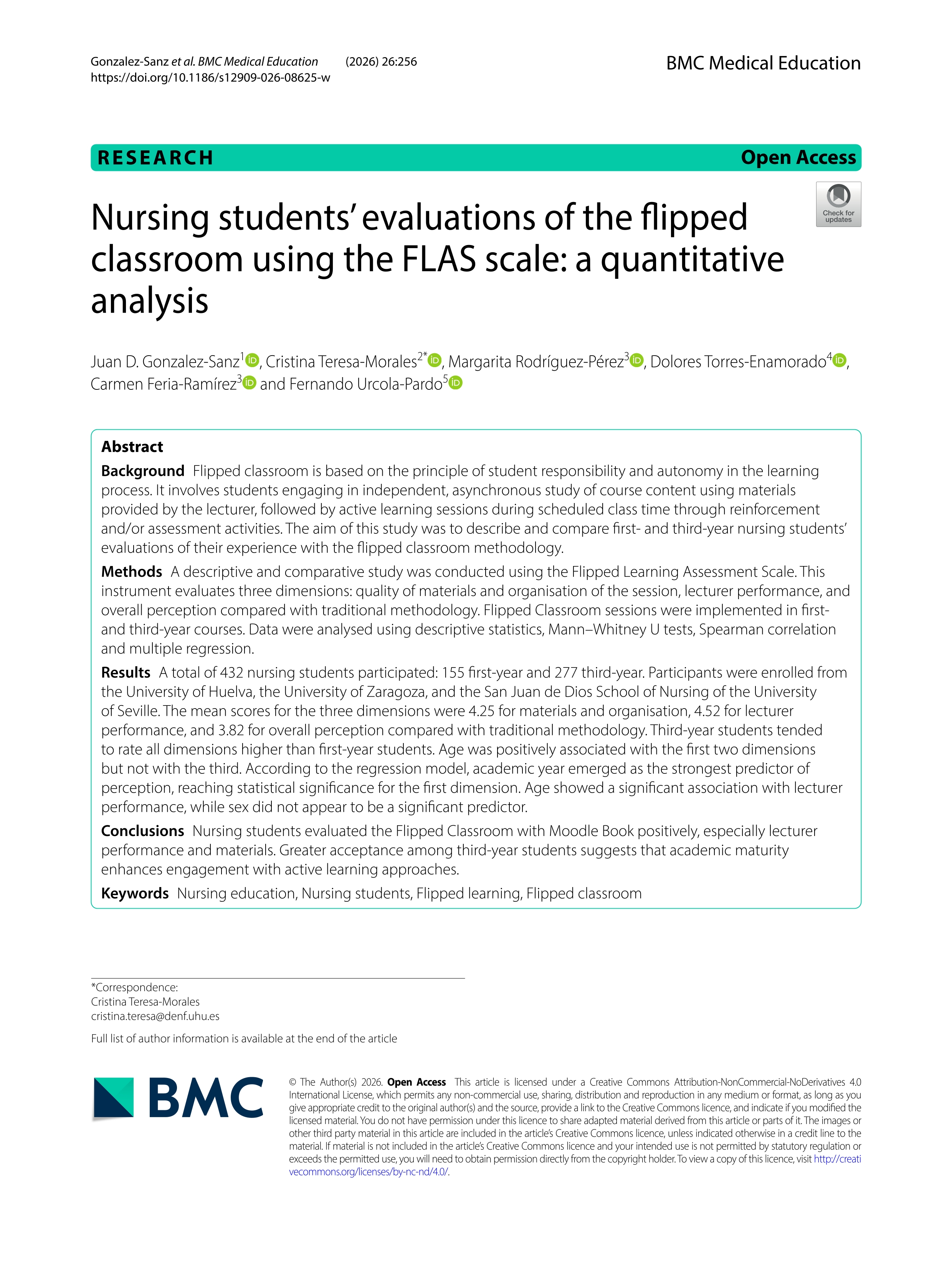
Resumen: Background Flipped classroom is based on the principle of student responsibility and autonomy in the learning process. It involves students engaging in independent, asynchronous study of course content using materials provided by the lecturer, followed by active learning sessions during scheduled class time through reinforcement and/or assessment activities. The aim of this study was to describe and compare first- and third-year nursing students’ evaluations of their experience with the flipped classroom methodology. Methods A descriptive and comparative study was conducted using the Flipped Learning Assessment Scale. This instrument evaluates three dimensions: quality of materials and organisation of the session, lecturer performance, and overall perception compared with traditional methodology. Flipped Classroom sessions were implemented in firstand third-year courses. Data were analysed using descriptive statistics, Mann–Whitney U tests, Spearman correlation and multiple regression. Results A total of 432 nursing students participated: 155 first-year and 277 third-year. Participants were enrolled from the University of Huelva, the University of Zaragoza, and the San Juan de Dios School of Nursing of the University of Seville. The mean scores for the three dimensions were 4.25 for materials and organisation, 4.52 for lecturer performance, and 3.82 for overall perception compared with traditional methodology. Third-year students tended to rate all dimensions higher than first-year students. Age was positively associated with the first two dimensions but not with the third. According to the regression model, academic year emerged as the strongest predictor of perception, reaching statistical significance for the first dimension. Age showed a significant association with lecturer performance, while sex did not appear to be a significant predictor.
Conclusions Nursing students evaluated the Flipped Classroom with Moodle Book positively, especially lecturer
performance and materials. Greater acceptance among third-year students suggests that academic maturity
enhances engagement with active learning approaches.
Keywords Nursing education, Nursing students, Flipped learning, Flipped classroom
Idioma: Inglés
DOI: 10.1186/s12909-026-08625-w
Año: 2026
Publicado en: BMC MEDICAL EDUCATION 26, 1 (2026), 256 [11 pp.]
ISSN: 1472-6920
Financiación: info:eu-repo/grantAgreement/ES/DGA/B53-23R
Tipo y forma: Article (Published version)
Área (Departamento): Área Enfermería (Dpto. Fisiatría y Enfermería)
Exportado de SIDERAL (2026-02-19-14:10:45)
Visitas y descargas
Conclusions Nursing students evaluated the Flipped Classroom with Moodle Book positively, especially lecturer
performance and materials. Greater acceptance among third-year students suggests that academic maturity
enhances engagement with active learning approaches.
Keywords Nursing education, Nursing students, Flipped learning, Flipped classroom
Idioma: Inglés
DOI: 10.1186/s12909-026-08625-w
Año: 2026
Publicado en: BMC MEDICAL EDUCATION 26, 1 (2026), 256 [11 pp.]
ISSN: 1472-6920
Financiación: info:eu-repo/grantAgreement/ES/DGA/B53-23R
Tipo y forma: Article (Published version)
Área (Departamento): Área Enfermería (Dpto. Fisiatría y Enfermería)
Exportado de SIDERAL (2026-02-19-14:10:45)
Permalink:
Visitas y descargas
Este artículo se encuentra en las siguientes colecciones:
articulos > articulos-por-area > enfermeria
Notice créée le 2026-02-19, modifiée le 2026-02-19