Experimental and theoretical studies of isomeric metal (N^C^N)Cl coordination complexes (Metal = Pt, Pd) with multiple conductance pathways in single-molecule junctions
Bastante, Pablo ; Davidson, Ross J. ; Chelli, Yahia ; Daaoub, Abdalghani H. S. ; Cea, Pilar (Universidad de Zaragoza) ; Martin, Santiago ; Batsanov, Andrei S. ; Sangtarash, Sara ; Sadeghi, Hatef ; Bryce, Martin R. ; Agrait, Nicolas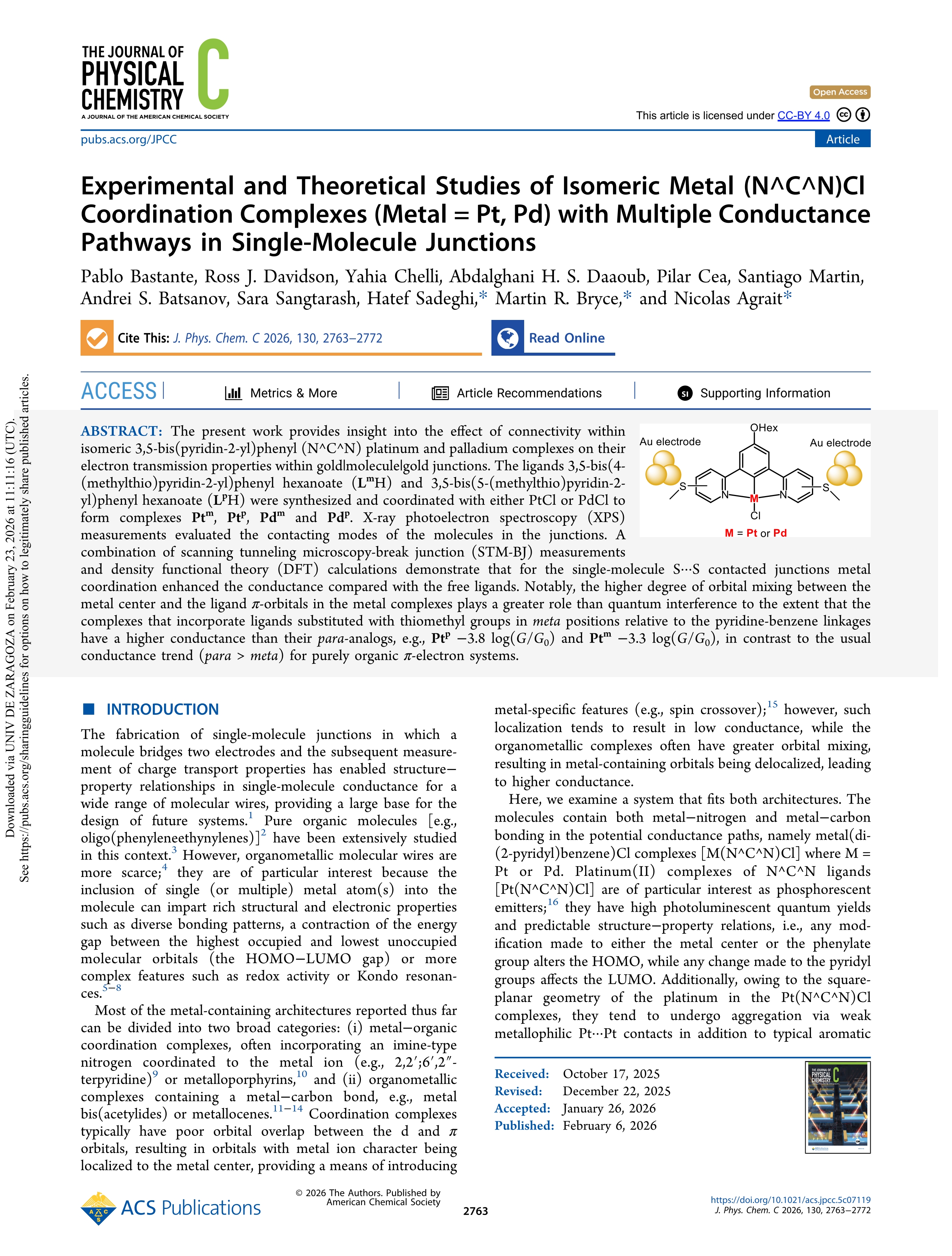

Resumen: The present work provides insight into the effect of connectivity within isomeric 3,5-bis(pyridin-2-yl)phenyl (N^C^N) platinum and palladium complexes on their electron transmission properties within gold|molecule|gold junctions. The ligands 3,5-bis(4-(methylthio)pyridin-2-yl)phenyl hexanoate (LmH) and 3,5-bis(5-(methylthio)pyridin-2-yl)phenyl hexanoate (Lp H) were synthesized and coordinated with either PtCl or PdCl to form complexes Ptm, Ptp, Pdm and Pdp. X-ray photoelectron spectroscopy (XPS) measurements evaluated the contacting modes of the molecules in the junctions. A combination of scanning tunneling microscopy-break junction (STM-BJ) measurements and density functional theory (DFT) calculations demonstrate that for the single-molecule S···S contacted junctions metal coordination enhanced the conductance compared with the free ligands. Notably, the higher degree of orbital mixing between the metal center and the ligand π-orbitals in the metal complexes plays a greater role than quantum interference to the extent that the complexes that incorporate ligands substituted with thiomethyl groups in meta positions relative to the pyridine-benzene linkages have a higher conductance than their para-analogs, e.g., Ptp −3.8 log(G/G0) and Ptm −3.3 log(G/G0), in contrast to the usual conductance trend (para > meta) for purely organic π-electron systems.
Idioma: Inglés
DOI: 10.1021/acs.jpcc.5c07119
Año: 2026
Publicado en: Journal of physical chemistry. C. 130, 7 (2026), 2763-2772
ISSN: 1932-7447
Financiación: info:eu-repo/grantAgreement/ES/DGA/E31-23R-PLATON
Financiación: info:eu-repo/grantAgreement/EC/H2020/767187/EU/Quantum Interference Enhanced Thermoelectricity/QuIET
Financiación: info:eu-repo/grantAgreement/ES/MICINN/PID2022-141433OB-I00
Tipo y forma: Artículo (Versión definitiva)
Área (Departamento): Área Química Física (Dpto. Química Física)
 Debe reconocer adecuadamente la autoría, proporcionar un enlace a la licencia e indicar si se han realizado cambios. Puede hacerlo de cualquier manera razonable, pero no de una manera que sugiera que tiene el apoyo del licenciador o lo recibe por el uso que hace.
Exportado de SIDERAL (2026-02-23-14:54:17)
Visitas y descargas
Idioma: Inglés
DOI: 10.1021/acs.jpcc.5c07119
Año: 2026
Publicado en: Journal of physical chemistry. C. 130, 7 (2026), 2763-2772
ISSN: 1932-7447
Financiación: info:eu-repo/grantAgreement/ES/DGA/E31-23R-PLATON
Financiación: info:eu-repo/grantAgreement/EC/H2020/767187/EU/Quantum Interference Enhanced Thermoelectricity/QuIET
Financiación: info:eu-repo/grantAgreement/ES/MICINN/PID2022-141433OB-I00
Tipo y forma: Artículo (Versión definitiva)
Área (Departamento): Área Química Física (Dpto. Química Física)
Debe reconocer adecuadamente la autoría, proporcionar un enlace a la licencia e indicar si se han realizado cambios. Puede hacerlo de cualquier manera razonable, pero no de una manera que sugiera que tiene el apoyo del licenciador o lo recibe por el uso que hace. Exportado de SIDERAL (2026-02-23-14:54:17)
Enlace permanente:
Visitas y descargas
Este artículo se encuentra en las siguientes colecciones:
Artículos > Artículos por área > Química Física
Registro creado el 2026-02-23, última modificación el 2026-02-23