Morphometric dissimilarity in association cortices linked to autism subtype with more severe symptoms
Jiang, Hongxiu ; Rodriguez-Cruces, Raul ; Xie, Ke ; Kebets, Valeria ; Wang, Yezhou ; Weber, Clara F. ; He, Ying ; Kember, Jonah ; Sweatman, Hilary ; Gracia Tabuenca, Zeus (Universidad de Zaragoza) ; Poline, Jean-Baptiste ; Bzdok, Danilo ; Hong, Seok-Jun ; Bernhardt, Boris ; Chai, Xiaoqian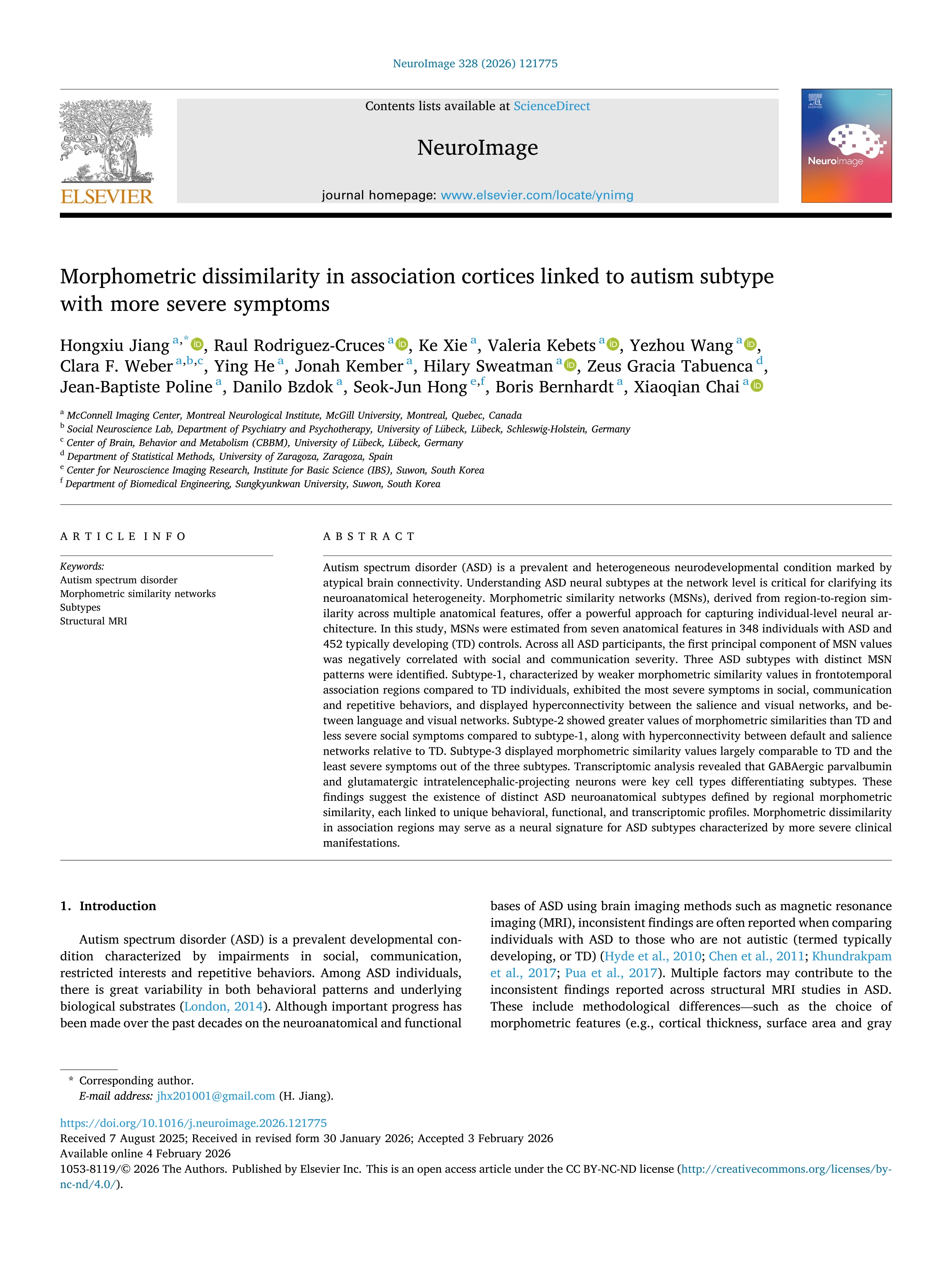
Resumen: Autism spectrum disorder (ASD) is a prevalent and heterogeneous neurodevelopmental condition marked by atypical brain connectivity. Understanding ASD neural subtypes at the network level is critical for clarifying its neuroanatomical heterogeneity. Morphometric similarity networks (MSNs), derived from region-to-region similarity across multiple anatomical features, offer a powerful approach for capturing individual-level neural architecture. In this study, MSNs were estimated from seven anatomical features in 348 individuals with ASD and 452 typically developing (TD) controls. Across all ASD participants, the first principal component of MSN values was negatively correlated with social and communication severity. Three ASD subtypes with distinct MSN patterns were identified. Subtype-1, characterized by weaker morphometric similarity values in frontotemporal association regions compared to TD individuals, exhibited the most severe symptoms in social, communication and repetitive behaviors, and displayed hyperconnectivity between the salience and visual networks, and between language and visual networks. Subtype-2 showed greater values of morphometric similarities than TD and
less severe social symptoms compared to subtype-1, along with hyperconnectivity between default and salience networks relative to TD. Subtype-3 displayed morphometric similarity values largely comparable to TD and the least severe symptoms out of the three subtypes. Transcriptomic analysis revealed that GABAergic parvalbumin and glutamatergic intratelencephalic-projecting neurons were key cell types differentiating subtypes. These findings suggest the existence of distinct ASD neuroanatomical subtypes defined by regional morphometric similarity, each linked to unique behavioral, functional, and transcriptomic profiles. Morphometric dissimilarity in association regions may serve as a neural signature for ASD subtypes characterized by more severe clinical manifestations.
Idioma: Inglés
DOI: 10.1016/j.neuroimage.2026.121775
Año: 2026
Publicado en: NEUROIMAGE 328 (2026), 121775 [10 pp.]
ISSN: 1053-8119
Tipo y forma: Artículo (Versión definitiva)
Área (Departamento): Área Estadís. Investig. Opera. (Dpto. Métodos Estadísticos)
 Debe reconocer adecuadamente la autoría, proporcionar un enlace a la licencia e indicar si se han realizado cambios. Puede hacerlo de cualquier manera razonable, pero no de una manera que sugiera que tiene el apoyo del licenciador o lo recibe por el uso que hace. No puede utilizar el material para una finalidad comercial. Si remezcla, transforma o crea a partir del material, no puede difundir el material modificado.
Exportado de SIDERAL (2026-02-23-14:55:03)
Visitas y descargas
less severe social symptoms compared to subtype-1, along with hyperconnectivity between default and salience networks relative to TD. Subtype-3 displayed morphometric similarity values largely comparable to TD and the least severe symptoms out of the three subtypes. Transcriptomic analysis revealed that GABAergic parvalbumin and glutamatergic intratelencephalic-projecting neurons were key cell types differentiating subtypes. These findings suggest the existence of distinct ASD neuroanatomical subtypes defined by regional morphometric similarity, each linked to unique behavioral, functional, and transcriptomic profiles. Morphometric dissimilarity in association regions may serve as a neural signature for ASD subtypes characterized by more severe clinical manifestations.
Idioma: Inglés
DOI: 10.1016/j.neuroimage.2026.121775
Año: 2026
Publicado en: NEUROIMAGE 328 (2026), 121775 [10 pp.]
ISSN: 1053-8119
Tipo y forma: Artículo (Versión definitiva)
Área (Departamento): Área Estadís. Investig. Opera. (Dpto. Métodos Estadísticos)
Debe reconocer adecuadamente la autoría, proporcionar un enlace a la licencia e indicar si se han realizado cambios. Puede hacerlo de cualquier manera razonable, pero no de una manera que sugiera que tiene el apoyo del licenciador o lo recibe por el uso que hace. No puede utilizar el material para una finalidad comercial. Si remezcla, transforma o crea a partir del material, no puede difundir el material modificado.Exportado de SIDERAL (2026-02-23-14:55:03)
Enlace permanente:
Visitas y descargas
Este artículo se encuentra en las siguientes colecciones:
Artículos > Artículos por área > Estadística e Investigación Operativa
Registro creado el 2026-02-23, última modificación el 2026-02-23