The Mydriasis-Free Handheld ERG Device and Its Utility in Clinical Practice: A Review
Arias-Álvarez, Marta (Universidad de Zaragoza) ; Sopeña-Pinilla, María ; Rodriguez-Mena, Diego (Universidad de Zaragoza) ; Pinilla, Isabel (Universidad de Zaragoza)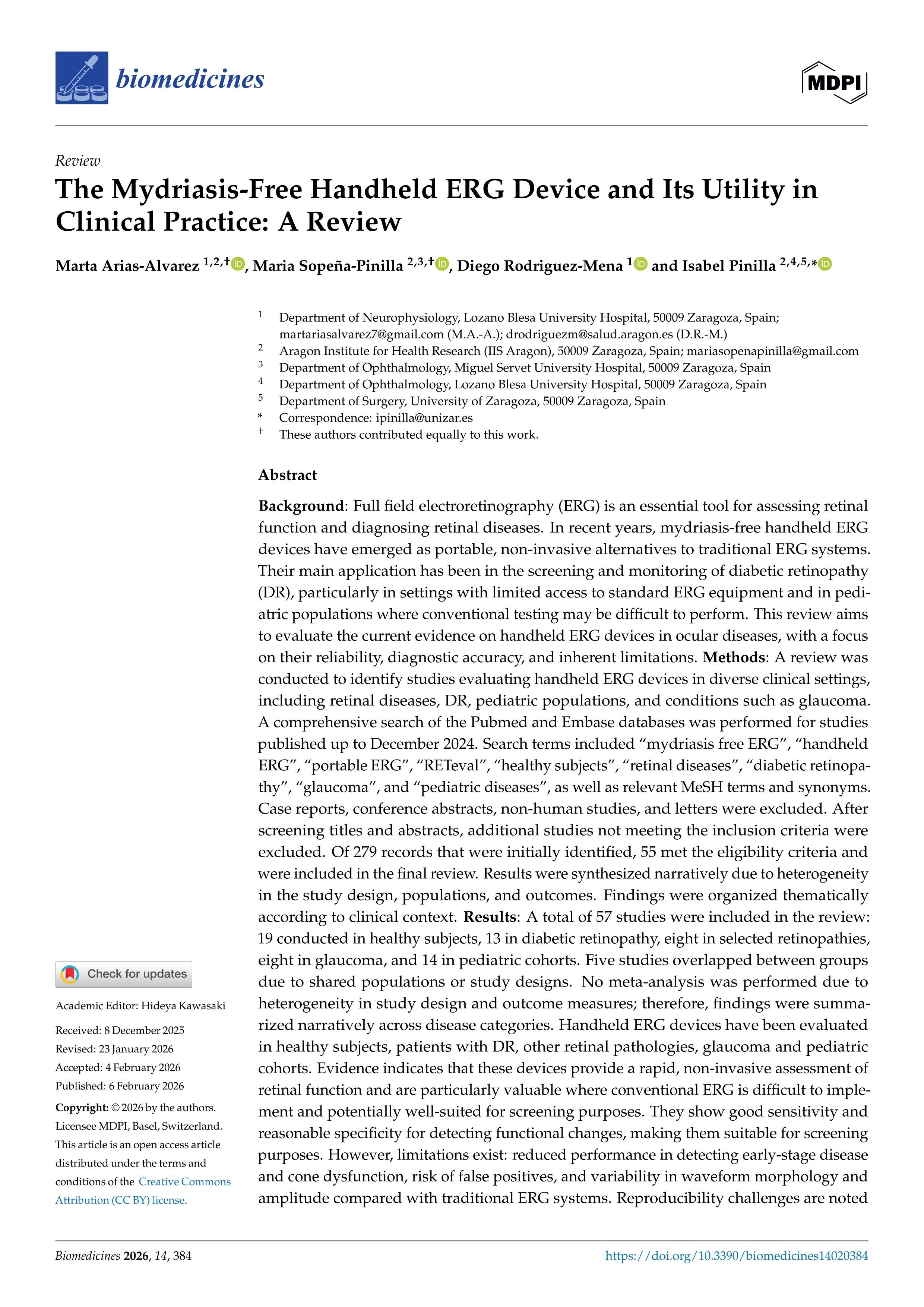
Resumen: Background: Full field electroretinography (ERG) is an essential tool for assessing retinal function and diagnosing retinal diseases. In recent years, mydriasis-free handheld ERG devices have emerged as portable, non-invasive alternatives to traditional ERG systems. Their main application has been in the screening and monitoring of diabetic retinopathy (DR), particularly in settings with limited access to standard ERG equipment and in pediatric populations where conventional testing may be difficult to perform. This review aims to evaluate the current evidence on handheld ERG devices in ocular diseases, with a focus on their reliability, diagnostic accuracy, and inherent limitations. Methods: A review was conducted to identify studies evaluating handheld ERG devices in diverse clinical settings, including retinal diseases, DR, pediatric populations, and conditions such as glaucoma. A comprehensive search of the Pubmed and Embase databases was performed for studies published up to December 2024. Search terms included “mydriasis free ERG”, “handheld ERG”, “portable ERG”, “RETeval”, “healthy subjects”, “retinal diseases”, “diabetic retinopathy”, “glaucoma”, and “pediatric diseases”, as well as relevant MeSH terms and synonyms. Case reports, conference abstracts, non-human studies, and letters were excluded. After screening titles and abstracts, additional studies not meeting the inclusion criteria were excluded. Of 279 records that were initially identified, 55 met the eligibility criteria and were included in the final review. Results were synthesized narratively due to heterogeneity in the study design, populations, and outcomes. Findings were organized thematically according to clinical context. Results: A total of 57 studies were included in the review: 19 conducted in healthy subjects, 13 in diabetic retinopathy, eight in selected retinopathies, eight in glaucoma, and 14 in pediatric cohorts. Five studies overlapped between groups due to shared populations or study designs. No meta-analysis was performed due to heterogeneity in study design and outcome measures; therefore, findings were summarized narratively across disease categories. Handheld ERG devices have been evaluated in healthy subjects, patients with DR, other retinal pathologies, glaucoma and pediatric cohorts. Evidence indicates that these devices provide a rapid, non-invasive assessment of retinal function and are particularly valuable where conventional ERG is difficult to implement and potentially well-suited for screening purposes. They show good sensitivity and reasonable specificity for detecting functional changes, making them suitable for screening purposes. However, limitations exist: reduced performance in detecting early-stage disease and cone dysfunction, risk of false positives, and variability in waveform morphology and amplitude compared with traditional ERG systems. Reproducibility challenges are noted among pediatric patients and individuals with poor fixation or unstable eye movements. These discrepancies highlight the need for establishing robust normative datasets for both healthy subjects and specific disease states. Conclusions: Handheld ERG devices provide a rapid, accessible and user-friendly option for retinal assessment. While not a replacement for conventional ERG, they serve as complementary tools, particularly in early disease and in contexts where standard testing is less feasible. Further research is required to refine testing protocols, improve diagnostic accuracy, and validate their application across a broader spectrum of ocular diseases.
Idioma: Inglés
DOI: 10.3390/biomedicines14020384
Año: 2026
Publicado en: Biomedicines 14, 2 (2026), 384 [31 pp.]
ISSN: 2227-9059
Financiación: info:eu-repo/grantAgreement/ES/ISCIII/PI24-01249
Tipo y forma: Review (Published version)
Área (Departamento): Area Medicina (Dpto. Medicina, Psiqu. y Derm.)
Área (Departamento): Área Oftalmología (Dpto. Cirugía)
 You must give appropriate credit, provide a link to the license, and indicate if changes were made. You may do so in any reasonable manner, but not in any way that suggests the licensor endorses you or your use.
Exportado de SIDERAL (2026-02-24-14:47:18)
Visitas y descargas
Idioma: Inglés
DOI: 10.3390/biomedicines14020384
Año: 2026
Publicado en: Biomedicines 14, 2 (2026), 384 [31 pp.]
ISSN: 2227-9059
Financiación: info:eu-repo/grantAgreement/ES/ISCIII/PI24-01249
Tipo y forma: Review (Published version)
Área (Departamento): Area Medicina (Dpto. Medicina, Psiqu. y Derm.)
Área (Departamento): Área Oftalmología (Dpto. Cirugía)
You must give appropriate credit, provide a link to the license, and indicate if changes were made. You may do so in any reasonable manner, but not in any way that suggests the licensor endorses you or your use. Exportado de SIDERAL (2026-02-24-14:47:18)
Permalink:
Visitas y descargas
Este artículo se encuentra en las siguientes colecciones:
Articles > Artículos por área > Oftalmología
Articles > Artículos por área > Medicina
Record created 2026-02-24, last modified 2026-02-25