Acute stress of the healthcare workforce during the COVID-19 pandemic evolution: a cross-sectional study in Spain
Mira, José Joaquín ; Carrillo, Irene ; Guilabert, Mercedes ; Mula, Aurora ; Martin-Delgado, Jimmy ; Pérez-Jover, Maria Virtudes ; Vicente, Maria Asunción ; Fernández, César ; Behalf of the SARS-CoV-2 Second Victim Study Group ; Astier, Pilar (Universidad de Zaragoza)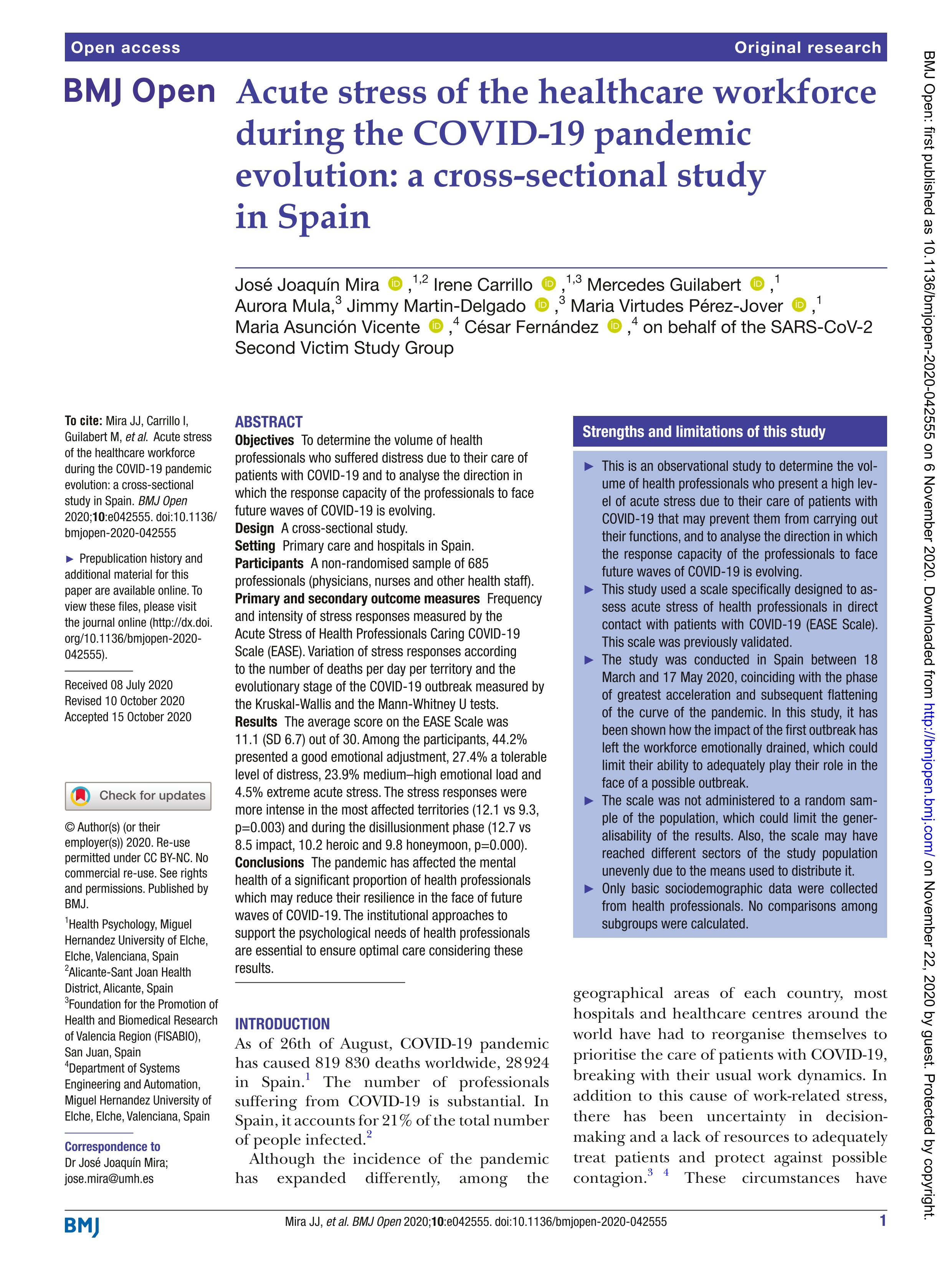
Resumen: ObjectivesTo determine the volume of health professionals who suffered distress due to their care of patients with COVID-19 and to analyse the direction in which the response capacity of the professionals to face future waves of COVID-19 is evolving.DesignA cross-sectional study.SettingPrimary care and hospitals in Spain.ParticipantsA non-randomised sample of 685 professionals (physicians, nurses and other health staff).Primary and secondary outcome measuresFrequency and intensity of stress responses measured by the Acute Stress of Health Professionals Caring COVID-19 Scale (EASE). Variation of stress responses according to the number of deaths per day per territory and the evolutionary stage of the COVID-19 outbreak measured by the Kruskal-Wallis and the Mann-Whitney U tests.ResultsThe average score on the EASE Scale was 11.1 (SD 6.7) out of 30. Among the participants, 44.2% presented a good emotional adjustment, 27.4% a tolerable level of distress, 23.9% medium–high emotional load and 4.5% extreme acute stress. The stress responses were more intense in the most affected territories (12.1 vs 9.3, p=0.003) and during the disillusionment phase (12.7 vs 8.5 impact, 10.2 heroic and 9.8 honeymoon, p=0.000).ConclusionsThe pandemic has affected the mental health of a significant proportion of health professionals which may reduce their resilience in the face of future waves of COVID-19. The institutional approaches to support the psychological needs of health professionals are essential to ensure optimal care considering these results.
Idioma: Inglés
DOI: 10.1136/bmjopen-2020-042555
Año: 2020
Publicado en: BMJ Open 10, 11 (2020), e042555 [9 pp.]
ISSN: 2044-6055
Factor impacto JCR: 2.692 (2020)
Categ. JCR: MEDICINE, GENERAL & INTERNAL rank: 64 / 167 = 0.383 (2020) - Q2 - T2
Factor impacto SCIMAGO: 1.131 - Medicine (miscellaneous) (Q1)
Tipo y forma: Artículo (Versión definitiva)
Área (Departamento): Area Medicina (Dpto. Medicina, Psiqu. y Derm.)
 Debe reconocer adecuadamente la autoría, proporcionar un enlace a la licencia e indicar si se han realizado cambios. Puede hacerlo de cualquier manera razonable, pero no de una manera que sugiera que tiene el apoyo del licenciador o lo recibe por el uso que hace. No puede utilizar el material para una finalidad comercial.
Exportado de SIDERAL (2026-02-27-12:36:07)
Visitas y descargas
Idioma: Inglés
DOI: 10.1136/bmjopen-2020-042555
Año: 2020
Publicado en: BMJ Open 10, 11 (2020), e042555 [9 pp.]
ISSN: 2044-6055
Factor impacto JCR: 2.692 (2020)
Categ. JCR: MEDICINE, GENERAL & INTERNAL rank: 64 / 167 = 0.383 (2020) - Q2 - T2
Factor impacto SCIMAGO: 1.131 - Medicine (miscellaneous) (Q1)
Tipo y forma: Artículo (Versión definitiva)
Área (Departamento): Area Medicina (Dpto. Medicina, Psiqu. y Derm.)
Debe reconocer adecuadamente la autoría, proporcionar un enlace a la licencia e indicar si se han realizado cambios. Puede hacerlo de cualquier manera razonable, pero no de una manera que sugiera que tiene el apoyo del licenciador o lo recibe por el uso que hace. No puede utilizar el material para una finalidad comercial.Exportado de SIDERAL (2026-02-27-12:36:07)
Enlace permanente:
Visitas y descargas
Este artículo se encuentra en las siguientes colecciones:
Artículos > Artículos por área > Medicina
Registro creado el 2026-02-27, última modificación el 2026-02-27