Parental barriers to active commuting to school in children: does parental gender matter?
Aibar Solana, A. (Universidad de Zaragoza) ; Mandic, S. ; Generelo Lanaspa, E. (Universidad de Zaragoza) ; Gallardo, L.O. (Universidad de Zaragoza) ; Zaragoza Casterad, J. (Universidad de Zaragoza)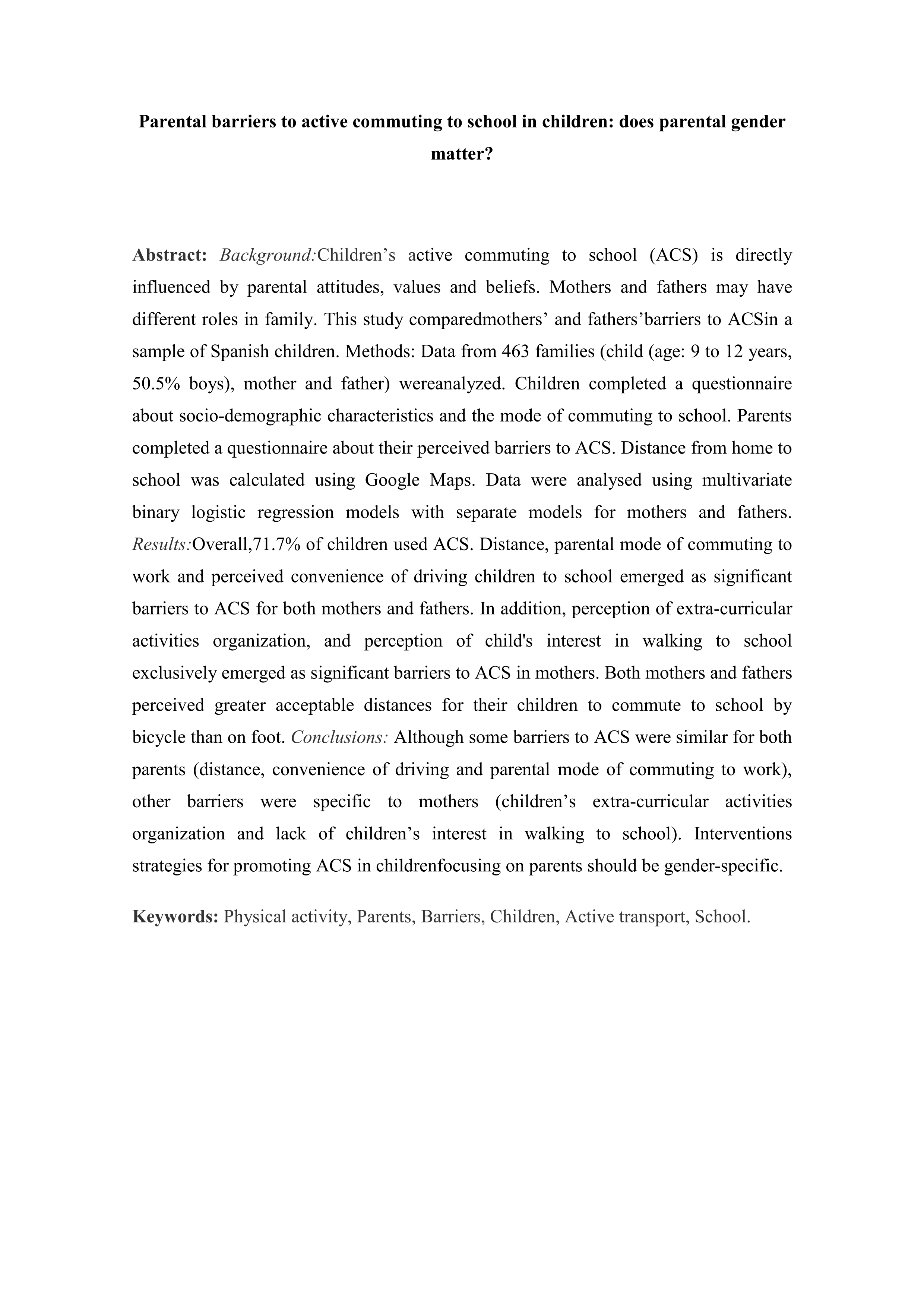
Resumen: Background: Children's active commuting to school (ACS) is influenced by parental attitudes, values and beliefs. Mothers and fathers may have different roles in family. This study compared mothers’ and fathers’ barriers to ACS in a sample of Spanish children.
Methods: Data from 463 families (child (age: 9 to 12 years, 50.5% boys), mother and father) were analyzed. Children completed a questionnaire about socio-demographic characteristics and the mode of commuting to school. Both parents completed a questionnaire about their perceived barriers to ACS. Distance from home to school was calculated using Google Maps. Data were analysed using multivariate binary logistic regression models with separate models for mothers and fathers.
Results: Overall, 71.7% of children used ACS. Distance, parental mode of commuting to work and perceived convenience of driving children to school emerged as significant barriers to ACS for both mothers and fathers. Child's extra-curricular activities and child's lack of interest in walking to school were also significant correlates of ACS in mothers only, but not in families that lived within a walkable distance to school.
Conclusions: Although some barriers to ACS were similar for both parents (distance, convenience of driving and parental mode of commuting to work), other barriers were specific to mothers (children's extra-curricular activities organization and lack of children's interest in walking to school). Interventions strategies for promoting ACS in children focusing on parents should be gender-specific.
Idioma: Inglés
DOI: 10.1016/j.jth.2018.03.005
Año: 2018
Publicado en: Journal of Transport & Health 9 (2018), 141-149
ISSN: 2214-1405
Factor impacto JCR: 2.583 (2018)
Categ. JCR: PUBLIC, ENVIRONMENTAL & OCCUPATIONAL HEALTH rank: 32 / 162 = 0.198 (2018) - Q1 - T1
Categ. JCR: TRANSPORTATION rank: 14 / 36 = 0.389 (2018) - Q2 - T2
Factor impacto SCIMAGO: 0.908 - Health Policy (Q1) - Pollution (Q1) - Transportation (Q1) - Safety Research (Q1) - Safety, Risk, Reliability and Quality (Q1) - Public Health, Environmental and Occupational Health (Q1)
Tipo y forma: Article (PostPrint)
Área (Departamento): Área Didáctica Expres.Corporal (Dpto. Expres.Music.Plást.Corp.)
Exportado de SIDERAL (2026-03-06-14:49:58)
Visitas y descargas
Methods: Data from 463 families (child (age: 9 to 12 years, 50.5% boys), mother and father) were analyzed. Children completed a questionnaire about socio-demographic characteristics and the mode of commuting to school. Both parents completed a questionnaire about their perceived barriers to ACS. Distance from home to school was calculated using Google Maps. Data were analysed using multivariate binary logistic regression models with separate models for mothers and fathers.
Results: Overall, 71.7% of children used ACS. Distance, parental mode of commuting to work and perceived convenience of driving children to school emerged as significant barriers to ACS for both mothers and fathers. Child's extra-curricular activities and child's lack of interest in walking to school were also significant correlates of ACS in mothers only, but not in families that lived within a walkable distance to school.
Conclusions: Although some barriers to ACS were similar for both parents (distance, convenience of driving and parental mode of commuting to work), other barriers were specific to mothers (children's extra-curricular activities organization and lack of children's interest in walking to school). Interventions strategies for promoting ACS in children focusing on parents should be gender-specific.
Idioma: Inglés
DOI: 10.1016/j.jth.2018.03.005
Año: 2018
Publicado en: Journal of Transport & Health 9 (2018), 141-149
ISSN: 2214-1405
Factor impacto JCR: 2.583 (2018)
Categ. JCR: PUBLIC, ENVIRONMENTAL & OCCUPATIONAL HEALTH rank: 32 / 162 = 0.198 (2018) - Q1 - T1
Categ. JCR: TRANSPORTATION rank: 14 / 36 = 0.389 (2018) - Q2 - T2
Factor impacto SCIMAGO: 0.908 - Health Policy (Q1) - Pollution (Q1) - Transportation (Q1) - Safety Research (Q1) - Safety, Risk, Reliability and Quality (Q1) - Public Health, Environmental and Occupational Health (Q1)
Tipo y forma: Article (PostPrint)
Área (Departamento): Área Didáctica Expres.Corporal (Dpto. Expres.Music.Plást.Corp.)
Exportado de SIDERAL (2026-03-06-14:49:58)
Permalink:
Visitas y descargas
Este artículo se encuentra en las siguientes colecciones:
articulos > articulos-por-area > didactica_de_la_expresion_corporal
Notice créée le 2026-03-06, modifiée le 2026-03-06