Associations between time spent with digital media and body image among European adolescents
Loganathan, Gowsiga ; Buck, Christoph ; Williams, Garrath ; Veidebaum, Toomas ; Tornaritis, Michael ; Molnár, Dénes ; Miguel-Berges, María L (Universidad de Zaragoza) ; Lissner, Lauren ; Formisano, Annarita ; De Henauw, Stefaan ; Baran, Joanna ; Hebestreit, Antje ; Sina, Elida ;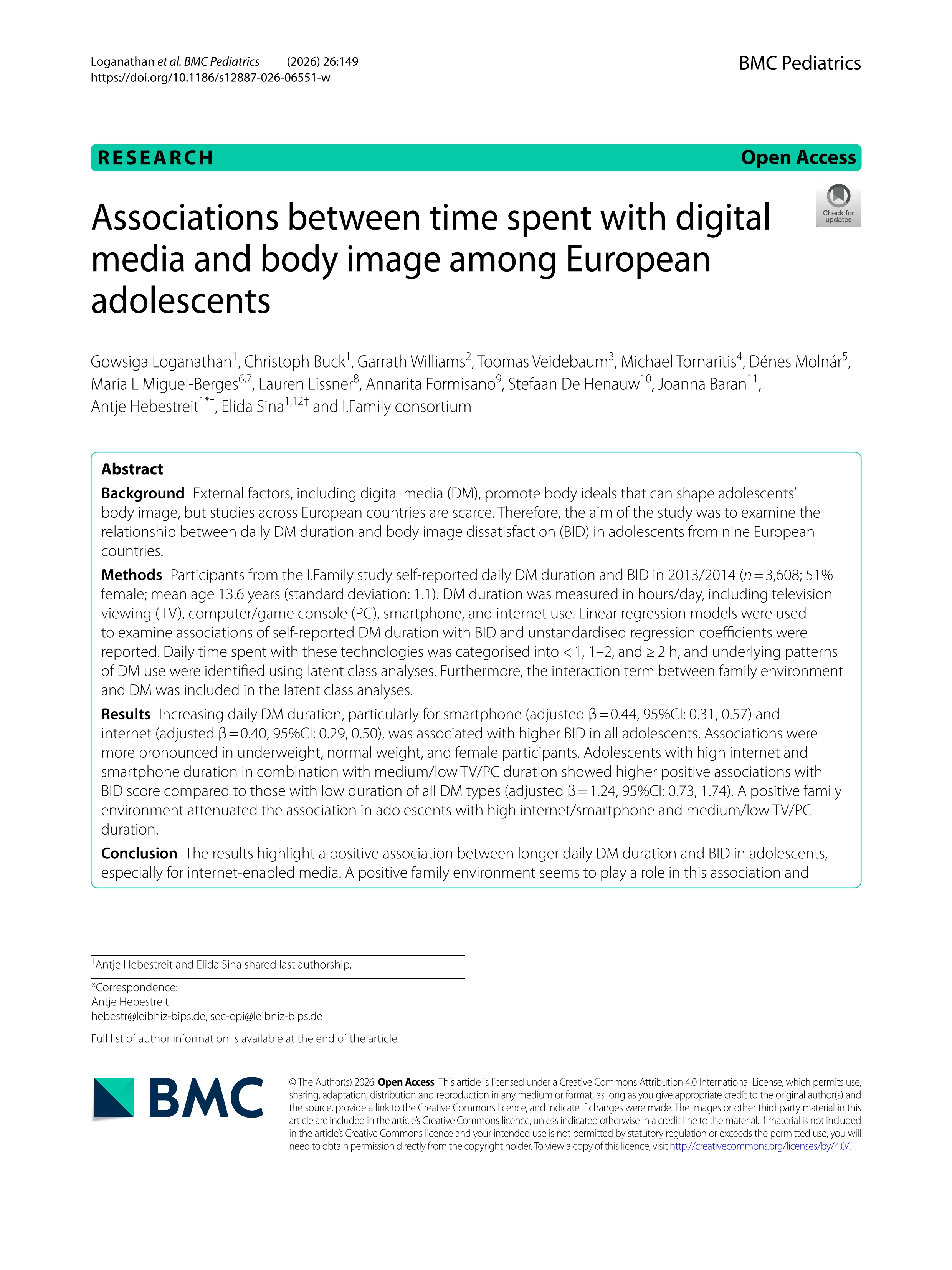
Resumen: Background: External factors, including digital media (DM), promote body ideals that can shape adolescents’body image, but studies across European countries are scarce. Therefore, the aim of the study was to examine the relationship between daily DM duration and body image dissatisfaction (BID) in adolescents from nine European countries. Methods: Participants from the I.Family study self-reported daily DM duration and BID in 2013/2014 (n=3,608; 51% female; mean age 13.6 years (standard deviation: 1.1). DM duration was measured in hours/day, including television viewing (TV), computer/game console (PC), smartphone, and internet use. Linear regression models were used to examine associations of self-reported DM duration with BID and unstandardised regression coefficients were reported. Daily time spent with these technologies was categorised into <1, 1–2, and ≥2 h, and underlying patterns of DM use were identified using latent class analyses. Furthermore, the interaction term between family environment and DM was included in the latent class analyses. Results: Increasing daily DM duration, particularly for smartphone (adjusted β=0.44, 95%CI: 0.31, 0.57) and internet (adjusted β=0.40, 95%CI: 0.29, 0.50), was associated with higher BID in all adolescents. Associations were more pronounced in underweight, normal weight, and female participants. Adolescents with high internet and smartphone duration in combination with medium/low TV/PC duration showed higher positive associations with BID score compared to those with low duration of all DM types (adjusted β=1.24, 95%CI: 0.73, 1.74). A positive family environment attenuated the association in adolescents with high internet/smartphone and medium/low TV/PC duration. Conclusion: The results highlight a positive association between longer daily DM duration and BID in adolescents, especially for internet-enabled media. A positive family environment seems to play a role in this association and should be further investigated in future research. Additionally, understanding the potential mechanisms explaining these associations can inform future interventions promoting healthy body image in adolescents.
Idioma: Inglés
DOI: 10.1186/s12887-026-06551-w
Año: 2026
Publicado en: BMC PEDIATRICS 26, 1 (2026), [11 pp.]
ISSN: 1471-2431
Tipo y forma: Article (Published version)
Área (Departamento): Área Medic.Prevent.Salud Públ. (Dpto. Microb.Ped.Radio.Sal.Pú.)
Exportado de SIDERAL (2026-03-16-08:16:00)
Visitas y descargas
Idioma: Inglés
DOI: 10.1186/s12887-026-06551-w
Año: 2026
Publicado en: BMC PEDIATRICS 26, 1 (2026), [11 pp.]
ISSN: 1471-2431
Tipo y forma: Article (Published version)
Área (Departamento): Área Medic.Prevent.Salud Públ. (Dpto. Microb.Ped.Radio.Sal.Pú.)
Exportado de SIDERAL (2026-03-16-08:16:00)
Permalink:
Visitas y descargas
Este artículo se encuentra en las siguientes colecciones:
articulos > articulos-por-area > medicina_preventiva_y_salud_publica
Notice créée le 2026-03-16, modifiée le 2026-03-16