Older adults’ perspectives on their residential care homes: a case study
Gil-Lacruz, Marta (Universidad de Zaragoza) ; Leché-Martín, Eduardo Alberto (Universidad de Zaragoza) ; Henning, Marcus Alexander ; Gil-Lacruz, Ana Isabel (Universidad de Zaragoza)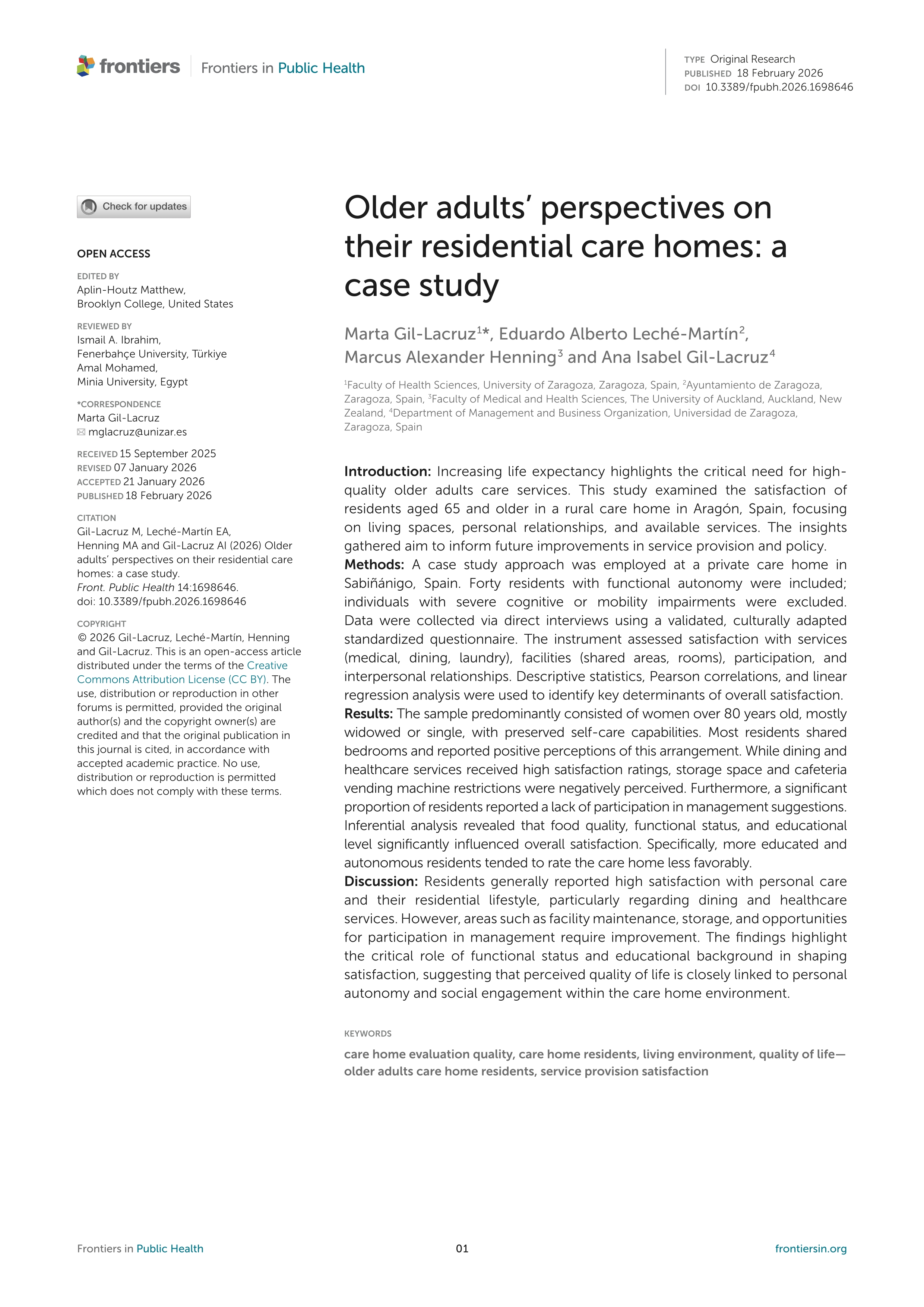
Resumen: Introduction: Increasing life expectancy highlights the critical need for highquality older adults care services. This study examined the satisfaction of residents aged 65 and older in a rural care home in Aragón, Spain, focusing on living spaces, personal relationships, and available services. The insights gathered aim to inform future improvements in service provision and policy. Methods: A case study approach was employed at a private care home in Sabiñánigo, Spain. Forty residents with functional autonomy were included; individuals with severe cognitive or mobility impairments were excluded. Data were collected via direct interviews using a validated, culturally adapted standardized questionnaire. The instrument assessed satisfaction with services (medical, dining, laundry), facilities (shared areas, rooms), participation, and interpersonal relationships. Descriptive statistics, Pearson correlations, and linear regression analysis were used to identify key determinants of overall satisfaction.
Results: The sample predominantly consisted of women over 80 years old, mostly widowed or single, with preserved self-care capabilities. Most residents shared bedrooms and reported positive perceptions of this arrangement. While dining and healthcare services received high satisfaction ratings, storage space and cafeteria vending machine restrictions were negatively perceived. Furthermore, a significant
proportion of residents reported a lack of participation in management suggestions. Inferential analysis revealed that food quality, functional status, and educational level significantly influenced overall satisfaction. Specifically, more educated and autonomous residents tended to rate the care home less favorably. Discussion: Residents generally reported high satisfaction with personal care
and their residential lifestyle, particularly regarding dining and healthcare services. However, areas such as facility maintenance, storage, and opportunities for participation in management require improvement. The findings highlight the critical role of functional status and educational background in shaping satisfaction, suggesting that perceived quality of life is closely linked to personal
autonomy and social engagement within the care home environment.
Idioma: Inglés
DOI: 10.3389/fpubh.2026.1698646
Año: 2026
Publicado en: Frontiers in public health 14 (2026)
ISSN: 2296-2565
Financiación: info:eu-repo/grantAgreement/ES/DGA/S16-23R
Tipo y forma: Article (Published version)
Área (Departamento): Área Organización de Empresas (Dpto. Direcc.Organiza.Empresas)
Área (Departamento): Área Psicología Social (Dpto. Psicología y Sociología)
Área (Departamento): Área Trabajo Social y Serv.Soc (Dpto. Psicología y Sociología)
Exportado de SIDERAL (2026-03-16-08:16:14)
Visitas y descargas
Results: The sample predominantly consisted of women over 80 years old, mostly widowed or single, with preserved self-care capabilities. Most residents shared bedrooms and reported positive perceptions of this arrangement. While dining and healthcare services received high satisfaction ratings, storage space and cafeteria vending machine restrictions were negatively perceived. Furthermore, a significant
proportion of residents reported a lack of participation in management suggestions. Inferential analysis revealed that food quality, functional status, and educational level significantly influenced overall satisfaction. Specifically, more educated and autonomous residents tended to rate the care home less favorably. Discussion: Residents generally reported high satisfaction with personal care
and their residential lifestyle, particularly regarding dining and healthcare services. However, areas such as facility maintenance, storage, and opportunities for participation in management require improvement. The findings highlight the critical role of functional status and educational background in shaping satisfaction, suggesting that perceived quality of life is closely linked to personal
autonomy and social engagement within the care home environment.
Idioma: Inglés
DOI: 10.3389/fpubh.2026.1698646
Año: 2026
Publicado en: Frontiers in public health 14 (2026)
ISSN: 2296-2565
Financiación: info:eu-repo/grantAgreement/ES/DGA/S16-23R
Tipo y forma: Article (Published version)
Área (Departamento): Área Organización de Empresas (Dpto. Direcc.Organiza.Empresas)
Área (Departamento): Área Psicología Social (Dpto. Psicología y Sociología)
Área (Departamento): Área Trabajo Social y Serv.Soc (Dpto. Psicología y Sociología)
Exportado de SIDERAL (2026-03-16-08:16:14)
Permalink:
Visitas y descargas
Este artículo se encuentra en las siguientes colecciones:
articulos > articulos-por-area > trabajo_social_y_servicios_sociales
articulos > articulos-por-area > organizacion_de_empresas
articulos > articulos-por-area > psicologia_social
Notice créée le 2026-03-16, modifiée le 2026-03-16