Deep learning to predict left ventricular hypertrophy from the electrocardiogram
Naderi, Hafiz ; Kaplan, Thomas ; van Duijvenboden, Stefan ; Pujadas, Esmeralda Ruiz ; Aung, Nay ; Anwar A Chahal, C ; Lekadir, Karim ; Chamling, Bishwas ; Dörr, Marcus ; Markus, Marcello R P ; Petersen, Steffen E ; Ramírez, Julia (Universidad de Zaragoza) ; Munroe, Patricia B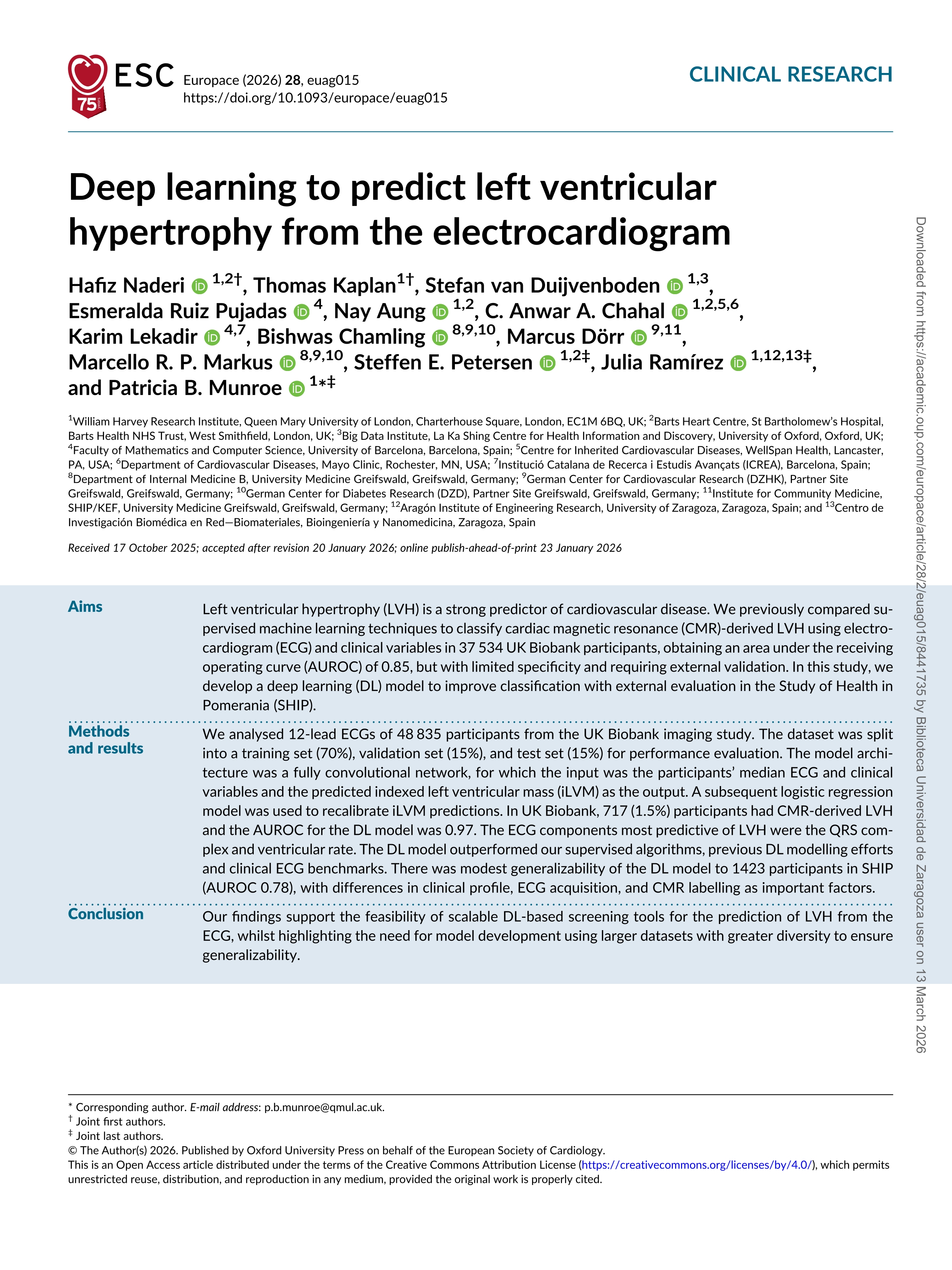

Resumen: Aims: Left ventricular hypertrophy (LVH) is a strong predictor of cardiovascular disease. We previously compared supervised machine learning techniques to classify cardiac magnetic resonance (CMR)-derived LVH using electrocardiogram (ECG) and clinical variables in 37 534 UK Biobank participants, obtaining an area under the receiving operating curve (AUROC) of 0.85, but with limited specificity and requiring external validation. In this study, we develop a deep learning (DL) model to improve classification with external evaluation in the Study of Health in Pomerania (SHIP). Methods and results: We analysed 12-lead ECGs of 48 835 participants from the UK Biobank imaging study. The dataset was split into a training set (70%), validation set (15%), and test set (15%) for performance evaluation. The model architecture was a fully convolutional network, for which the input was the participants’ median ECG and clinical variables and the predicted indexed left ventricular mass (iLVM) as the output. A subsequent logistic regression model was used to recalibrate iLVM predictions. In UK Biobank, 717 (1.5%) participants had CMR-derived LVH and the AUROC for the DL model was 0.97. The ECG components most predictive of LVH were the QRS complex and ventricular rate. The DL model outperformed our supervised algorithms, previous DL modelling efforts and clinical ECG benchmarks. There was modest generalizability of the DL model to 1423 participants in SHIP (AUROC 0.78), with differences in clinical profile, ECG acquisition, and CMR labelling as important factors. Conclusion: Our findings support the feasibility of scalable DL-based screening tools for the prediction of LVH from the ECG, whilst highlighting the need for model development using larger datasets with greater diversity to ensure generalizability.
Idioma: Inglés
DOI: 10.1093/europace/euag015
Año: 2026
Publicado en: Europace 28, 2 (2026), [15 pp.]
ISSN: 1099-5129
Financiación: info:eu-repo/grantAgreement/ES/AEI/PID2023-148975OB-I00
Financiación: info:eu-repo/grantAgreement/EC/H2020/825903 /EU/An EU-Canada joint infrastructure for next-generation multi-Study Heart research/euCanSHare
Financiación: info:eu-repo/grantAgreement/ES/MICINN/RYC2021-031413-I
Tipo y forma: Artículo (Versión definitiva)
Área (Departamento): Área Teoría Señal y Comunicac. (Dpto. Ingeniería Electrón.Com.)
 Debe reconocer adecuadamente la autoría, proporcionar un enlace a la licencia e indicar si se han realizado cambios. Puede hacerlo de cualquier manera razonable, pero no de una manera que sugiera que tiene el apoyo del licenciador o lo recibe por el uso que hace.
Exportado de SIDERAL (2026-03-16-08:16:45)
Visitas y descargas
Idioma: Inglés
DOI: 10.1093/europace/euag015
Año: 2026
Publicado en: Europace 28, 2 (2026), [15 pp.]
ISSN: 1099-5129
Financiación: info:eu-repo/grantAgreement/ES/AEI/PID2023-148975OB-I00
Financiación: info:eu-repo/grantAgreement/EC/H2020/825903 /EU/An EU-Canada joint infrastructure for next-generation multi-Study Heart research/euCanSHare
Financiación: info:eu-repo/grantAgreement/ES/MICINN/RYC2021-031413-I
Tipo y forma: Artículo (Versión definitiva)
Área (Departamento): Área Teoría Señal y Comunicac. (Dpto. Ingeniería Electrón.Com.)
Debe reconocer adecuadamente la autoría, proporcionar un enlace a la licencia e indicar si se han realizado cambios. Puede hacerlo de cualquier manera razonable, pero no de una manera que sugiera que tiene el apoyo del licenciador o lo recibe por el uso que hace. Exportado de SIDERAL (2026-03-16-08:16:45)
Enlace permanente:
Visitas y descargas
Este artículo se encuentra en las siguientes colecciones:
Artículos > Artículos por área > Teoría de la Señal y Comunicaciones
Registro creado el 2026-03-16, última modificación el 2026-03-16