Influence of time, intensity, and total dose parameters on the ultrasound effects of percutaneous electrolysis: an in vitro experimental study
Malo-Urriés, Miguel (Universidad de Zaragoza) ; Rodríguez-Sanz, Jacobo ; Borrella-Andrés, Sergio ; Albarova-Corral, Isabel (Universidad de Zaragoza) ; Garcia-Ribell, Erik ; Gaitán-Villena, José Antonio ; López-de-Celis, Carlos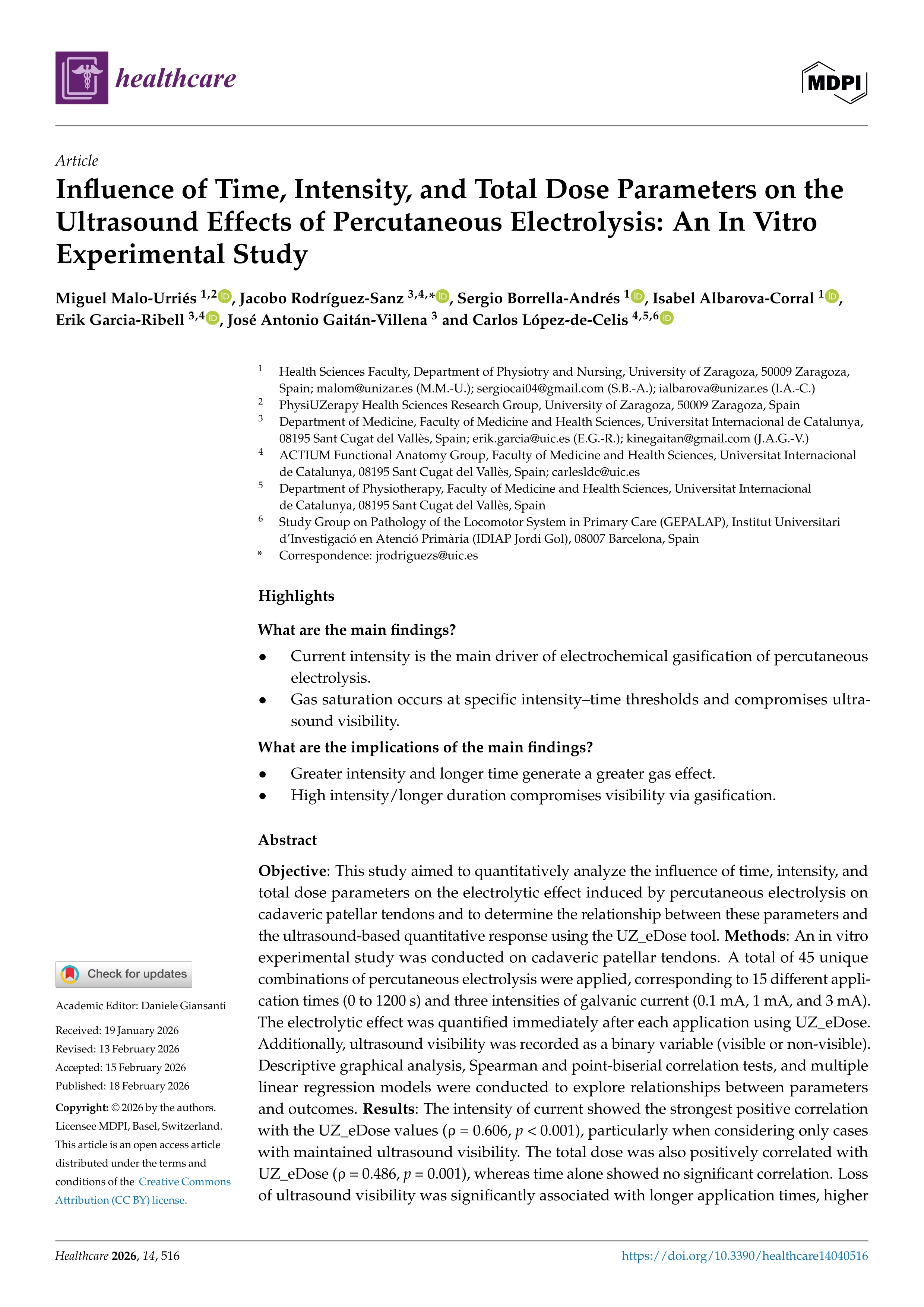
Resumen: Objective: This study aimed to quantitatively analyze the influence of time, intensity, and total dose parameters on the electrolytic effect induced by percutaneous electrolysis on cadaveric patellar tendons and to determine the relationship between these parameters and the ultrasound-based quantitative response using the UZ_eDose tool. Methods: An in vitro experimental study was conducted on cadaveric patellar tendons. A total of 45 unique combinations of percutaneous electrolysis were applied, corresponding to 15 different application times (0 to 1200 s) and three intensities of galvanic current (0.1 mA, 1 mA, and 3 mA). The electrolytic effect was quantified immediately after each application using UZ_eDose. Additionally, ultrasound visibility was recorded as a binary variable (visible or non-visible). Descriptive graphical analysis, Spearman and point-biserial correlation tests, and multiple linear regression models were conducted to explore relationships between parameters and outcomes. Results: The intensity of current showed the strongest positive correlation with the UZ_eDose values (ρ = 0.606, p < 0.001), particularly when considering only cases with maintained ultrasound visibility. The total dose was also positively correlated with UZ_eDose (ρ = 0.486, p = 0.001), whereas time alone showed no significant correlation. Loss of ultrasound visibility was significantly associated with longer application times, higher intensities, and greater total doses (p < 0.001). Multiple linear regression models confirmed the predominant role of intensity in predicting the electrolytic effect, explaining up to 62.7% of the variance when excluding non-visible cases. Conclusions: The electrolytic effect, as quantified by UZ_eDose, is primarily influenced by the intensity of the current and the cumulative dose applied. However, excessive intensities and durations can lead to gas saturation, compromising ultrasound visibility. These findings suggest that both intensity and time should be carefully balanced to maximize the therapeutic effect while preserving imaging control, supporting the use of ultrasound-based quantification tools for optimized, individualized dosimetry.
Idioma: Inglés
DOI: 10.3390/healthcare14040516
Año: 2026
Publicado en: Healthcare (Switzerland) 14, 4 (2026), 516 [14 pp.]
ISSN: 2227-9032
Tipo y forma: Artículo (Versión definitiva)
Área (Departamento): Área Fisioterapia (Dpto. Fisiatría y Enfermería)
 Debe reconocer adecuadamente la autoría, proporcionar un enlace a la licencia e indicar si se han realizado cambios. Puede hacerlo de cualquier manera razonable, pero no de una manera que sugiera que tiene el apoyo del licenciador o lo recibe por el uso que hace.
Exportado de SIDERAL (2026-03-16-08:16:48)
Visitas y descargas
Idioma: Inglés
DOI: 10.3390/healthcare14040516
Año: 2026
Publicado en: Healthcare (Switzerland) 14, 4 (2026), 516 [14 pp.]
ISSN: 2227-9032
Tipo y forma: Artículo (Versión definitiva)
Área (Departamento): Área Fisioterapia (Dpto. Fisiatría y Enfermería)
Debe reconocer adecuadamente la autoría, proporcionar un enlace a la licencia e indicar si se han realizado cambios. Puede hacerlo de cualquier manera razonable, pero no de una manera que sugiera que tiene el apoyo del licenciador o lo recibe por el uso que hace. Exportado de SIDERAL (2026-03-16-08:16:48)
Enlace permanente:
Visitas y descargas
Este artículo se encuentra en las siguientes colecciones:
Artículos > Artículos por área > Fisioterapia
Registro creado el 2026-03-16, última modificación el 2026-03-16