Clinical subtypes in breast cancer patients with brain metastases from an ambispective registry of advanced breast cancer, GEICAM/2014-03 (RegistEM)
López-Tarruella, Sara ; Guerrero-Zotano, Ángel ; Antolín, Silvia ; Cruz, Josefina ; Martínez, Purificación ; Rodríguez, César A. ; Falo, Catalina ; Rodríguez-Lescure, Álvaro ; Adrover, Encarna ; Hernández, María ; Andrés, Raquel (Universidad de Zaragoza) ; Chacón, José Ignacio ; Alonso Romero, José Luis ; Miguel, Ana ; Gómez-Raposo, César ; Margelí, Mireia ; González, Iria ; Guerra, Juan Antonio ; Antón, Antonio (Universidad de Zaragoza) ; Tibau, Ariadna ; Miralles, Juan José ; Escudero, María José ; Bezares, Susana ; Rojo, Federico ; Álvarez, Isabel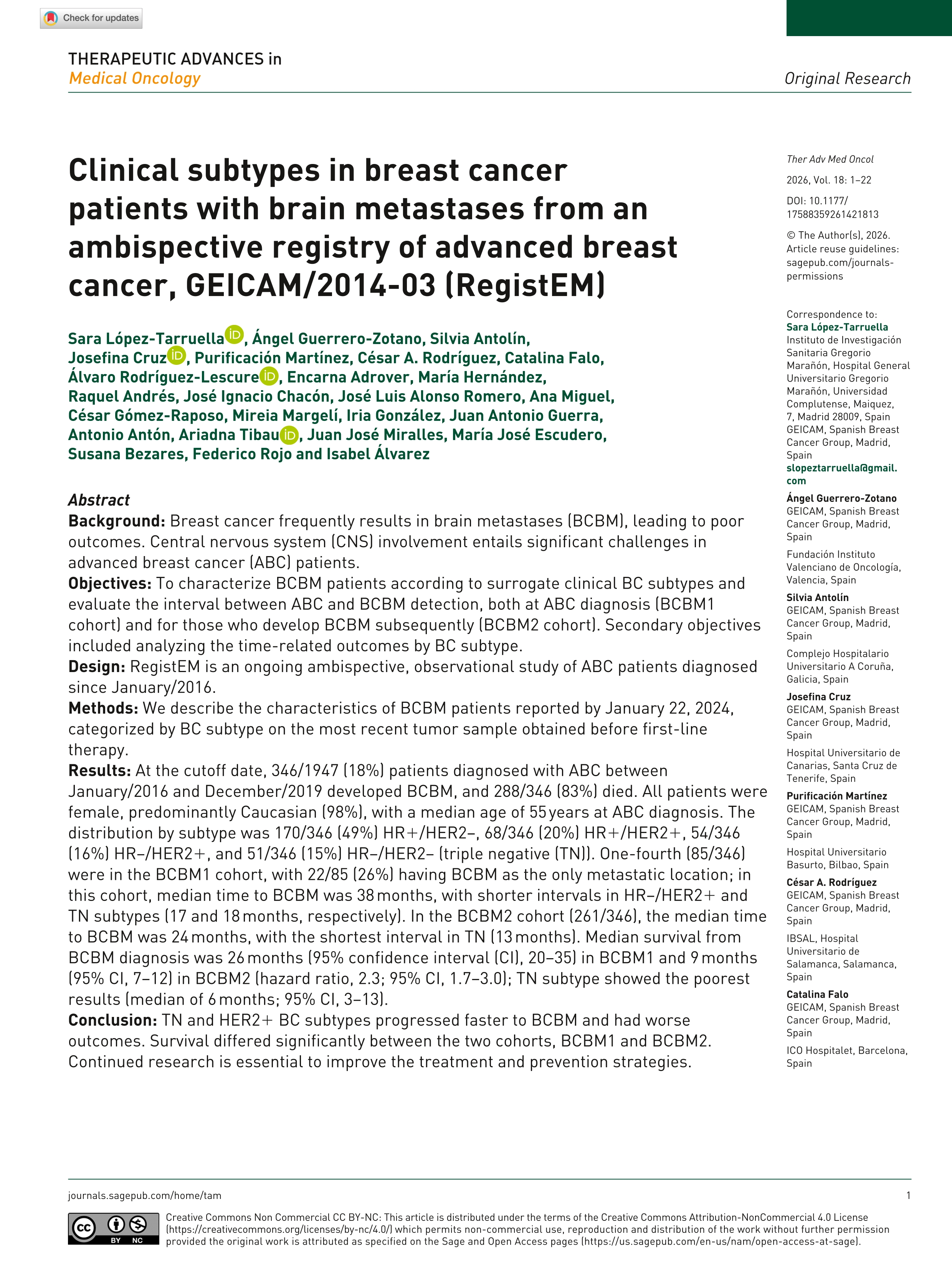
Resumen: Background:
Breast cancer frequently results in brain metastases (BCBM), leading to poor outcomes. Central nervous system (CNS) involvement entails significant challenges in advanced breast cancer (ABC) patients.
Objectives:
To characterize BCBM patients according to surrogate clinical BC subtypes and evaluate the interval between ABC and BCBM detection, both at ABC diagnosis (BCBM1 cohort) and for those who develop BCBM subsequently (BCBM2 cohort). Secondary objectives included analyzing the time-related outcomes by BC subtype.
Design:
RegistEM is an ongoing ambispective, observational study of ABC patients diagnosed since January/2016.
Methods:
We describe the characteristics of BCBM patients reported by January 22, 2024, categorized by BC subtype on the most recent tumor sample obtained before first-line therapy.
Results:
At the cutoff date, 346/1947 (18%) patients diagnosed with ABC between January/2016 and December/2019 developed BCBM, and 288/346 (83%) died. All patients were female, predominantly Caucasian (98%), with a median age of 55 years at ABC diagnosis. The distribution by subtype was 170/346 (49%) HR+/HER2−, 68/346 (20%) HR+/HER2+, 54/346 (16%) HR−/HER2+, and 51/346 (15%) HR−/HER2− (triple negative (TN)). One-fourth (85/346) were in the BCBM1 cohort, with 22/85 (26%) having BCBM as the only metastatic location; in this cohort, median time to BCBM was 38 months, with shorter intervals in HR−/HER2+ and TN subtypes (17 and 18 months, respectively). In the BCBM2 cohort (261/346), the median time to BCBM was 24 months, with the shortest interval in TN (13 months). Median survival from BCBM diagnosis was 26 months (95% confidence interval (CI), 20−35) in BCBM1 and 9 months (95% CI, 7−12) in BCBM2 (hazard ratio, 2.3; 95% CI, 1.7−3.0); TN subtype showed the poorest results (median of 6 months; 95% CI, 3−13).
Conclusion:
TN and HER2+ BC subtypes progressed faster to BCBM and had worse outcomes. Survival differed significantly between the two cohorts, BCBM1 and BCBM2. Continued research is essential to improve the treatment and prevention strategies.
Idioma: Inglés
DOI: 10.1177/17588359261421813
Año: 2026
Publicado en: Therapeutic Advances in Medical Oncology 18 (2026), [22 pp.]
ISSN: 1758-8340
Tipo y forma: Artículo (Versión definitiva)
Área (Departamento): Area Medicina (Dpto. Medicina, Psiqu. y Derm.)
 Debe reconocer adecuadamente la autoría, proporcionar un enlace a la licencia e indicar si se han realizado cambios. Puede hacerlo de cualquier manera razonable, pero no de una manera que sugiera que tiene el apoyo del licenciador o lo recibe por el uso que hace. No puede utilizar el material para una finalidad comercial.
Exportado de SIDERAL (2026-03-16-08:16:56)
Visitas y descargas
Breast cancer frequently results in brain metastases (BCBM), leading to poor outcomes. Central nervous system (CNS) involvement entails significant challenges in advanced breast cancer (ABC) patients.
Objectives:
To characterize BCBM patients according to surrogate clinical BC subtypes and evaluate the interval between ABC and BCBM detection, both at ABC diagnosis (BCBM1 cohort) and for those who develop BCBM subsequently (BCBM2 cohort). Secondary objectives included analyzing the time-related outcomes by BC subtype.
Design:
RegistEM is an ongoing ambispective, observational study of ABC patients diagnosed since January/2016.
Methods:
We describe the characteristics of BCBM patients reported by January 22, 2024, categorized by BC subtype on the most recent tumor sample obtained before first-line therapy.
Results:
At the cutoff date, 346/1947 (18%) patients diagnosed with ABC between January/2016 and December/2019 developed BCBM, and 288/346 (83%) died. All patients were female, predominantly Caucasian (98%), with a median age of 55 years at ABC diagnosis. The distribution by subtype was 170/346 (49%) HR+/HER2−, 68/346 (20%) HR+/HER2+, 54/346 (16%) HR−/HER2+, and 51/346 (15%) HR−/HER2− (triple negative (TN)). One-fourth (85/346) were in the BCBM1 cohort, with 22/85 (26%) having BCBM as the only metastatic location; in this cohort, median time to BCBM was 38 months, with shorter intervals in HR−/HER2+ and TN subtypes (17 and 18 months, respectively). In the BCBM2 cohort (261/346), the median time to BCBM was 24 months, with the shortest interval in TN (13 months). Median survival from BCBM diagnosis was 26 months (95% confidence interval (CI), 20−35) in BCBM1 and 9 months (95% CI, 7−12) in BCBM2 (hazard ratio, 2.3; 95% CI, 1.7−3.0); TN subtype showed the poorest results (median of 6 months; 95% CI, 3−13).
Conclusion:
TN and HER2+ BC subtypes progressed faster to BCBM and had worse outcomes. Survival differed significantly between the two cohorts, BCBM1 and BCBM2. Continued research is essential to improve the treatment and prevention strategies.
Idioma: Inglés
DOI: 10.1177/17588359261421813
Año: 2026
Publicado en: Therapeutic Advances in Medical Oncology 18 (2026), [22 pp.]
ISSN: 1758-8340
Tipo y forma: Artículo (Versión definitiva)
Área (Departamento): Area Medicina (Dpto. Medicina, Psiqu. y Derm.)
Debe reconocer adecuadamente la autoría, proporcionar un enlace a la licencia e indicar si se han realizado cambios. Puede hacerlo de cualquier manera razonable, pero no de una manera que sugiera que tiene el apoyo del licenciador o lo recibe por el uso que hace. No puede utilizar el material para una finalidad comercial.Exportado de SIDERAL (2026-03-16-08:16:56)
Enlace permanente:
Visitas y descargas
Este artículo se encuentra en las siguientes colecciones:
Artículos > Artículos por área > Medicina
Registro creado el 2026-03-16, última modificación el 2026-03-16