Search for Axion-like particles from nearby pre-supernova stars
Mittal, Saurabh ; Siegert, Thomas ; Calore, Francesca ; Carenza, Pierluca ; Eisenberger, Laura ; Giannotti, Maurizio (Universidad de Zaragoza) ; Lella, Alessandro ; Mirizzi, Alessandro ; Tsatsis, Dimitris ; Yoneda, Hiroki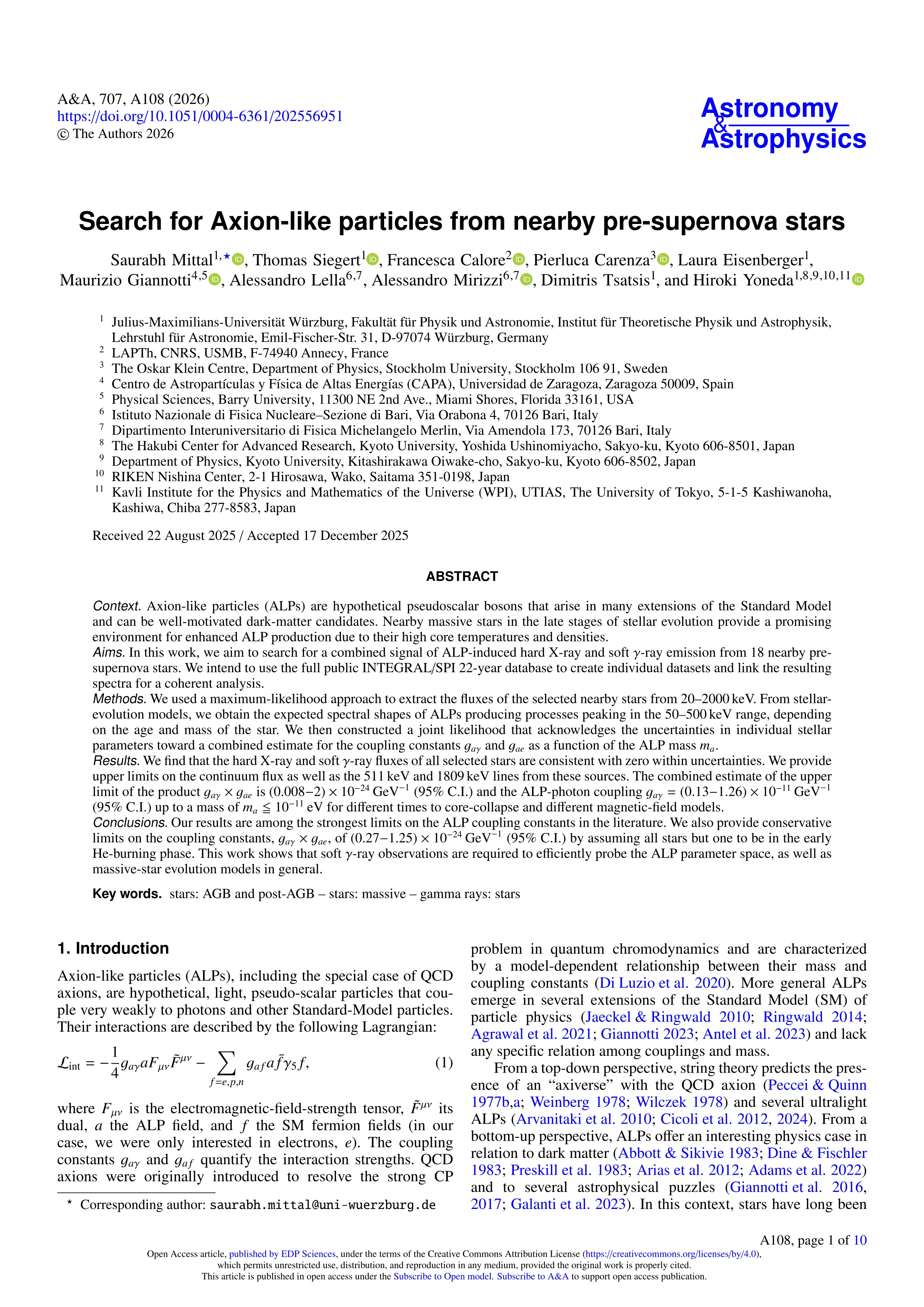
Resumen: Context. Axion-like particles (ALPs) are hypothetical pseudoscalar bosons that arise in many extensions of the Standard Model and can be well-motivated dark-matter candidates. Nearby massive stars in the late stages of stellar evolution provide a promising environment for enhanced ALP production due to their high core temperatures and densities. Aims. In this work, we aim to search for a combined signal of ALP-induced hard X-ray and soft γ-ray emission from 18 nearby presupernova stars. We intend to use the full public INTEGRAL/SPI 22-year database to create individual datasets and link the resulting spectra for a coherent analysis. Methods. We used a maximum-likelihood approach to extract the fluxes of the selected nearby stars from 20–2000 keV. From stellarevolution models, we obtain the expected spectral shapes of ALPs producing processes peaking in the 50–500 keV range, depending on the age and mass of the star. We then constructed a joint likelihood that acknowledges the uncertainties in individual stellar parameters toward a combined estimate for the coupling constants gaγ and gae as a function of the ALP mass ma. Results. We find that the hard X-ray and soft γ-ray fluxes of all selected stars are consistent with zero within uncertainties. We provide upper limits on the continuum flux as well as the 511 keV and 1809 keV lines from these sources. The combined estimate of the upper limit of the product gaγ × gae is (0.008−2) × 10−24 GeV−1 (95% C.I.) and the ALP-photon coupling gaγ = (0.13−1.26) × 10−11 GeV−1 (95% C.I.) up to a mass of ma 5 10−11 eV for different times to core-collapse and different magnetic-field models. Conclusions. Our results are among the strongest limits on the ALP coupling constants in the literature. We also provide conservative limits on the coupling constants, gaγ × gae, of (0.27−1.25) × 10−24 GeV−1 (95% C.I.) by assuming all stars but one to be in the early He-burning phase. This work shows that soft γ-ray observations are required to efficiently probe the ALP parameter space, as well as massive-star evolution models in general.
Idioma: Inglés
DOI: 10.1051/0004-6361/202556951
Año: 2026
Publicado en: Astronomy and Astrophysics 707 (2026), A108 [10 pp.]
ISSN: 0004-6361
Tipo y forma: Article (Published version)
Área (Departamento): Área Astronomía y Astrofísica (Dpto. Física Teórica)
 You must give appropriate credit, provide a link to the license, and indicate if changes were made. You may do so in any reasonable manner, but not in any way that suggests the licensor endorses you or your use.
Exportado de SIDERAL (2026-03-16-08:17:05)
Visitas y descargas
Idioma: Inglés
DOI: 10.1051/0004-6361/202556951
Año: 2026
Publicado en: Astronomy and Astrophysics 707 (2026), A108 [10 pp.]
ISSN: 0004-6361
Tipo y forma: Article (Published version)
Área (Departamento): Área Astronomía y Astrofísica (Dpto. Física Teórica)
You must give appropriate credit, provide a link to the license, and indicate if changes were made. You may do so in any reasonable manner, but not in any way that suggests the licensor endorses you or your use. Exportado de SIDERAL (2026-03-16-08:17:05)
Permalink:
Visitas y descargas
Este artículo se encuentra en las siguientes colecciones:
Articles > Artículos por área > Astronomía y astrofísica
Record created 2026-03-16, last modified 2026-03-16