Colloidal Magnus effect in polymer solutions
De Corato, Marco (Universidad de Zaragoza) ; Zhang, Kun ; Zhu, Lailai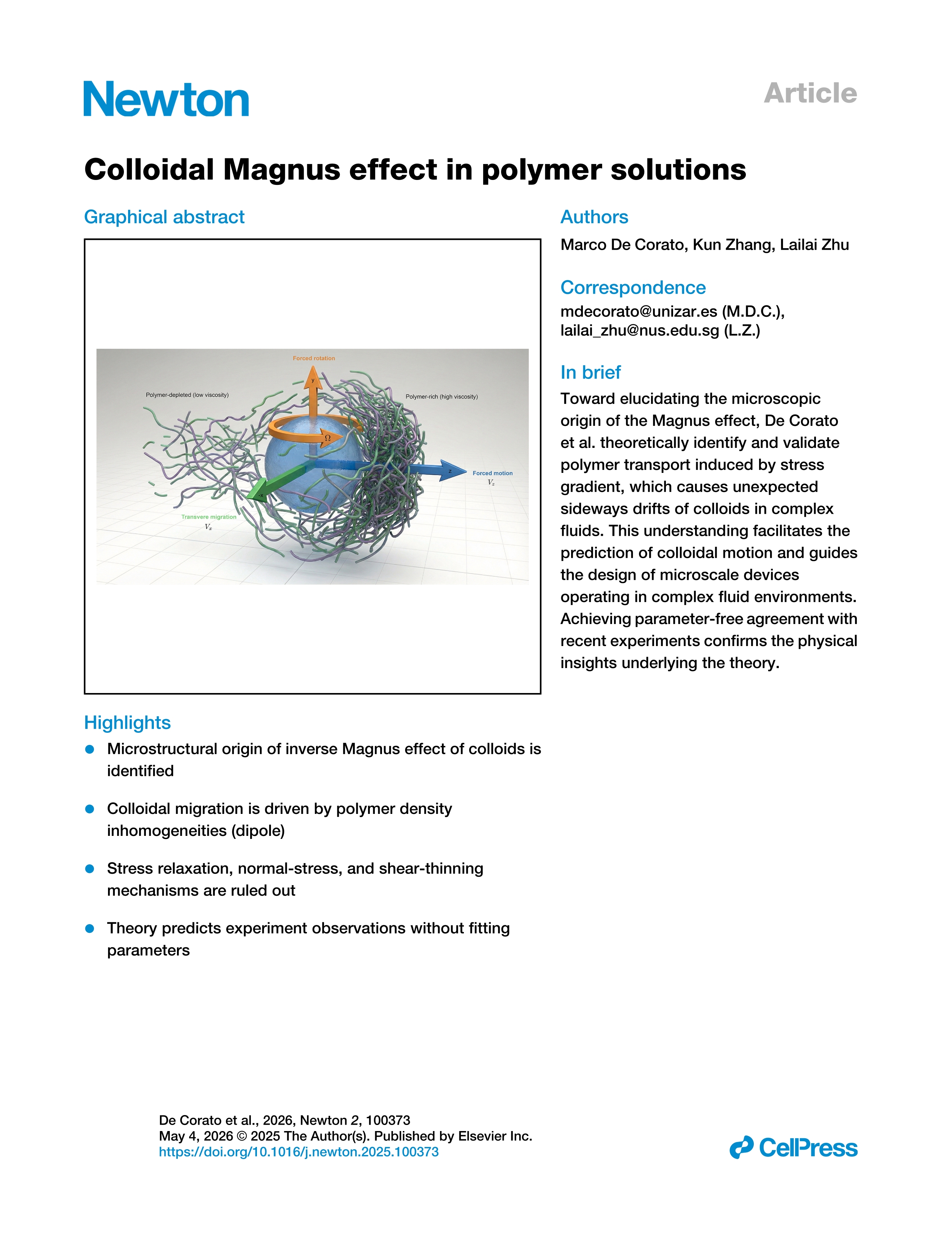
Resumen: Rotating particles moving in fluids undergo a transverse migration via the inertia-induced Magnus effect. This phenomenon vanishes at colloidal scales because inertia is negligible and the fluid flow is time reversible. Yet,
recent experiments discovered an inverse Magnus effect of colloids in polymeric and micellar solutions, supposedly because their viscoelasticity breaks the time reversibility. Our study shows that classical viscoelastic features—stress relaxation, normal-stress differences, and/or shear thinning—cannot explain this phenomenon. Instead, it originates from local polymer density inhomogeneities due to their stress-gradient-induced transport, a mechanism increasingly important at smaller scales—indeed, relevant to colloidal experiments. Incorporating this mechanism into our model leads to quantitative agreement with the experiments without fitting parameters. Our work provides new insights into colloidal motion in complex fluids with microstructural inhomogeneities, offers a simple mechanistic theory for predicting the resulting migration, and underscores the necessity of assimilating these findings in future designs of micro-machinery, such as those including swimmers, actuators, or rheometers.
Idioma: Inglés
DOI: 10.1016/j.newton.2025.100373
Año: 2026
Publicado en: Newton 2, [13 pp.] (2026), 100373
ISSN: 2950-6360
Financiación: info:eu-repo/grantAgreement/ES/MCIU/PID2022-139803NB-I00
Financiación: info:eu-repo/grantAgreement/ES/MICINN/RYC2021-030948-I
Tipo y forma: Article (Published version)
Área (Departamento): Área Mecánica de Fluidos (Dpto. Ciencia Tecnol.Mater.Fl.)
Exportado de SIDERAL (2026-03-16-08:17:31)
Visitas y descargas
recent experiments discovered an inverse Magnus effect of colloids in polymeric and micellar solutions, supposedly because their viscoelasticity breaks the time reversibility. Our study shows that classical viscoelastic features—stress relaxation, normal-stress differences, and/or shear thinning—cannot explain this phenomenon. Instead, it originates from local polymer density inhomogeneities due to their stress-gradient-induced transport, a mechanism increasingly important at smaller scales—indeed, relevant to colloidal experiments. Incorporating this mechanism into our model leads to quantitative agreement with the experiments without fitting parameters. Our work provides new insights into colloidal motion in complex fluids with microstructural inhomogeneities, offers a simple mechanistic theory for predicting the resulting migration, and underscores the necessity of assimilating these findings in future designs of micro-machinery, such as those including swimmers, actuators, or rheometers.
Idioma: Inglés
DOI: 10.1016/j.newton.2025.100373
Año: 2026
Publicado en: Newton 2, [13 pp.] (2026), 100373
ISSN: 2950-6360
Financiación: info:eu-repo/grantAgreement/ES/MCIU/PID2022-139803NB-I00
Financiación: info:eu-repo/grantAgreement/ES/MICINN/RYC2021-030948-I
Tipo y forma: Article (Published version)
Área (Departamento): Área Mecánica de Fluidos (Dpto. Ciencia Tecnol.Mater.Fl.)
Exportado de SIDERAL (2026-03-16-08:17:31)
Permalink:
Visitas y descargas
Este artículo se encuentra en las siguientes colecciones:
articulos > articulos-por-area > mecanica_de_fluidos
Notice créée le 2026-03-16, modifiée le 2026-03-16