Matrix-integrated microfluidic tumor models for evaluating drug delivery systems and pre-clinical testing
Guerrero-López, Paula (Universidad de Zaragoza) ; Alamán-Díez, Pilar (Universidad de Zaragoza) ; Hernández-Hatibi, Soraya (Universidad de Zaragoza) ; Balsas, Patricia (Universidad de Zaragoza) ; García-Aznar, José Manuel (Universidad de Zaragoza)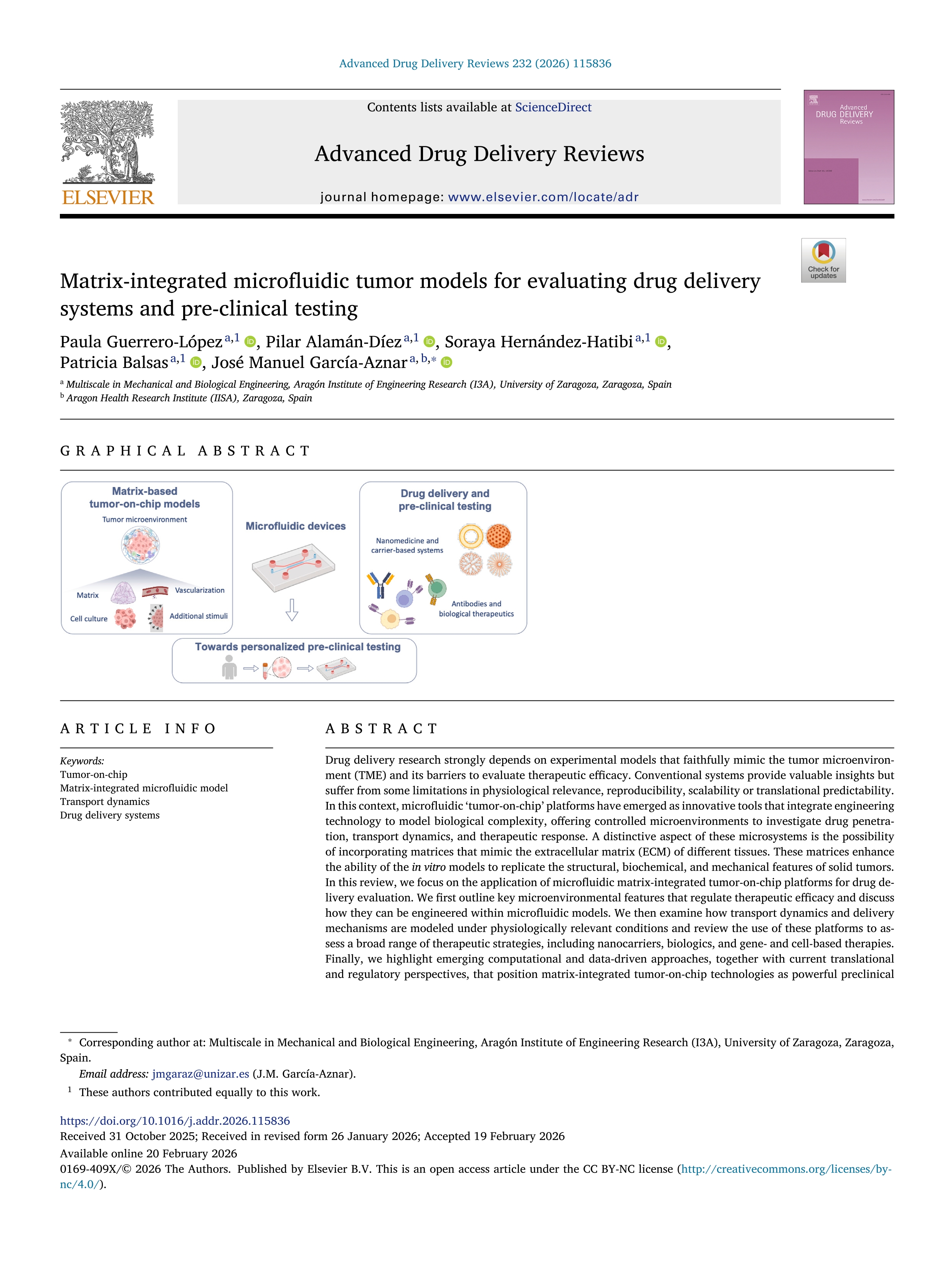

Resumen: Drug delivery research strongly depends on experimental models that faithfully mimic the tumor microenvironment (TME) and its barriers to evaluate therapeutic efficacy. Conventional systems provide valuable insights but suffer from some limitations in physiological relevance, reproducibility, scalability or translational predictability. In this context, microfluidic ‘tumor-on-chip’ platforms have emerged as innovative tools that integrate engineering technology to model biological complexity, offering controlled microenvironments to investigate drug penetration, transport dynamics, and therapeutic response. A distinctive aspect of these microsystems is the possibility of incorporating matrices that mimic the extracellular matrix (ECM) of different tissues. These matrices enhance the ability of the in vitro models to replicate the structural, biochemical, and mechanical features of solid tumors. In this review, we focus on the application of microfluidic matrix-integrated tumor-on-chip platforms for drug delivery evaluation. We first outline key microenvironmental features that regulate therapeutic efficacy and discuss how they can be engineered within microfluidic models. We then examine how transport dynamics and delivery mechanisms are modeled under physiologically relevant conditions and review the use of these platforms to assess a broad range of therapeutic strategies, including nanocarriers, biologics, and gene- and cell-based therapies. Finally, we highlight emerging computational and data-driven approaches, together with current translational and regulatory perspectives, that position matrix-integrated tumor-on-chip technologies as powerful preclinical tools. These models aim to bridge the gap between simplified in vitro assays and more complex in vivo studies, ultimately accelerating the translation of drug delivery systems into clinical practice and paving the way for more personalized therapeutic strategies.
Idioma: Inglés
DOI: 10.1016/j.addr.2026.115836
Año: 2026
Publicado en: ADVANCED DRUG DELIVERY REVIEWS 232 (2026), 115836 [24 pp.]
ISSN: 0169-409X
Financiación: info:eu-repo/grantAgreement/EC/H2020/101018587/EU/Individual and Collective Migration of the Immune Cellular System/ICoMICS
Financiación: info:eu-repo/grantAgreement/ES/MCIU/PID2024-155384OB-C21
Tipo y forma: Article (Published version)
Área (Departamento): Área Mec.Med.Cont. y Teor.Est. (Dpto. Ingeniería Mecánica)
Área (Departamento): Área Cienc.Mater. Ingen.Metal. (Dpto. Ciencia Tecnol.Mater.Fl.)
 You must give appropriate credit, provide a link to the license, and indicate if changes were made. You may do so in any reasonable manner, but not in any way that suggests the licensor endorses you or your use. You may not use the material for commercial purposes.
Exportado de SIDERAL (2026-03-16-08:17:32)
Visitas y descargas
Idioma: Inglés
DOI: 10.1016/j.addr.2026.115836
Año: 2026
Publicado en: ADVANCED DRUG DELIVERY REVIEWS 232 (2026), 115836 [24 pp.]
ISSN: 0169-409X
Financiación: info:eu-repo/grantAgreement/EC/H2020/101018587/EU/Individual and Collective Migration of the Immune Cellular System/ICoMICS
Financiación: info:eu-repo/grantAgreement/ES/MCIU/PID2024-155384OB-C21
Tipo y forma: Article (Published version)
Área (Departamento): Área Mec.Med.Cont. y Teor.Est. (Dpto. Ingeniería Mecánica)
Área (Departamento): Área Cienc.Mater. Ingen.Metal. (Dpto. Ciencia Tecnol.Mater.Fl.)
You must give appropriate credit, provide a link to the license, and indicate if changes were made. You may do so in any reasonable manner, but not in any way that suggests the licensor endorses you or your use. You may not use the material for commercial purposes. Exportado de SIDERAL (2026-03-16-08:17:32)
Permalink:
Visitas y descargas
Este artículo se encuentra en las siguientes colecciones:
Articles > Artículos por área > Ciencia de los Materiales e Ingeniería Metalúrgica
Articles > Artículos por área > Mec. de Medios Contínuos y Teor. de Estructuras
Record created 2026-03-16, last modified 2026-03-16