Physicochemical characterization of hydrochar from polyurethane foam waste: Assessing the role of processing parameters
Ciuffi, Benedetta ; Cipriani, Edoardo ; Fratini, Emiliano ; Arauzo, Jesús (Universidad de Zaragoza) ; Rosi, Luca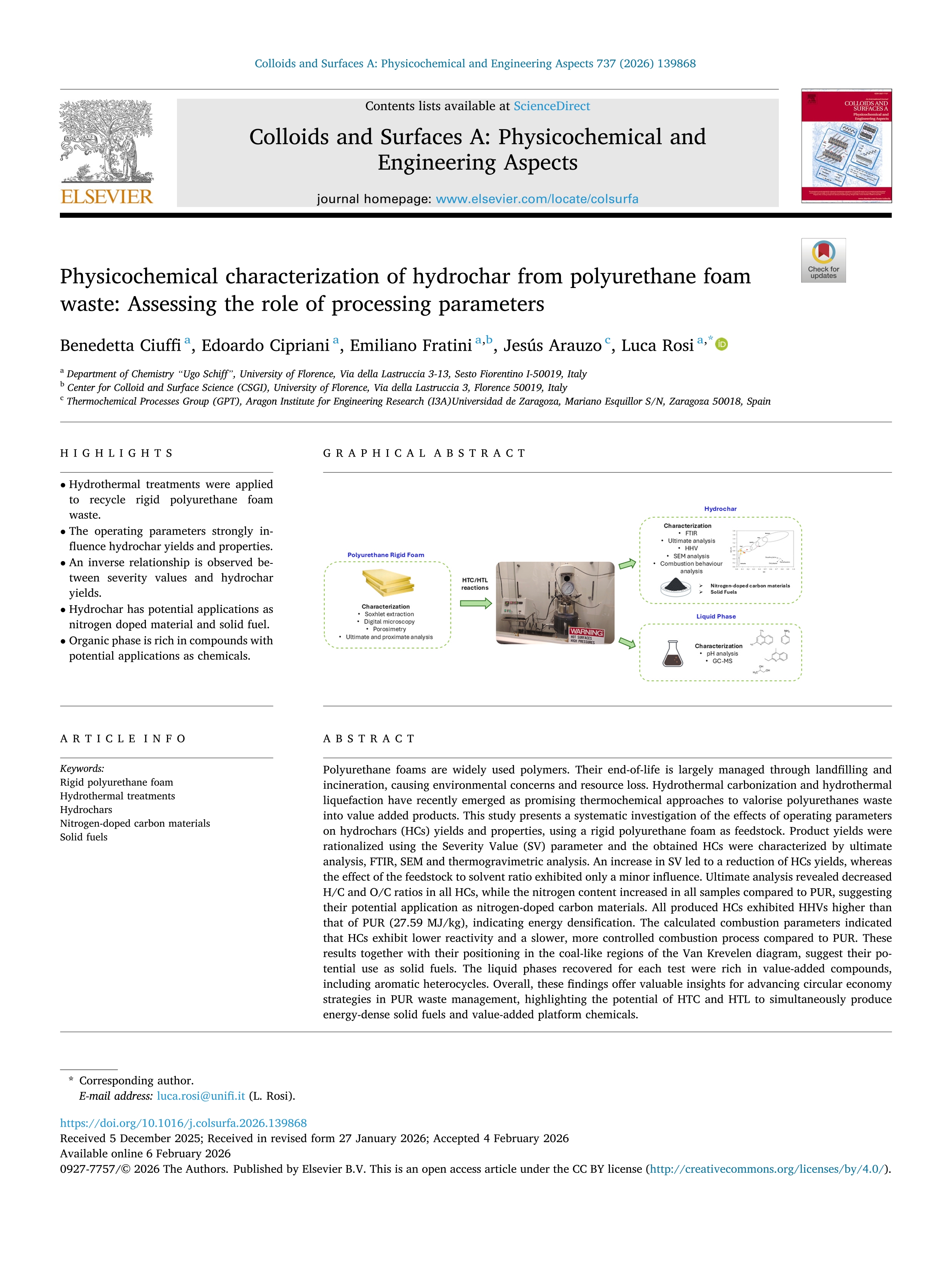
Resumen: Polyurethane foams are widely used polymers. Their end-of-life is largely managed through landfilling and incineration, causing environmental concerns and resource loss. Hydrothermal carbonization and hydrothermal liquefaction have recently emerged as promising thermochemical approaches to valorise polyurethanes waste into value added products. This study presents a systematic investigation of the effects of operating parameters on hydrochars (HCs) yields and properties, using a rigid polyurethane foam as feedstock. Product yields were rationalized using the Severity Value (SV) parameter and the obtained HCs were characterized by ultimate analysis, FTIR, SEM and thermogravimetric analysis. An increase in SV led to a reduction of HCs yields, whereas the effect of the feedstock to solvent ratio exhibited only a minor influence. Ultimate analysis revealed decreased H/C and O/C ratios in all HCs, while the nitrogen content increased in all samples compared to PUR, suggesting their potential application as nitrogen-doped carbon materials. All produced HCs exhibited HHVs higher than that of PUR (27.59 MJ/kg), indicating energy densification. The calculated combustion parameters indicated
that HCs exhibit lower reactivity and a slower, more controlled combustion process compared to PUR. These results together with their positioning in the coal-like regions of the Van Krevelen diagram, suggest their potential use as solid fuels. The liquid phases recovered for each test were rich in value-added compounds, including aromatic heterocycles. Overall, these findings offer valuable insights for advancing circular economy strategies in PUR waste management, highlighting the potential of HTC and HTL to simultaneously produce energy-dense solid fuels and value-added platform chemicals.
Idioma: Inglés
DOI: 10.1016/j.colsurfa.2026.139868
Año: 2026
Publicado en: Colloids and Surfaces A: Physicochemical and Engineering Aspects 737 (2026), 139868 [14 pp.]
ISSN: 0927-7757
Tipo y forma: Article (Published version)
Área (Departamento): Área Ingeniería Química (Dpto. Ing.Quím.Tecnol.Med.Amb.)
 You must give appropriate credit, provide a link to the license, and indicate if changes were made. You may do so in any reasonable manner, but not in any way that suggests the licensor endorses you or your use.
Exportado de SIDERAL (2026-03-16-08:17:52)
Visitas y descargas
that HCs exhibit lower reactivity and a slower, more controlled combustion process compared to PUR. These results together with their positioning in the coal-like regions of the Van Krevelen diagram, suggest their potential use as solid fuels. The liquid phases recovered for each test were rich in value-added compounds, including aromatic heterocycles. Overall, these findings offer valuable insights for advancing circular economy strategies in PUR waste management, highlighting the potential of HTC and HTL to simultaneously produce energy-dense solid fuels and value-added platform chemicals.
Idioma: Inglés
DOI: 10.1016/j.colsurfa.2026.139868
Año: 2026
Publicado en: Colloids and Surfaces A: Physicochemical and Engineering Aspects 737 (2026), 139868 [14 pp.]
ISSN: 0927-7757
Tipo y forma: Article (Published version)
Área (Departamento): Área Ingeniería Química (Dpto. Ing.Quím.Tecnol.Med.Amb.)
You must give appropriate credit, provide a link to the license, and indicate if changes were made. You may do so in any reasonable manner, but not in any way that suggests the licensor endorses you or your use. Exportado de SIDERAL (2026-03-16-08:17:52)
Permalink:
Visitas y descargas
Este artículo se encuentra en las siguientes colecciones:
Articles > Artículos por área > Ingeniería Química
Record created 2026-03-16, last modified 2026-03-16