Biogenesis of Au Nanoparticles from Plant-Derived Metabolites – In Vitro and In Vivo StudiesClick to copy article link
Kulczynska, Julia ; Topa, Natalia ; Widziolek, Magdalena ; Homa, Joanna ; Kwiecien, Inga ; Gamez, Enrique ; Arruebo, Manuel (Universidad de Zaragoza) ; Kyziol, Agnieszka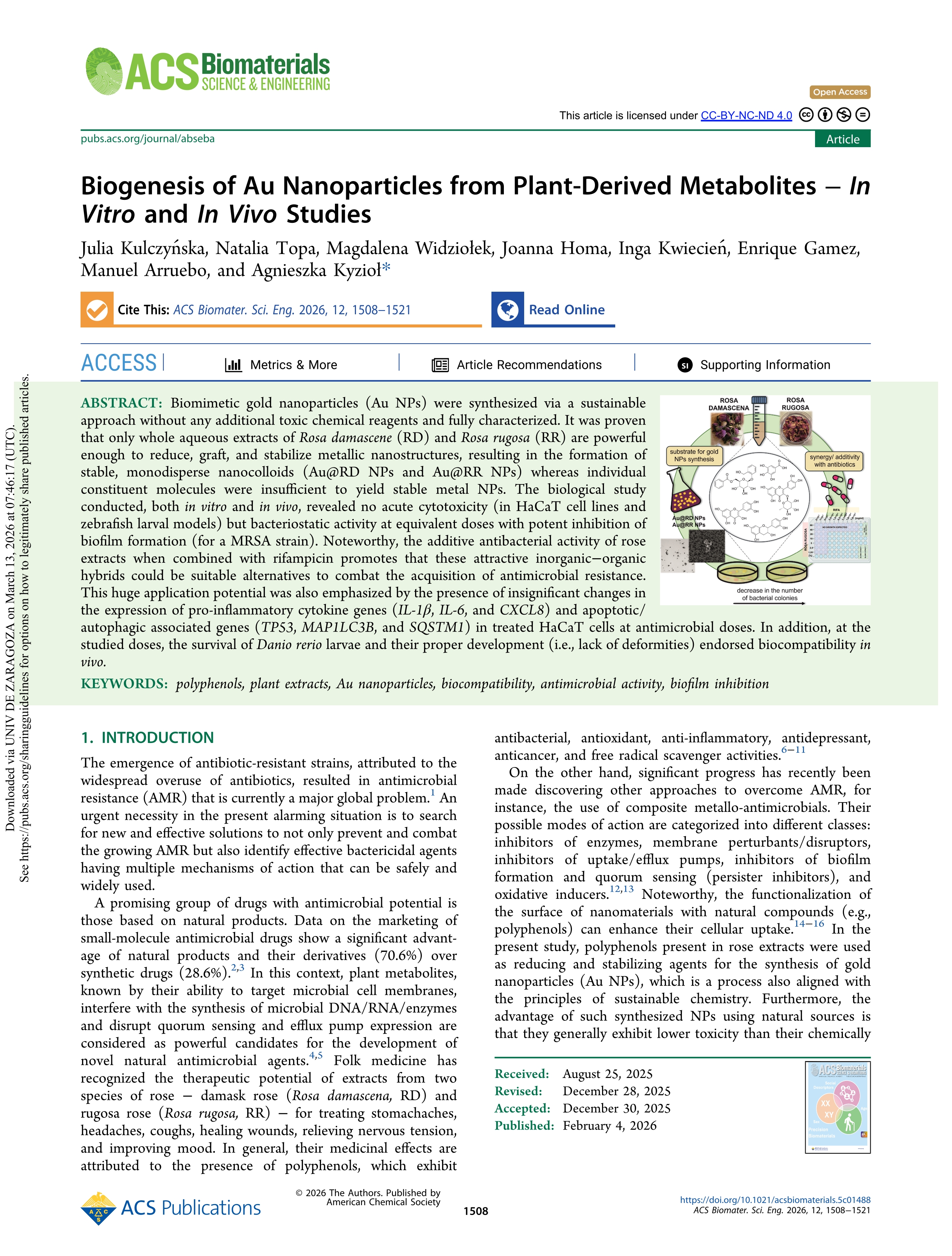
Resumen: Biomimetic gold nanoparticles (Au NPs) were synthesized via a sustainable approach without any additional toxic chemical reagents and fully characterized. It was proven that only whole aqueous extracts of Rosa damascene (RD) and Rosa rugosa (RR) are powerful enough to reduce, graft, and stabilize metallic nanostructures, resulting in the formation of stable, monodisperse nanocolloids (Au@RD NPs and Au@RR NPs) whereas individual constituent molecules were insufficient to yield stable metal NPs. The biological study conducted, both in vitro and in vivo, revealed no acute cytotoxicity (in HaCaT cell lines and zebrafish larval models) but bacteriostatic activity at equivalent doses with potent inhibition of biofilm formation (for a MRSA strain). Noteworthy, the additive antibacterial activity of rose extracts when combined with rifampicin promotes that these attractive inorganic–organic hybrids could be suitable alternatives to combat the acquisition of antimicrobial resistance. This huge application potential was also emphasized by the presence of insignificant changes in the expression of pro-inflammatory cytokine genes (IL-1β, IL-6, and CXCL8) and apoptotic/autophagic associated genes (TP53, MAP1LC3B, and SQSTM1) in treated HaCaT cells at antimicrobial doses. In addition, at the studied doses, the survival of Danio rerio larvae and their proper development (i.e., lack of deformities) endorsed biocompatibility in vivo.
Idioma: Inglés
DOI: 10.1021/acsbiomaterials.5c01488
Año: 2026
Publicado en: ACS BIOMATERIALS SCIENCE & ENGINEERING 12, 3 (2026), 1508-1521
ISSN: 2373-9878
Financiación: info:eu-repo/grantAgreement/ES/AEI/CEX2023-001286-S
Financiación: info:eu-repo/grantAgreement/ES/MICINN/PID2023-146091OB-I00
Tipo y forma: Article (Published version)
Área (Departamento): Área Ingeniería Química (Dpto. Ing.Quím.Tecnol.Med.Amb.)
 You must give appropriate credit, provide a link to the license, and indicate if changes were made. You may do so in any reasonable manner, but not in any way that suggests the licensor endorses you or your use. You may not use the material for commercial purposes. If you remix, transform, or build upon the material, you may not distribute the modified material.
Exportado de SIDERAL (2026-03-16-08:18:04)
Visitas y descargas
Idioma: Inglés
DOI: 10.1021/acsbiomaterials.5c01488
Año: 2026
Publicado en: ACS BIOMATERIALS SCIENCE & ENGINEERING 12, 3 (2026), 1508-1521
ISSN: 2373-9878
Financiación: info:eu-repo/grantAgreement/ES/AEI/CEX2023-001286-S
Financiación: info:eu-repo/grantAgreement/ES/MICINN/PID2023-146091OB-I00
Tipo y forma: Article (Published version)
Área (Departamento): Área Ingeniería Química (Dpto. Ing.Quím.Tecnol.Med.Amb.)
You must give appropriate credit, provide a link to the license, and indicate if changes were made. You may do so in any reasonable manner, but not in any way that suggests the licensor endorses you or your use. You may not use the material for commercial purposes. If you remix, transform, or build upon the material, you may not distribute the modified material. Exportado de SIDERAL (2026-03-16-08:18:04)
Permalink:
Visitas y descargas
Este artículo se encuentra en las siguientes colecciones:
Articles > Artículos por área > Ingeniería Química
Record created 2026-03-16, last modified 2026-03-16