Multisite phosphorylation of the AML-linked C-terminal of nucleophosmin (NPM1) orchestrates protein stability, DNA binding and charge block-driven phase separation
Rivero-García, Pablo ; Giner-Arroyo, Rafael L ; Tamargo-Azpilicueta, Joaquín ; Telfer, Abbey ; Frezza , Elisa ; Velázquez-Campoy, Adrián (Universidad de Zaragoza) ; Díaz-Moreno, Sofía ; De la Rosa, Miguel A. ; Díaz-Moreno, Irene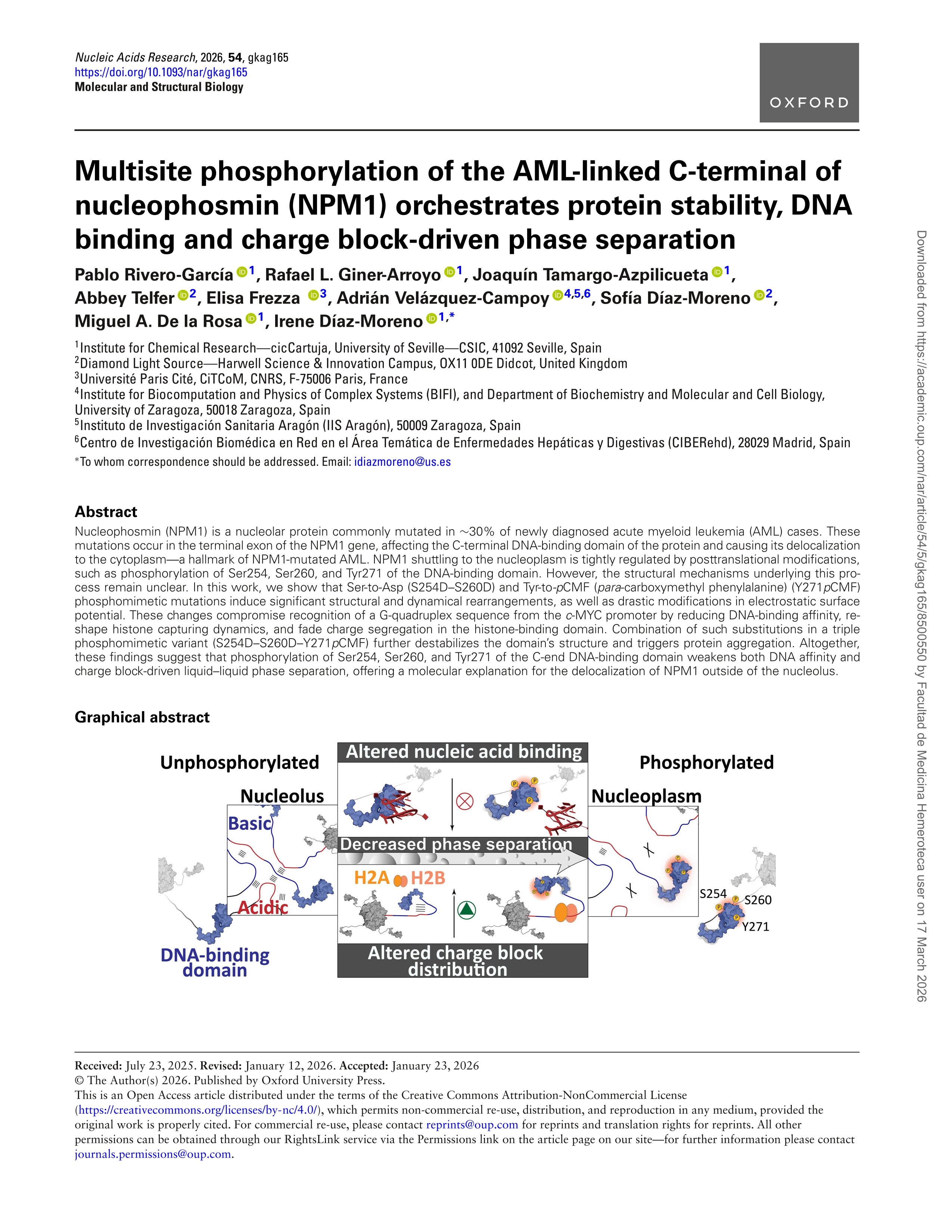
Resumen: Nucleophosmin (NPM1) is a nucleolar protein commonly mutated in ~30% of newly diagnosed acute myeloid leukemia (AML) cases. These mutations occur in the terminal exon of the NPM1 gene, affecting the C-terminal DNA-binding domain of the protein and causing its delocalization to the cytoplasm—a hallmark of NPM1-mutated AML. NPM1 shuttling to the nucleoplasm is tightly regulated by posttranslational modifications, such as phosphorylation of Ser254, Ser260, and Tyr271 of the DNA-binding domain. However, the structural mechanisms underlying this process remain unclear. In this work, we show that Ser-to-Asp (S254D–S260D) and Tyr-to-pCMF (para-carboxymethyl phenylalanine) (Y271pCMF) phosphomimetic mutations induce significant structural and dynamical rearrangements, as well as drastic modifications in electrostatic surface potential. These changes compromise recognition of a G-quadruplex sequence from the c-MYC promoter by reducing DNA-binding affinity, reshape histone capturing dynamics, and fade charge segregation in the histone-binding domain. Combination of such substitutions in a triple phosphomimetic variant (S254D–S260D–Y271pCMF) further destabilizes the domain’s structure and triggers protein aggregation. Altogether, these findings suggest that phosphorylation of Ser254, Ser260, and Tyr271 of the C-end DNA-binding domain weakens both DNA affinity and charge block-driven liquid–liquid phase separation, offering a molecular explanation for the delocalization of NPM1 outside of the nucleolus.
Idioma: Inglés
DOI: 10.1093/nar/gkag165
Año: 2026
Publicado en: Nucleic Acids Research 54, 5 (2026), 17 pp.
ISSN: 0305-1048
Financiación: info:eu-repo/grantAgreement/ES/CSIC/JAEINT24-EX-0171
Financiación: info:eu-repo/grantAgreement/ES/MCIU/PID2024-157414NB-I00
Tipo y forma: Artículo (Versión definitiva)
Área (Departamento): Área Bioquímica y Biolog.Mole. (Dpto. Bioq.Biolog.Mol. Celular)
 Debe reconocer adecuadamente la autoría, proporcionar un enlace a la licencia e indicar si se han realizado cambios. Puede hacerlo de cualquier manera razonable, pero no de una manera que sugiera que tiene el apoyo del licenciador o lo recibe por el uso que hace. No puede utilizar el material para una finalidad comercial.
Exportado de SIDERAL (2026-03-18-13:52:38)
Visitas y descargas
Idioma: Inglés
DOI: 10.1093/nar/gkag165
Año: 2026
Publicado en: Nucleic Acids Research 54, 5 (2026), 17 pp.
ISSN: 0305-1048
Financiación: info:eu-repo/grantAgreement/ES/CSIC/JAEINT24-EX-0171
Financiación: info:eu-repo/grantAgreement/ES/MCIU/PID2024-157414NB-I00
Tipo y forma: Artículo (Versión definitiva)
Área (Departamento): Área Bioquímica y Biolog.Mole. (Dpto. Bioq.Biolog.Mol. Celular)
Debe reconocer adecuadamente la autoría, proporcionar un enlace a la licencia e indicar si se han realizado cambios. Puede hacerlo de cualquier manera razonable, pero no de una manera que sugiera que tiene el apoyo del licenciador o lo recibe por el uso que hace. No puede utilizar el material para una finalidad comercial.Exportado de SIDERAL (2026-03-18-13:52:38)
Enlace permanente:
Visitas y descargas
Este artículo se encuentra en las siguientes colecciones:
Artículos > Artículos por área > Bioquímica y Biología Molecular
Registro creado el 2026-03-18, última modificación el 2026-03-18