Evaluating the Usefulness and Ease of Use of a Next-Generation–Connected Drug Delivery Device for Growth Hormone Therapy: Qualitative Study of Health Care Professionals’ Perceptions
Labarta, José I. (Universidad de Zaragoza) ; Dimitri, Paul ; Keiser, Matthew ; Koledova, Ekaterina ; Rivera-Romero, Octavio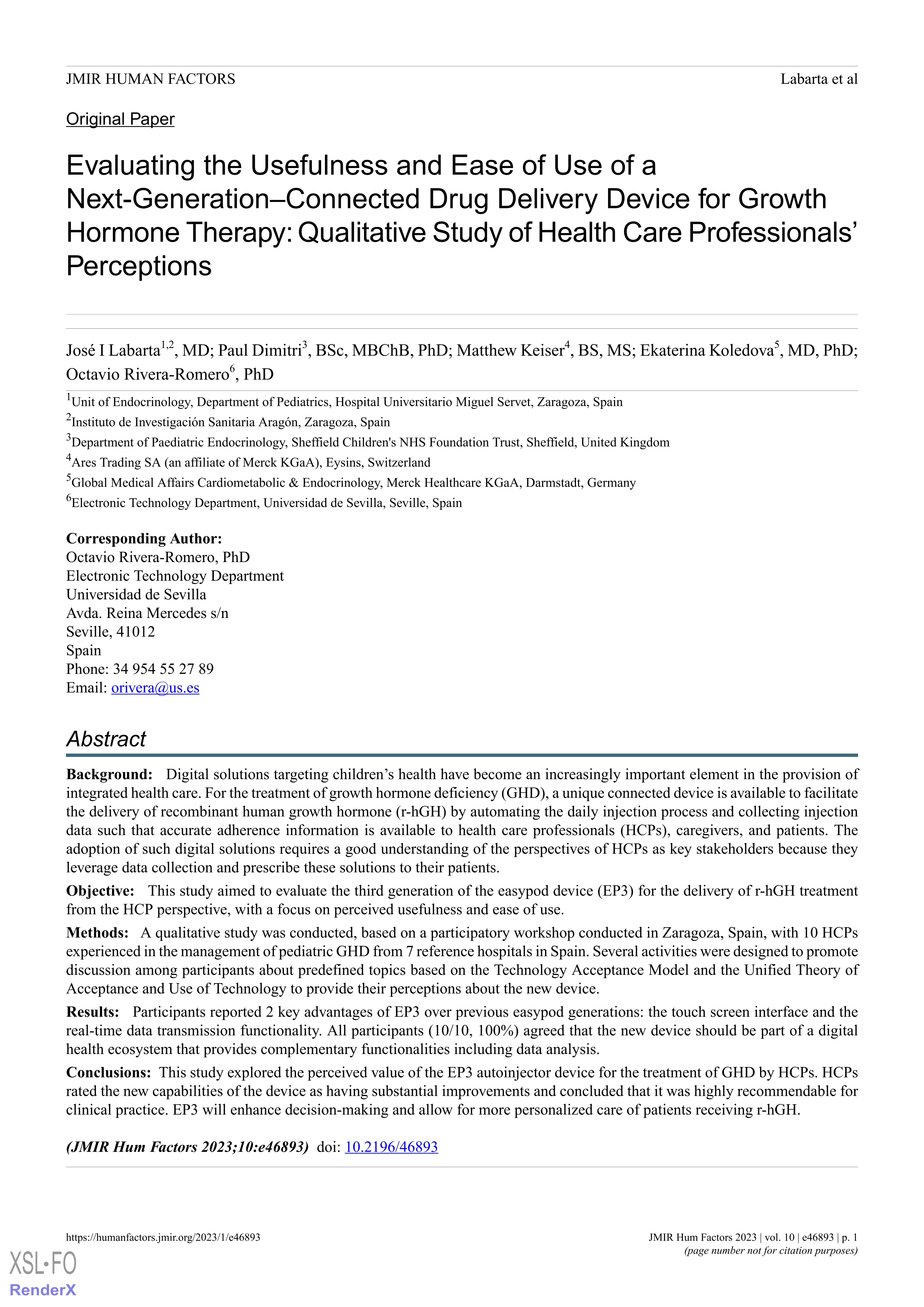
Resumen: Background: Digital solutions targeting children’s health have become an increasingly important element in the provision of integrated health care. For the treatment of growth hormone deficiency (GHD), a unique connected device is available to facilitate the delivery of recombinant human growth hormone (r-hGH) by automating the daily injection process and collecting injection data such that accurate adherence information is available to health care professionals (HCPs), caregivers, and patients. The adoption of such digital solutions requires a good understanding of the perspectives of HCPs as key stakeholders because they leverage data collection and prescribe these solutions to their patients.
Objective: This study aimed to evaluate the third generation of the easypod device (EP3) for the delivery of r-hGH treatment from the HCP perspective, with a focus on perceived usefulness and ease of use.
Methods: A qualitative study was conducted, based on a participatory workshop conducted in Zaragoza, Spain, with 10 HCPs experienced in the management of pediatric GHD from 7 reference hospitals in Spain. Several activities were designed to promote discussion among participants about predefined topics based on the Technology Acceptance Model and the Unified Theory of Acceptance and Use of Technology to provide their perceptions about the new device.
Results: Participants reported 2 key advantages of EP3 over previous easypod generations: the touch screen interface and the real-time data transmission functionality. All participants (10/10, 100%) agreed that the new device should be part of a digital health ecosystem that provides complementary functionalities including data analysis.
Conclusions: This study explored the perceived value of the EP3 autoinjector device for the treatment of GHD by HCPs. HCPs rated the new capabilities of the device as having substantial improvements and concluded that it was highly recommendable for clinical practice. EP3 will enhance decision-making and allow for more personalized care of patients receiving r-hGH.
Idioma: Inglés
DOI: 10.2196/46893
Año: 2023
Publicado en: JMIR Human Factors 10 (2023), e46893 [15 pp.]
ISSN: 2292-9495
Factor impacto CITESCORE: 3.4 - Human Factors and Ergonomics (Q2) - Health Informatics (Q3)
Factor impacto SCIMAGO: 0.777 - Human Factors and Ergonomics (Q2) - Health Informatics (Q2)
Tipo y forma: Artículo (Versión definitiva)
Área (Departamento): Área Pediatría (Dpto. Microb.Ped.Radio.Sal.Pú.)
 Debe reconocer adecuadamente la autoría, proporcionar un enlace a la licencia e indicar si se han realizado cambios. Puede hacerlo de cualquier manera razonable, pero no de una manera que sugiera que tiene el apoyo del licenciador o lo recibe por el uso que hace.
Exportado de SIDERAL (2026-03-18-13:52:43)
Visitas y descargas
Objective: This study aimed to evaluate the third generation of the easypod device (EP3) for the delivery of r-hGH treatment from the HCP perspective, with a focus on perceived usefulness and ease of use.
Methods: A qualitative study was conducted, based on a participatory workshop conducted in Zaragoza, Spain, with 10 HCPs experienced in the management of pediatric GHD from 7 reference hospitals in Spain. Several activities were designed to promote discussion among participants about predefined topics based on the Technology Acceptance Model and the Unified Theory of Acceptance and Use of Technology to provide their perceptions about the new device.
Results: Participants reported 2 key advantages of EP3 over previous easypod generations: the touch screen interface and the real-time data transmission functionality. All participants (10/10, 100%) agreed that the new device should be part of a digital health ecosystem that provides complementary functionalities including data analysis.
Conclusions: This study explored the perceived value of the EP3 autoinjector device for the treatment of GHD by HCPs. HCPs rated the new capabilities of the device as having substantial improvements and concluded that it was highly recommendable for clinical practice. EP3 will enhance decision-making and allow for more personalized care of patients receiving r-hGH.
Idioma: Inglés
DOI: 10.2196/46893
Año: 2023
Publicado en: JMIR Human Factors 10 (2023), e46893 [15 pp.]
ISSN: 2292-9495
Factor impacto CITESCORE: 3.4 - Human Factors and Ergonomics (Q2) - Health Informatics (Q3)
Factor impacto SCIMAGO: 0.777 - Human Factors and Ergonomics (Q2) - Health Informatics (Q2)
Tipo y forma: Artículo (Versión definitiva)
Área (Departamento): Área Pediatría (Dpto. Microb.Ped.Radio.Sal.Pú.)
Debe reconocer adecuadamente la autoría, proporcionar un enlace a la licencia e indicar si se han realizado cambios. Puede hacerlo de cualquier manera razonable, pero no de una manera que sugiera que tiene el apoyo del licenciador o lo recibe por el uso que hace. Exportado de SIDERAL (2026-03-18-13:52:43)
Enlace permanente:
Visitas y descargas
Este artículo se encuentra en las siguientes colecciones:
Artículos > Artículos por área > Pediatría
Registro creado el 2026-03-18, última modificación el 2026-03-18