Promoting active outdoor play and healthy dietary behaviours through the co-creation of supporting physical and social environments for and with primary school-aged children living in underserved neighbourhoods in Europe: the protocol of the B-Challenged project
Altenburg, Teatske M ; Pawlowski, Charlotte S ; Ahrens, Wolfgang ; Brand, Tilman ; Buck, Christoph ; Börnhorst, Claudia ; Dzielska, Anna ; Klaufus, Leonie ; Miguel-Etayo, Pilar de ; Moreno, Luis (Universidad de Zaragoza) ; Okulicz-Kozaryn, Katarzyna ; Vrijkotte, Tanja G M ; Wink, Renée ; Belmon, Laura S ; Chinapaw, Mai J M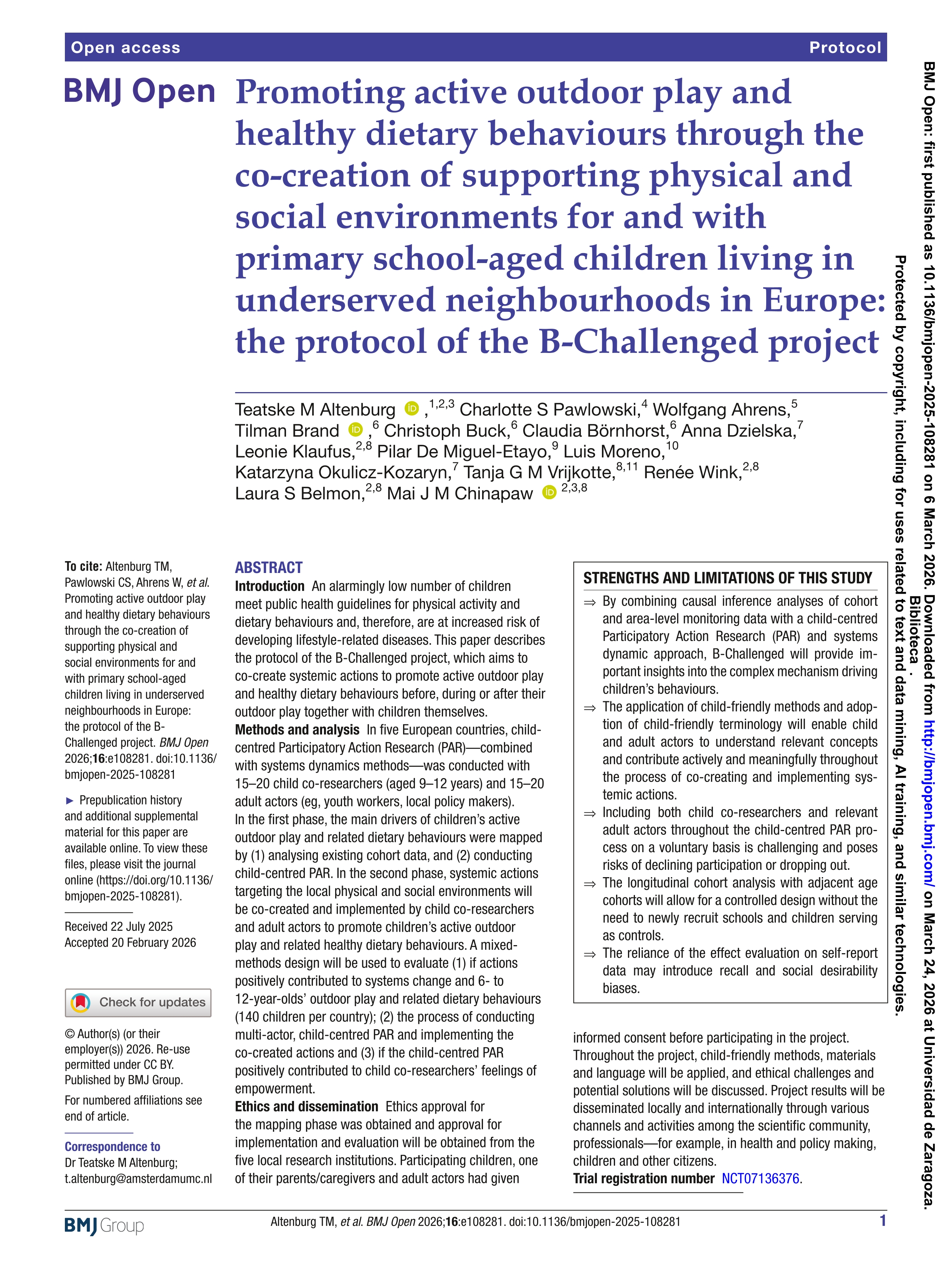

Resumen: Introduction An alarmingly low number of children meet public health guidelines for physical activity and dietary behaviours and, therefore, are at increased risk of developing lifestyle-related diseases. This paper describes the protocol of the B-Challenged project, which aims to co-create systemic actions to promote active outdoor play and healthy dietary behaviours before, during or after their outdoor play together with children themselves.
Methods and analysis In five European countries, child-centred Participatory Action Research (PAR)—combined with systems dynamics methods—was conducted with 15–20 child co-researchers (aged 9–12 years) and 15–20 adult actors (eg, youth workers, local policy makers). In the first phase, the main drivers of children’s active outdoor play and related dietary behaviours were mapped by (1) analysing existing cohort data, and (2) conducting child-centred PAR. In the second phase, systemic actions targeting the local physical and social environments will be co-created and implemented by child co-researchers and adult actors to promote children’s active outdoor play and related healthy dietary behaviours. A mixed-methods design will be used to evaluate (1) if actions positively contributed to systems change and 6- to 12-year-olds’ outdoor play and related dietary behaviours (140 children per country); (2) the process of conducting multi-actor, child-centred PAR and implementing the co-created actions and (3) if the child-centred PAR positively contributed to child co-researchers’ feelings of empowerment.
Ethics and dissemination Ethics approval for the mapping phase was obtained and approval for implementation and evaluation will be obtained from the five local research institutions. Participating children, one of their parents/caregivers and adult actors had given informed consent before participating in the project. Throughout the project, child-friendly methods, materials and language will be applied, and ethical challenges and potential solutions will be discussed. Project results will be disseminated locally and internationally through various channels and activities among the scientific community, professionals—for example, in health and policy making, children and other citizens.
Idioma: Inglés
DOI: 10.1136/bmjopen-2025-108281
Año: 2026
Publicado en: BMJ Open 16, 3 (2026), e108281 [11 pp.]
ISSN: 2044-6055
Financiación: info:eu-repo/grantAgreement/EC/H2020/101095426/EU/Fostering a European Research Area for Health Research/ERA4Health
Tipo y forma: Article (Published version)
Área (Departamento): Área Enfermería (Dpto. Fisiatría y Enfermería)
 You must give appropriate credit, provide a link to the license, and indicate if changes were made. You may do so in any reasonable manner, but not in any way that suggests the licensor endorses you or your use.
Exportado de SIDERAL (2026-03-26-14:31:02)
Visitas y descargas
Methods and analysis In five European countries, child-centred Participatory Action Research (PAR)—combined with systems dynamics methods—was conducted with 15–20 child co-researchers (aged 9–12 years) and 15–20 adult actors (eg, youth workers, local policy makers). In the first phase, the main drivers of children’s active outdoor play and related dietary behaviours were mapped by (1) analysing existing cohort data, and (2) conducting child-centred PAR. In the second phase, systemic actions targeting the local physical and social environments will be co-created and implemented by child co-researchers and adult actors to promote children’s active outdoor play and related healthy dietary behaviours. A mixed-methods design will be used to evaluate (1) if actions positively contributed to systems change and 6- to 12-year-olds’ outdoor play and related dietary behaviours (140 children per country); (2) the process of conducting multi-actor, child-centred PAR and implementing the co-created actions and (3) if the child-centred PAR positively contributed to child co-researchers’ feelings of empowerment.
Ethics and dissemination Ethics approval for the mapping phase was obtained and approval for implementation and evaluation will be obtained from the five local research institutions. Participating children, one of their parents/caregivers and adult actors had given informed consent before participating in the project. Throughout the project, child-friendly methods, materials and language will be applied, and ethical challenges and potential solutions will be discussed. Project results will be disseminated locally and internationally through various channels and activities among the scientific community, professionals—for example, in health and policy making, children and other citizens.
Idioma: Inglés
DOI: 10.1136/bmjopen-2025-108281
Año: 2026
Publicado en: BMJ Open 16, 3 (2026), e108281 [11 pp.]
ISSN: 2044-6055
Financiación: info:eu-repo/grantAgreement/EC/H2020/101095426/EU/Fostering a European Research Area for Health Research/ERA4Health
Tipo y forma: Article (Published version)
Área (Departamento): Área Enfermería (Dpto. Fisiatría y Enfermería)
You must give appropriate credit, provide a link to the license, and indicate if changes were made. You may do so in any reasonable manner, but not in any way that suggests the licensor endorses you or your use. Exportado de SIDERAL (2026-03-26-14:31:02)
Permalink:
Visitas y descargas
Este artículo se encuentra en las siguientes colecciones:
Articles > Artículos por área > Enfermería
Record created 2026-03-26, last modified 2026-04-07