How eating behaviours associate to body composition in European adolescents: a cross-sectional analysis from the HELENA study
Jimeno-Martínez, Andrea ; Seral-Cortés, Miguel (Universidad de Zaragoza) ; Maneschy, Ivie ; Rupérez, Azahara I. ; Widhalm, Kurt ; Kafatos, Anthony ; Molina-Hidalgo, Cristina ; González-Gross, Marcela ; Gómez-Martínez, Sonia ; Nova, Esther ; De Henauw, Stefaan ; Molnár, Dénes ; Roccaldo, Romana ; Béghin, Laurent ; Kersting, Mathilde ; Breidenassel, Christina ; Manios, Yannis ; Gutierrez, Angel ; Arnaoutis, Giannis ; Moreno, Luis A. (Universidad de Zaragoza) ; HELENA Study Group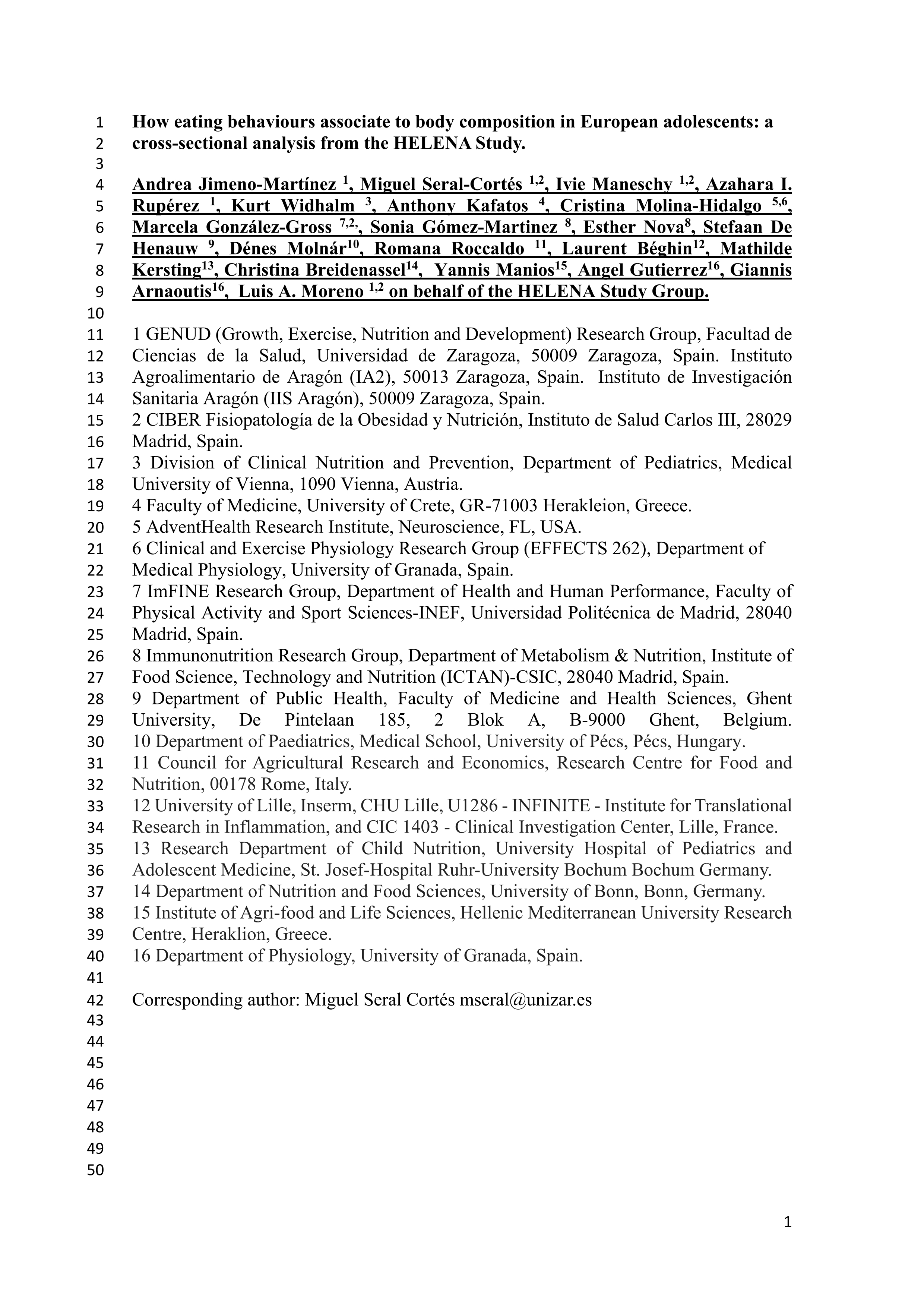

Resumen: Background
Adolescence is a key developmental stage marked by physiological and behavioural changes. Eating behaviour, modifiable and sex-dependent, may be altered and linked to future health issues. This cross-sectional study aims to assess whether eating behaviours and body composition are associated in an adolescent sample.
Methods
Participants aged 12.5–17.5 years were recruited from 10 European cities, with valid data on age, sex, socio-demographic status, body composition and physical activity and who had also completed the specific eating behaviour questionnaire “Eating Behaviour and Weight Problems Inventory for Children”. Different linear regression models were adjusted for relevant confounders, and ANCOVA models were performed.
Results
Eating Behaviours related to weight concerns, dietary restraint, emotional eating, fear of weight gain, healthy nutrition and figure dissatisfaction were strongly positively associated with higher Body Mass Index (BMI), Fat Mass Index (FMI) and Waist Circumference (WC), especially in males (betas resulting from the association between these behavioural subscales and body composition in males, ranged from 0.174 to 0.974 for BMI, 0.172 to 0.930 for FMI, and 0.128 to 0.889 for WC). The strongest association was detected in the weight concerns subscale for both males and females.
Conclusion
Eating behaviours across all domains are significantly linked to body composition, with variations depending on the specific behavioural domain and the adolescent’s sex. These findings are critical for identifying specific behavioural patterns that contribute to obesity and related health issues, providing new insights for more targeted prevention strategies during this crucial stage of development.
Idioma: Inglés
DOI: 10.1038/s41430-026-01709-2
Año: 2026
Publicado en: European Journal of Clinical Nutrition
ISSN: 0954-3007
Financiación: info:eu-repo/grantAgreement/EUR/FP6/FOOD-CT-2005-007034
Tipo y forma: Article (PostPrint)
Área (Departamento): Área Enfermería (Dpto. Fisiatría y Enfermería)
 All rights reserved by journal editor
Exportado de SIDERAL (2026-03-26-14:31:12)
Visitas y descargas
Adolescence is a key developmental stage marked by physiological and behavioural changes. Eating behaviour, modifiable and sex-dependent, may be altered and linked to future health issues. This cross-sectional study aims to assess whether eating behaviours and body composition are associated in an adolescent sample.
Methods
Participants aged 12.5–17.5 years were recruited from 10 European cities, with valid data on age, sex, socio-demographic status, body composition and physical activity and who had also completed the specific eating behaviour questionnaire “Eating Behaviour and Weight Problems Inventory for Children”. Different linear regression models were adjusted for relevant confounders, and ANCOVA models were performed.
Results
Eating Behaviours related to weight concerns, dietary restraint, emotional eating, fear of weight gain, healthy nutrition and figure dissatisfaction were strongly positively associated with higher Body Mass Index (BMI), Fat Mass Index (FMI) and Waist Circumference (WC), especially in males (betas resulting from the association between these behavioural subscales and body composition in males, ranged from 0.174 to 0.974 for BMI, 0.172 to 0.930 for FMI, and 0.128 to 0.889 for WC). The strongest association was detected in the weight concerns subscale for both males and females.
Conclusion
Eating behaviours across all domains are significantly linked to body composition, with variations depending on the specific behavioural domain and the adolescent’s sex. These findings are critical for identifying specific behavioural patterns that contribute to obesity and related health issues, providing new insights for more targeted prevention strategies during this crucial stage of development.
Idioma: Inglés
DOI: 10.1038/s41430-026-01709-2
Año: 2026
Publicado en: European Journal of Clinical Nutrition
ISSN: 0954-3007
Financiación: info:eu-repo/grantAgreement/EUR/FP6/FOOD-CT-2005-007034
Tipo y forma: Article (PostPrint)
Área (Departamento): Área Enfermería (Dpto. Fisiatría y Enfermería)
All rights reserved by journal editorExportado de SIDERAL (2026-03-26-14:31:12)
Permalink:
Visitas y descargas
Este artículo se encuentra en las siguientes colecciones:
Articles > Artículos por área > Enfermería
Record created 2026-03-26, last modified 2026-04-07