Structure and magnetism of mixed-valent iron oxysulfides Sr3Fe4O6S2 (Sr3(Fe3+)2O5(Fe2+)2OS2) and Sr4Fe4O7S2 (Sr4(Fe3+)2O6(Fe2+)2OS2)
Gillette, Alexis N. ; Lyon, Annabel R. ; Savvin, Stanislav ; Puente-Orench, Ines ; Rahimisheikh, Sepideh ; Hadermann, Joke ; Gimeno, Magali ; Neidig, Michael L. ; Clarke, Simon J.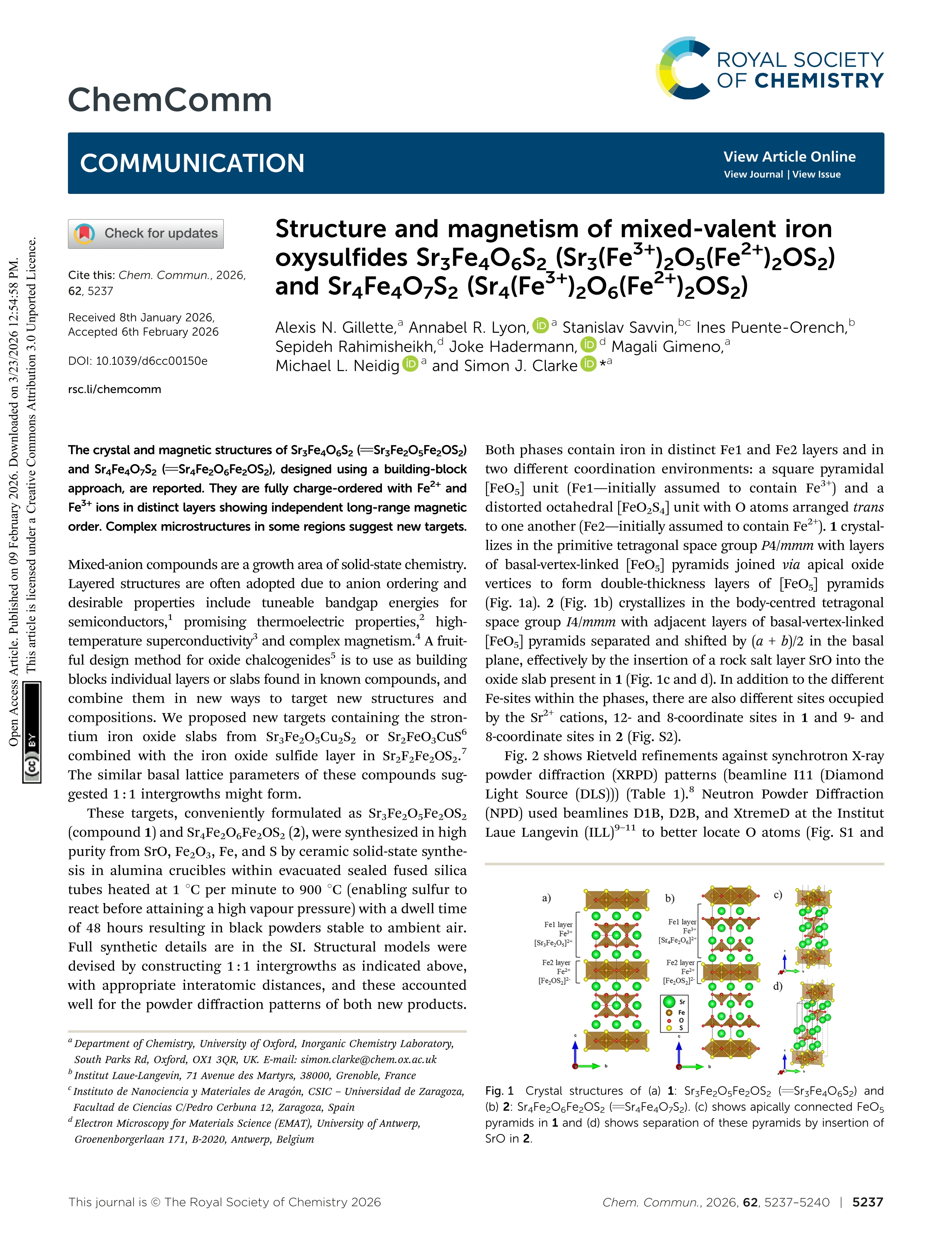
Resumen: The crystal and magnetic structures of Sr3Fe4O6S2 ([double bond, length as m-dash]Sr3Fe2O5Fe2OS2) and Sr4Fe4O7S2 ([double bond, length as m-dash]Sr4Fe2O6Fe2OS2), designed using a building-block approach, are reported. They are fully charge-ordered with Fe2+ and Fe3+ ions in distinct layers showing independent long-range magnetic order. Complex microstructures in some regions suggest new targets. Mixed-anion compounds are a growth area of solid-state chemistry. Layered structures are often adopted due to anion ordering and desirable properties include tuneable bandgap energies for semiconductors,1 promising thermoelectric properties,2 high-temperature superconductivity3 and complex magnetism.4 A fruitful design method for oxide chalcogenides5 is to use as building blocks individual layers or slabs found in known compounds, and combine them in new ways to target new structures and compositions. We proposed new targets containing the strontium iron oxide slabs from Sr3Fe2O5Cu2S2 or Sr2FeO3CuS6 combined with the iron oxide sulfide layer in Sr2F2Fe2OS2.7 The similar basal lattice parameters of these compounds suggested 1 : 1 intergrowths might form. These targets, conveniently formulated as Sr3Fe2O5Fe2OS2 (compound 1) and Sr4Fe2O6Fe2OS2 (2), were synthesized in high purity from SrO, Fe2O3, Fe, and S by ceramic solid-state synthesis in alumina crucibles within evacuated sealed fused silica tubes heated at 1 °C per minute to 900 °C (enabling sulfur to react before attaining a high vapour pressure) with a dwell time of 48 hours resulting in black powders stable to ambient air. Full synthetic details are in the SI. Structural models were devised by constructing 1 : 1 intergrowths as indicated above, with appropriate interatomic distances, and these accounted well for the powder diffraction patterns of both new products. Both phases contain iron in distinct Fe1 and Fe2 layers and in two different coordination environments: a square pyramidal [FeO5] unit (Fe1—initially assumed to contain Fe3+) and a distorted octahedral [FeO2S4] unit with O atoms arranged trans to one another (Fe2—initially assumed to contain Fe2+). 1 crystallizes in the primitive tetragonal space group P4/mmm with layers of basal-vertex-linked [FeO5] pyramids joined via apical oxide vertices to form double-thickness layers of [FeO5] pyramids (Fig. 1a). 2 (Fig. 1b) crystallizes in the body-centred tetragonal space group I4/mmm with adjacent layers of basal-vertex-linked [FeO5] pyramids separated and shifted by (a + b)/2 in the basal plane, effectively by the insertion of a rock salt layer SrO into the oxide slab present in 1 (Fig. 1c and d). In addition to the different Fe-sites within the phases, there are also different sites occupied by the Sr2+ cations, 12- and 8-coordinate sites in 1 and 9- and 8-coordinate sites in 2 (Fig. S2).
Idioma: Inglés
DOI: 10.1039/d6cc00150e
Año: 2026
Publicado en: Chemical Communications 62, 18 (2026), 5237-5240
ISSN: 1359-7345
Tipo y forma: Article (Published version)
Dataset asociado: PND data ( https://doi.org/10.5291/ILL-DATA.5-31-2917)
 You must give appropriate credit, provide a link to the license, and indicate if changes were made. You may do so in any reasonable manner, but not in any way that suggests the licensor endorses you or your use.
Exportado de SIDERAL (2026-03-26-14:31:34)
Visitas y descargas
Idioma: Inglés
DOI: 10.1039/d6cc00150e
Año: 2026
Publicado en: Chemical Communications 62, 18 (2026), 5237-5240
ISSN: 1359-7345
Tipo y forma: Article (Published version)
Dataset asociado: PND data ( https://doi.org/10.5291/ILL-DATA.5-31-2917)
You must give appropriate credit, provide a link to the license, and indicate if changes were made. You may do so in any reasonable manner, but not in any way that suggests the licensor endorses you or your use. Exportado de SIDERAL (2026-03-26-14:31:34)
Permalink:
Visitas y descargas
Este artículo se encuentra en las siguientes colecciones:
Articles
Record created 2026-03-26, last modified 2026-04-07