The Haunting Legacy of Mother Ireland: Transcending the Madonna-Whore Binary in Sally Rooney’s Intermezzo (2024)
Jiménez-Pérez, Natalia (Universidad de Zaragoza)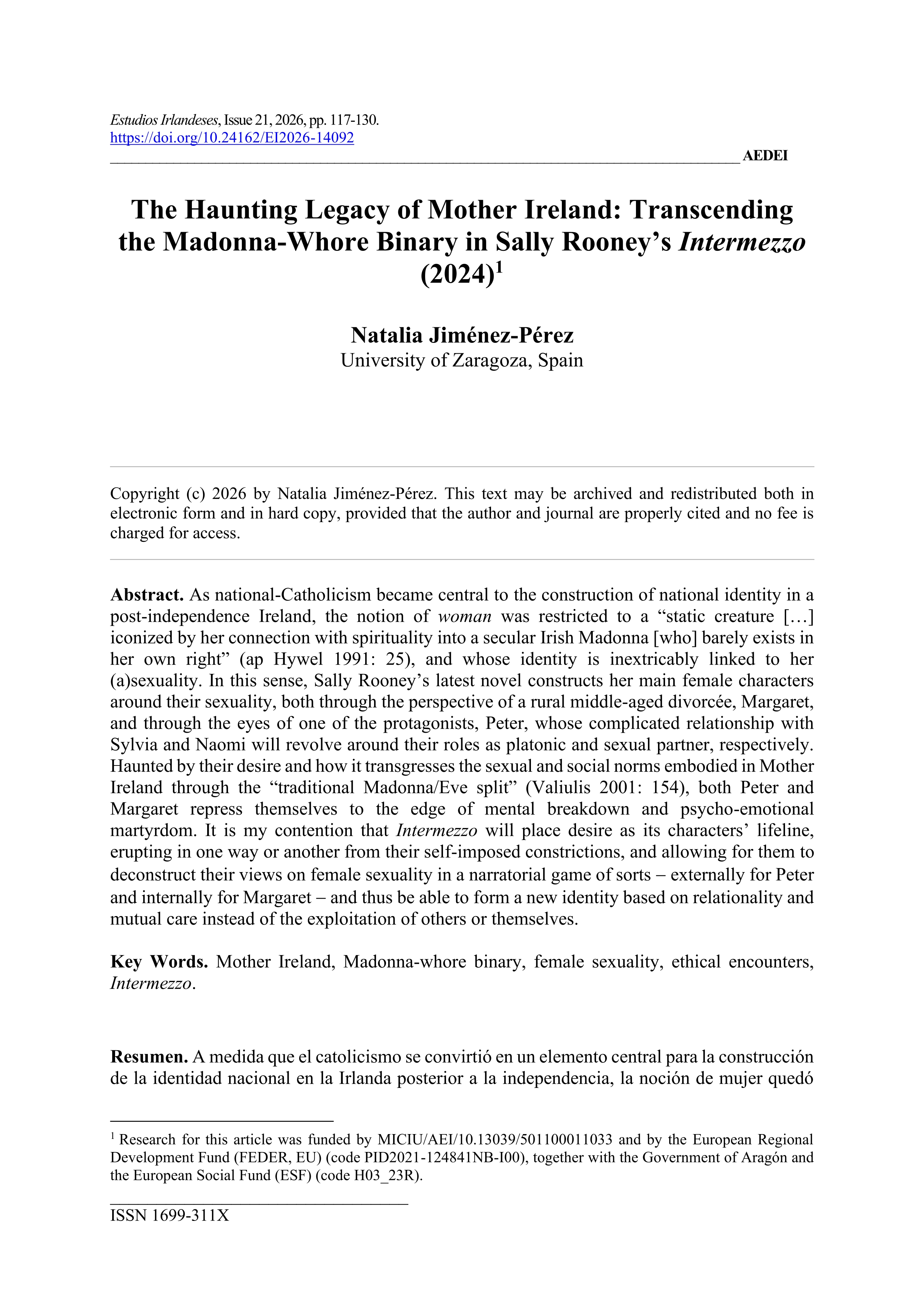
Resumen: As national-Catholicism became central to the construction of national identity in a post-independence Ireland, the notion of woman was restricted to a “static creature […] iconized by her connection with spirituality into a secular Irish Madonna [who] barely exists in her own right” (ap Hywel 1991: 25), and whose identity is inextricably linked to her (a)sexuality. In this sense, Sally Rooney’s latest novel constructs her main female characters around their sexuality, both through the perspective of a rural middle-aged divorcée, Margaret, and through the eyes of one of the protagonists, Peter, whose complicated relationship with Sylvia and Naomi will revolve around their roles as platonic and sexual partner, respectively. Haunted by their desire and how it transgresses the sexual and social norms embodied in Mother Ireland through the “traditional Madonna/Eve split” (Valiulis 2001: 154), both Peter and Margaret repress themselves to the edge of mental breakdown and psycho-emotional martyrdom. It is my contention that Intermezzo will place desire as its characters’ lifeline, erupting in one way or another from their self-imposed constrictions, and allowing for them to deconstruct their views on female sexuality in a narratorial game of sorts – externally for Peter and internally for Margaret – and thus be able to form a new identity based on relationality and mutual care instead of the exploitation of others or themselves.
Idioma: Inglés
DOI: 10.24162/EI2026-14092
Año: 2026
Publicado en: Estudios irlandeses 21 (2026), 117-130
ISSN: 1699-311X
Financiación: info:eu-repo/grantAgreement/ES/DGA-FSE/H03-23R
Financiación: info:eu-repo/grantAgreement/ES/MICIU/PID2021-124841NB-I00
Tipo y forma: Article (Published version)
Área (Departamento): Área Filología Inglesa (Dpto. Filolog.Inglesa y Alema.)
Dataset asociado: The Haunting Legacy of Mother Ireland: Transcending the Madonna-Whore Binary in Sally Rooney’s Intermezzo (2024) ( 10.24162/EI2026-14092)
 You must give appropriate credit, provide a link to the license, and indicate if changes were made. You may do so in any reasonable manner, but not in any way that suggests the licensor endorses you or your use. You may not use the material for commercial purposes.
Exportado de SIDERAL (2026-04-30-13:58:08)
Visitas y descargas
Idioma: Inglés
DOI: 10.24162/EI2026-14092
Año: 2026
Publicado en: Estudios irlandeses 21 (2026), 117-130
ISSN: 1699-311X
Financiación: info:eu-repo/grantAgreement/ES/DGA-FSE/H03-23R
Financiación: info:eu-repo/grantAgreement/ES/MICIU/PID2021-124841NB-I00
Tipo y forma: Article (Published version)
Área (Departamento): Área Filología Inglesa (Dpto. Filolog.Inglesa y Alema.)
Dataset asociado: The Haunting Legacy of Mother Ireland: Transcending the Madonna-Whore Binary in Sally Rooney’s Intermezzo (2024) ( 10.24162/EI2026-14092)
You must give appropriate credit, provide a link to the license, and indicate if changes were made. You may do so in any reasonable manner, but not in any way that suggests the licensor endorses you or your use. You may not use the material for commercial purposes. Exportado de SIDERAL (2026-04-30-13:58:08)
Permalink:
Visitas y descargas
Este artículo se encuentra en las siguientes colecciones:
Articles > Artículos por área > Filología Inglesa
Record created 2026-04-30, last modified 2026-04-30