Clonal dissemination and plasmid plasticity of KPC-3–producing Klebsiella pneumoniae ST512 during a hospital outbreak in Spain
Riesgo-Magaña, María ; Moreno-Mingorance, Albert ; Bueno, Jessica (Universidad de Zaragoza) ; Arnal, Sara ; Alvarado, Elena ; González-López, Juan José ; Seral, Cristina (Universidad de Zaragoza)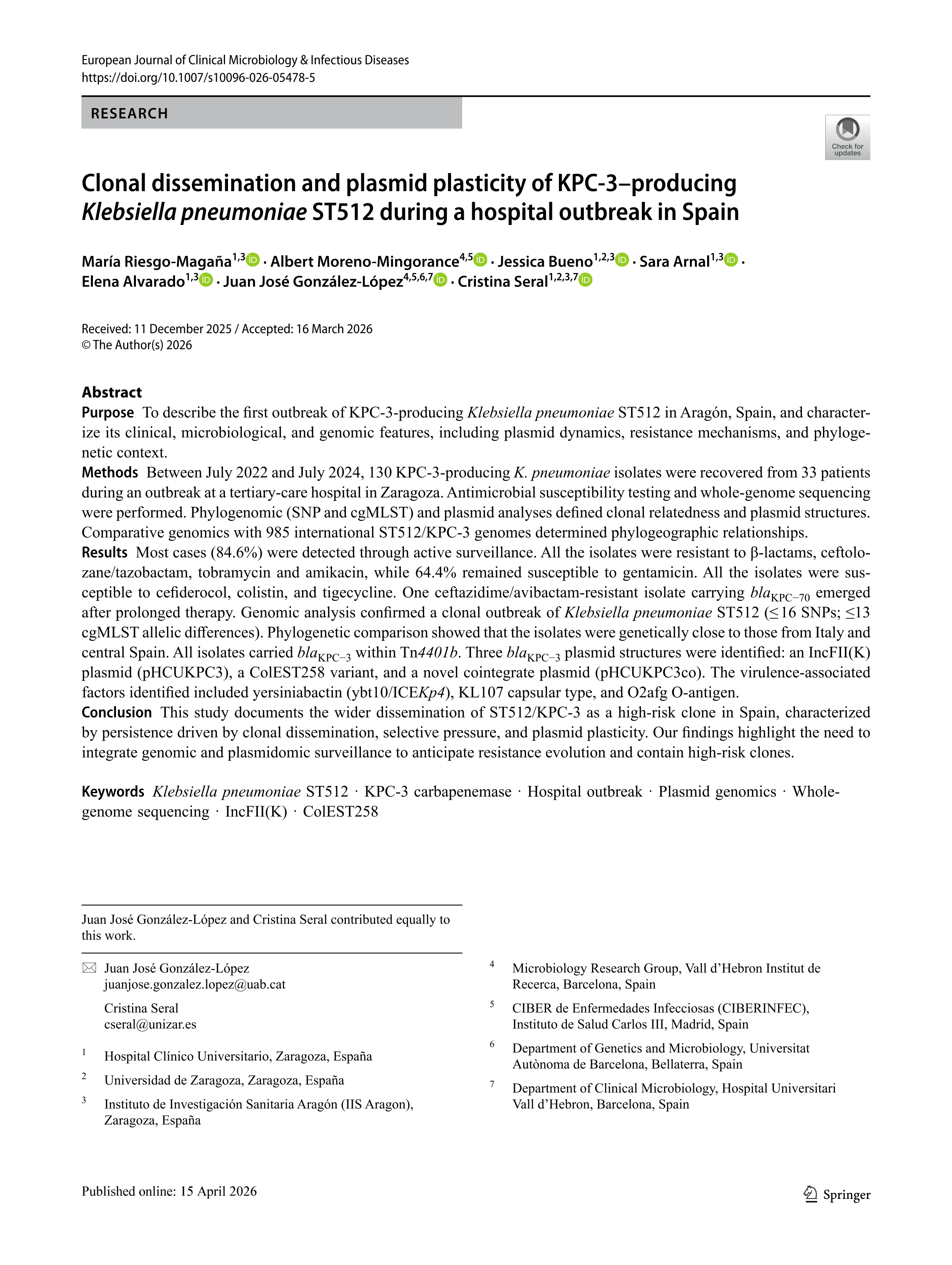
Resumen: Purpose
To describe the first outbreak of KPC-3-producing Klebsiella pneumoniae ST512 in Aragón, Spain, and characterize its clinical, microbiological, and genomic features, including plasmid dynamics, resistance mechanisms, and phylogenetic context.
Methods
Between July 2022 and July 2024, 130 KPC-3-producing K. pneumoniae isolates were recovered from 33 patients during an outbreak at a tertiary-care hospital in Zaragoza. Antimicrobial susceptibility testing and whole-genome sequencing were performed. Phylogenomic (SNP and cgMLST) and plasmid analyses defined clonal relatedness and plasmid structures. Comparative genomics with 985 international ST512/KPC-3 genomes determined phylogeographic relationships.
Results
Most cases (84.6%) were detected through active surveillance. All the isolates were resistant to β-lactams, ceftolozane/tazobactam, tobramycin and amikacin, while 64.4% remained susceptible to gentamicin. All the isolates were susceptible to cefiderocol, colistin, and tigecycline. One ceftazidime/avibactam-resistant isolate carrying blaKPC−70 emerged after prolonged therapy. Genomic analysis confirmed a clonal outbreak of Klebsiella pneumoniae ST512 (≤ 16 SNPs; ≤13 cgMLST allelic differences). Phylogenetic comparison showed that the isolates were genetically close to those from Italy and central Spain. All isolates carried blaKPC−3 within Tn4401b. Three blaKPC−3 plasmid structures were identified: an IncFII(K) plasmid (pHCUKPC3), a ColEST258 variant, and a novel cointegrate plasmid (pHCUKPC3co). The virulence-associated factors identified included yersiniabactin (ybt10/ICEKp4), KL107 capsular type, and O2afg O-antigen.
Conclusion
This study documents the wider dissemination of ST512/KPC-3 as a high-risk clone in Spain, characterized by persistence driven by clonal dissemination, selective pressure, and plasmid plasticity. Our findings highlight the need to integrate genomic and plasmidomic surveillance to anticipate resistance evolution and contain high-risk clones.
Idioma: Inglés
DOI: 10.1007/s10096-026-05478-5
Año: 2026
Publicado en: EUROPEAN JOURNAL OF CLINICAL MICROBIOLOGY & INFECTIOUS DISEASES (2026), [14 pp.]
ISSN: 0934-9723
Financiación: info:eu-repo/grantAgreement/ES/ISCIII/CB21-13-00054
Financiación: info:eu-repo/grantAgreement/ES/ISCIII/CB21-13-00087
Tipo y forma: Article (Published version)
Área (Departamento): Área Microbiología (Dpto. Microb.Ped.Radio.Sal.Pú.)
 You must give appropriate credit, provide a link to the license, and indicate if changes were made. You may do so in any reasonable manner, but not in any way that suggests the licensor endorses you or your use.
Exportado de SIDERAL (2026-04-30-13:58:09)
Visitas y descargas
To describe the first outbreak of KPC-3-producing Klebsiella pneumoniae ST512 in Aragón, Spain, and characterize its clinical, microbiological, and genomic features, including plasmid dynamics, resistance mechanisms, and phylogenetic context.
Methods
Between July 2022 and July 2024, 130 KPC-3-producing K. pneumoniae isolates were recovered from 33 patients during an outbreak at a tertiary-care hospital in Zaragoza. Antimicrobial susceptibility testing and whole-genome sequencing were performed. Phylogenomic (SNP and cgMLST) and plasmid analyses defined clonal relatedness and plasmid structures. Comparative genomics with 985 international ST512/KPC-3 genomes determined phylogeographic relationships.
Results
Most cases (84.6%) were detected through active surveillance. All the isolates were resistant to β-lactams, ceftolozane/tazobactam, tobramycin and amikacin, while 64.4% remained susceptible to gentamicin. All the isolates were susceptible to cefiderocol, colistin, and tigecycline. One ceftazidime/avibactam-resistant isolate carrying blaKPC−70 emerged after prolonged therapy. Genomic analysis confirmed a clonal outbreak of Klebsiella pneumoniae ST512 (≤ 16 SNPs; ≤13 cgMLST allelic differences). Phylogenetic comparison showed that the isolates were genetically close to those from Italy and central Spain. All isolates carried blaKPC−3 within Tn4401b. Three blaKPC−3 plasmid structures were identified: an IncFII(K) plasmid (pHCUKPC3), a ColEST258 variant, and a novel cointegrate plasmid (pHCUKPC3co). The virulence-associated factors identified included yersiniabactin (ybt10/ICEKp4), KL107 capsular type, and O2afg O-antigen.
Conclusion
This study documents the wider dissemination of ST512/KPC-3 as a high-risk clone in Spain, characterized by persistence driven by clonal dissemination, selective pressure, and plasmid plasticity. Our findings highlight the need to integrate genomic and plasmidomic surveillance to anticipate resistance evolution and contain high-risk clones.
Idioma: Inglés
DOI: 10.1007/s10096-026-05478-5
Año: 2026
Publicado en: EUROPEAN JOURNAL OF CLINICAL MICROBIOLOGY & INFECTIOUS DISEASES (2026), [14 pp.]
ISSN: 0934-9723
Financiación: info:eu-repo/grantAgreement/ES/ISCIII/CB21-13-00054
Financiación: info:eu-repo/grantAgreement/ES/ISCIII/CB21-13-00087
Tipo y forma: Article (Published version)
Área (Departamento): Área Microbiología (Dpto. Microb.Ped.Radio.Sal.Pú.)
You must give appropriate credit, provide a link to the license, and indicate if changes were made. You may do so in any reasonable manner, but not in any way that suggests the licensor endorses you or your use. Exportado de SIDERAL (2026-04-30-13:58:09)
Permalink:
Visitas y descargas
Este artículo se encuentra en las siguientes colecciones:
Articles > Artículos por área > Microbiología
Record created 2026-04-30, last modified 2026-04-30