Spinal motor neuron pools may be partly driven by impulsive common inputs
Yanguas Mayo, Javier (Universidad de Zaragoza) ; Pascual Valdunciel, Alejandro (Universidad de Zaragoza) ; Baker, Stuart N ; Laguna, Pablo (Universidad de Zaragoza) ; Farina, Dario ; Ibáñez Pereda, Jaime (Universidad de Zaragoza)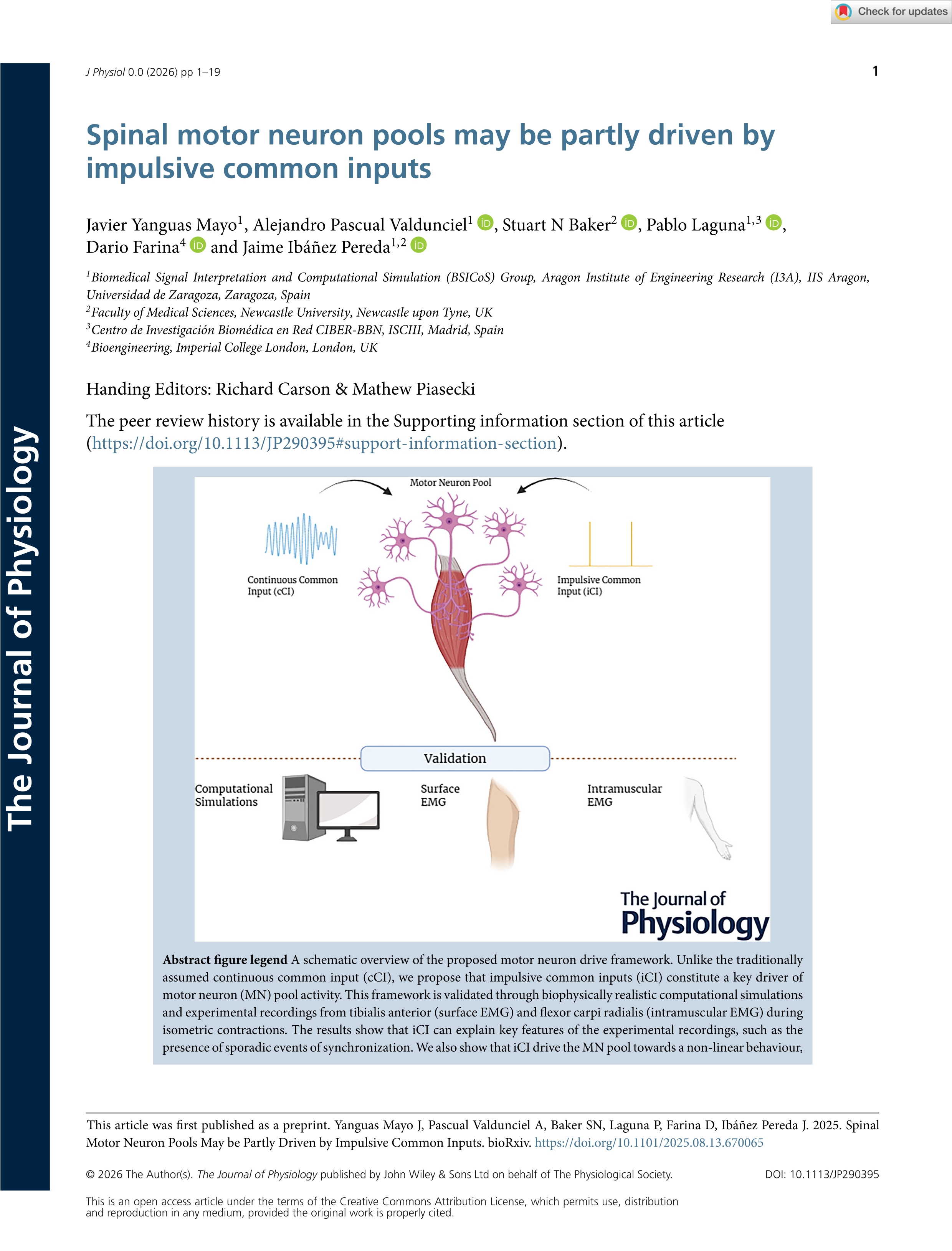
Resumen: Spinal motor neurons serve as the link between the nervous system and muscles. As the final common pathway of the neuromuscular system, they receive inputs from both higher‐level controllers and afferent pathways. It is often assumed that spinal motor neurons are primarily driven by continuous common inputs (cCI) within different frequency bands. Within this framework, the motor neuron pool behaves as a linear amplifier of the cCI. This implies that the frequency content of descending and spinal oscillatory signals is preserved and faithfully transmitted to the muscles; thus, the spectral content at the output of the motor neuron pool corresponds to that of the cCI. However, this framework overlooks the possibility that motor neurons could also be driven by impulsive common inputs (iCI), which can induce synchronization among them and disrupt the linear transmission of other synaptic inputs at the pool level. To test this hypothesis, computational simulations and experimental data from two different human muscles were used to characterize different aspects related to motor neuron spiking synchronization at the pool level. Our findings suggest that, indeed, iCI can account for relevant features observed in experimental data such as the presence of synchronization events at the pool level. We also observed that such impulsive inputs can affect the linearity in the transmission of cCI by the motor neuron pool. This study represents pioneering indirect evidence of the existence of iCI as inputs to motor neurons.
image
Key points
The current understanding of the motor control of voluntary movements assumes a continuous control, driven by oscillatory common signals.
Some aspects of motor unit pool behaviour (particularly in terms of spiking synchronization and spectral content) typically observed in experimental recordings cannot be reproduced in simulations that only use continuous common inputs (cCI) to motor neurons.
This study provides evidence indicating that spinal motor neurons receive a portion of their synaptic input in the form of impulsive common inputs (iCI) that synchronize their activity.
The study also shows how such iCI can affect the linear transmission of other cCI by the motor neuron pool.
These findings constitute a fundamental paradigm shift in the understanding of motor control and impact the development of interfaces that extract information from the activity of spinal motor neurons.
Idioma: Inglés
DOI: 10.1113/JP290395
Año: 2026
Publicado en: JOURNAL OF PHYSIOLOGY-LONDON (2026), [19 pp.]
ISSN: 0022-3751
Tipo y forma: Artículo (Versión definitiva)
Área (Departamento): Área Teoría Señal y Comunicac. (Dpto. Ingeniería Electrón.Com.)
 Debe reconocer adecuadamente la autoría, proporcionar un enlace a la licencia e indicar si se han realizado cambios. Puede hacerlo de cualquier manera razonable, pero no de una manera que sugiera que tiene el apoyo del licenciador o lo recibe por el uso que hace.
Exportado de SIDERAL (2026-04-30-13:58:34)
Visitas y descargas
image
Key points
The current understanding of the motor control of voluntary movements assumes a continuous control, driven by oscillatory common signals.
Some aspects of motor unit pool behaviour (particularly in terms of spiking synchronization and spectral content) typically observed in experimental recordings cannot be reproduced in simulations that only use continuous common inputs (cCI) to motor neurons.
This study provides evidence indicating that spinal motor neurons receive a portion of their synaptic input in the form of impulsive common inputs (iCI) that synchronize their activity.
The study also shows how such iCI can affect the linear transmission of other cCI by the motor neuron pool.
These findings constitute a fundamental paradigm shift in the understanding of motor control and impact the development of interfaces that extract information from the activity of spinal motor neurons.
Idioma: Inglés
DOI: 10.1113/JP290395
Año: 2026
Publicado en: JOURNAL OF PHYSIOLOGY-LONDON (2026), [19 pp.]
ISSN: 0022-3751
Tipo y forma: Artículo (Versión definitiva)
Área (Departamento): Área Teoría Señal y Comunicac. (Dpto. Ingeniería Electrón.Com.)
Debe reconocer adecuadamente la autoría, proporcionar un enlace a la licencia e indicar si se han realizado cambios. Puede hacerlo de cualquier manera razonable, pero no de una manera que sugiera que tiene el apoyo del licenciador o lo recibe por el uso que hace. Exportado de SIDERAL (2026-04-30-13:58:34)
Enlace permanente:
Visitas y descargas
Este artículo se encuentra en las siguientes colecciones:
Artículos > Artículos por área > Teoría de la Señal y Comunicaciones
Registro creado el 2026-04-30, última modificación el 2026-04-30