Effectiveness of deconstructive meditative practices in improving mental health and well-being: a systematic review
Lamas-Morales, Paulina (Universidad de Zaragoza) ; García-Rubio, Carlos ; Beltrán-Ruiz, María (Universidad de Zaragoza) ; Barceló-Soler, Alberto (Universidad de Zaragoza) ; López-Del-Hoyo, Yolanda (Universidad de Zaragoza) ; García-Campayo, Javier (Universidad de Zaragoza)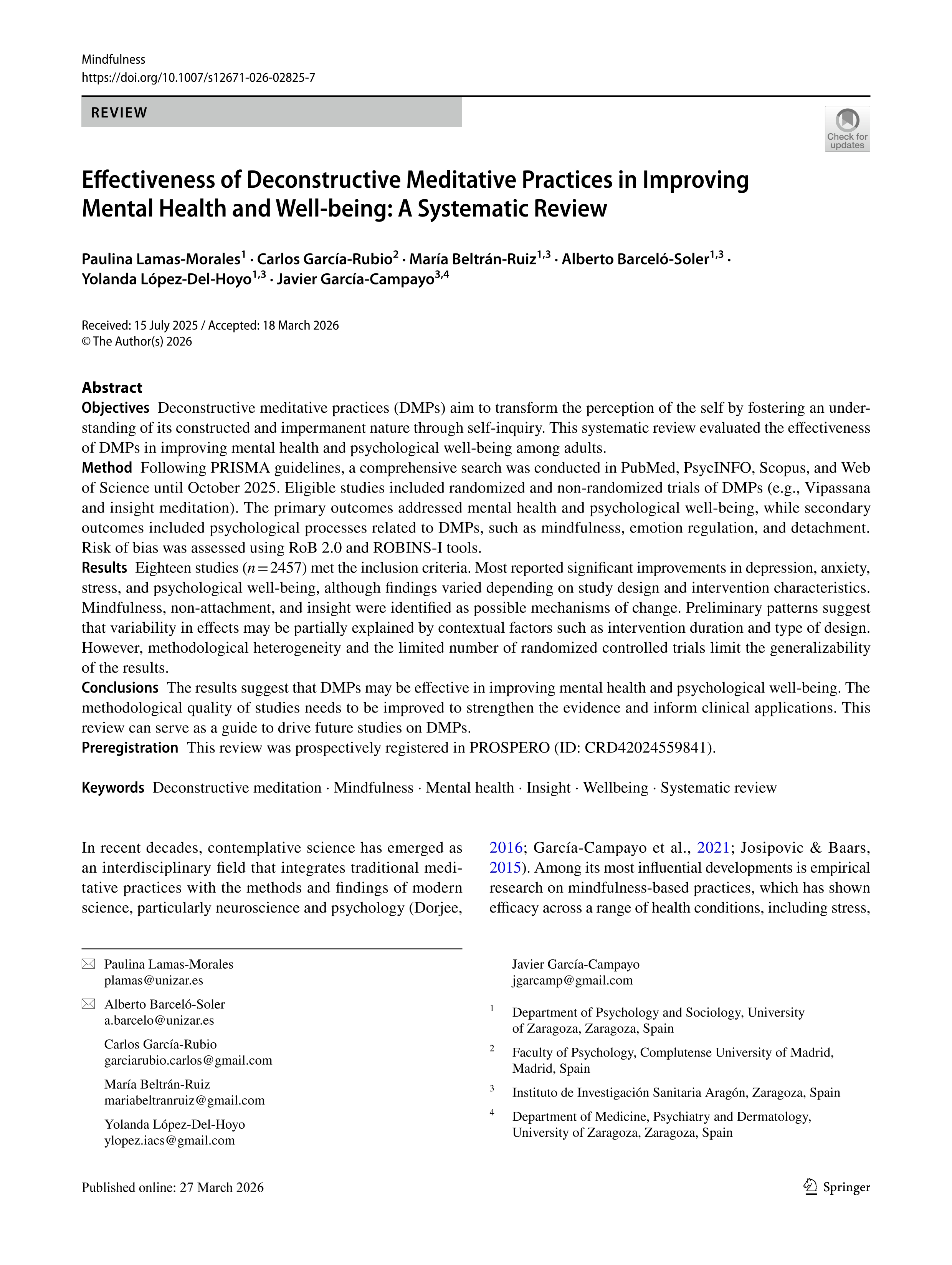
Resumen: Objectives
Deconstructive meditative practices (DMPs) aim to transform the perception of the self by fostering an understanding of its constructed and impermanent nature through self-inquiry. This systematic review evaluated the effectiveness of DMPs in improving mental health and psychological well-being among adults.
Method
Following PRISMA guidelines, a comprehensive search was conducted in PubMed, PsycINFO, Scopus, and Web of Science until October 2025. Eligible studies included randomized and non-randomized trials of DMPs (e.g., Vipassana and insight meditation). The primary outcomes addressed mental health and psychological well-being, while secondary outcomes included psychological processes related to DMPs, such as mindfulness, emotion regulation, and detachment. Risk of bias was assessed using RoB 2.0 and ROBINS-I tools.
Results
Eighteen studies (n = 2457) met the inclusion criteria. Most reported significant improvements in depression, anxiety, stress, and psychological well-being, although findings varied depending on study design and intervention characteristics. Mindfulness, non-attachment, and insight were identified as possible mechanisms of change. Preliminary patterns suggest that variability in effects may be partially explained by contextual factors such as intervention duration and type of design. However, methodological heterogeneity and the limited number of randomized controlled trials limit the generalizability of the results.
Conclusions
The results suggest that DMPs may be effective in improving mental health and psychological well-being. The methodological quality of studies needs to be improved to strengthen the evidence and inform clinical applications. This review can serve as a guide to drive future studies on DMPs.
Idioma: Inglés
DOI: 10.1007/s12671-026-02825-7
Año: 2026
Publicado en: Mindfulness (2026), [18 pp.]
ISSN: 1868-8527
Tipo y forma: Artículo (Versión definitiva)
Área (Departamento): Área Psicología Básica (Dpto. Psicología y Sociología)
Área (Departamento): Area Psiquiatría (Dpto. Medicina, Psiqu. y Derm.)
Área (Departamento): Área Psicolog.Evolut.Educac (Dpto. Psicología y Sociología)
 Debe reconocer adecuadamente la autoría, proporcionar un enlace a la licencia e indicar si se han realizado cambios. Puede hacerlo de cualquier manera razonable, pero no de una manera que sugiera que tiene el apoyo del licenciador o lo recibe por el uso que hace.
Exportado de SIDERAL (2026-05-05-13:36:56)
Visitas y descargas
Deconstructive meditative practices (DMPs) aim to transform the perception of the self by fostering an understanding of its constructed and impermanent nature through self-inquiry. This systematic review evaluated the effectiveness of DMPs in improving mental health and psychological well-being among adults.
Method
Following PRISMA guidelines, a comprehensive search was conducted in PubMed, PsycINFO, Scopus, and Web of Science until October 2025. Eligible studies included randomized and non-randomized trials of DMPs (e.g., Vipassana and insight meditation). The primary outcomes addressed mental health and psychological well-being, while secondary outcomes included psychological processes related to DMPs, such as mindfulness, emotion regulation, and detachment. Risk of bias was assessed using RoB 2.0 and ROBINS-I tools.
Results
Eighteen studies (n = 2457) met the inclusion criteria. Most reported significant improvements in depression, anxiety, stress, and psychological well-being, although findings varied depending on study design and intervention characteristics. Mindfulness, non-attachment, and insight were identified as possible mechanisms of change. Preliminary patterns suggest that variability in effects may be partially explained by contextual factors such as intervention duration and type of design. However, methodological heterogeneity and the limited number of randomized controlled trials limit the generalizability of the results.
Conclusions
The results suggest that DMPs may be effective in improving mental health and psychological well-being. The methodological quality of studies needs to be improved to strengthen the evidence and inform clinical applications. This review can serve as a guide to drive future studies on DMPs.
Idioma: Inglés
DOI: 10.1007/s12671-026-02825-7
Año: 2026
Publicado en: Mindfulness (2026), [18 pp.]
ISSN: 1868-8527
Tipo y forma: Artículo (Versión definitiva)
Área (Departamento): Área Psicología Básica (Dpto. Psicología y Sociología)
Área (Departamento): Area Psiquiatría (Dpto. Medicina, Psiqu. y Derm.)
Área (Departamento): Área Psicolog.Evolut.Educac (Dpto. Psicología y Sociología)
Debe reconocer adecuadamente la autoría, proporcionar un enlace a la licencia e indicar si se han realizado cambios. Puede hacerlo de cualquier manera razonable, pero no de una manera que sugiera que tiene el apoyo del licenciador o lo recibe por el uso que hace. Exportado de SIDERAL (2026-05-05-13:36:56)
Enlace permanente:
Visitas y descargas
Este artículo se encuentra en las siguientes colecciones:
Artículos > Artículos por área > Psicología Evolutiva y de la Educación
Artículos > Artículos por área > Psicología Básica
Artículos > Artículos por área > Psiquiatría
Registro creado el 2026-05-05, última modificación el 2026-05-05