Influence of mechanical blending method and consolidation temperature on electrical properties of the prepared graphene nanoplatelet/UHMWPE composite
Puértolas, José Antonio (Universidad de Zaragoza) ; Martínez Morlanes, María José ; Pascual, Francisco Javier ; Morimoto, Takahiro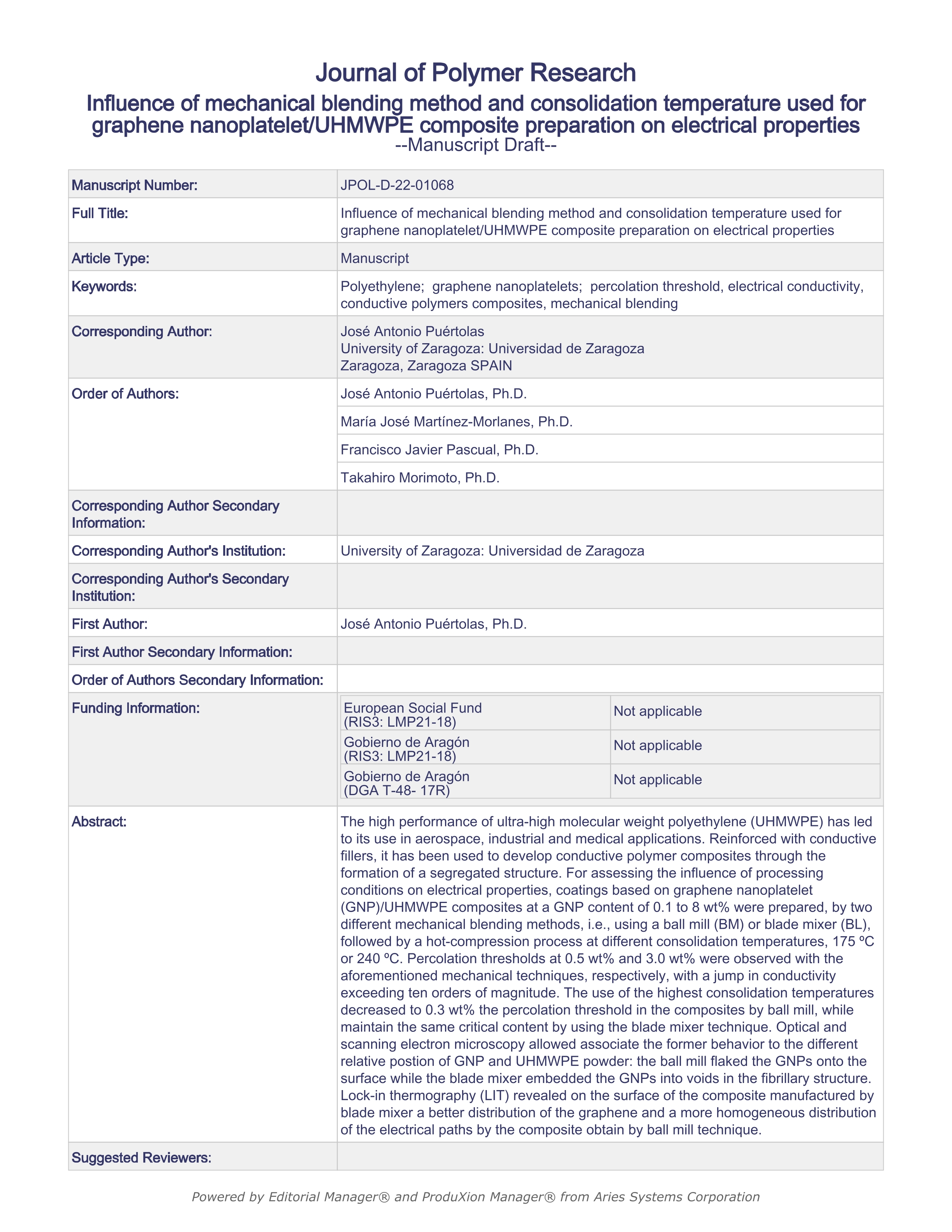
Resumen: The high performance of ultra-high molecular weight polyethylene (UHMWPE) has led to its use in aerospace, industrial and medical applications. Reinforced with conductive fllers, it has been used to develop conductive polymer composites through the formation of a segregated structure. For assessing the infuence of processing conditions on electrical properties, coatings based on graphene nanoplatelet (GNP)/UHMWPE composites at a GNP content of 0.1 to 8 wt% were prepared, by two diferent mechanical blending methods, i.e., using a ball mill (BM) or blade mixer (BL), followed by a hot-compression process at diferent consolidation temperatures, 175 ºC or 240 ºC. Percolation thresholds at 0.5 wt% and 3.0 wt% were observed with the aforementioned mechanical techniques, respectively, with a jump in conductivity exceeding ten orders of magnitude. The use of the highest consolidation temperatures provided a decrease of the percolation threshold to 0.3 wt% in the composites prepared by ball mill, while maintain the same critical content by using the blade mixer technique. Images obtained by optical and scanning electron microscopy allowed to associate the former behavior to the diferent relative position of GNP and UHMWPE powder: the ball mill faked the GNPs onto the surface while the blade mixer embedded the GNPs into voids in the fbrillary structure. Lock-in thermography (LIT) revealed on the surface of the composite manufactured by ball milling a better distribution of the graphene and the corresponding electrical paths, compared with the composites prepared by blade mixer.
Idioma: Inglés
DOI: 10.1007/s10965-022-03381-z
Año: 2022
Publicado en: JOURNAL OF POLYMER RESEARCH 30, 1 (2022), 21 [15 pp]
ISSN: 1022-9760
Factor impacto JCR: 2.8 (2022)
Categ. JCR: POLYMER SCIENCE rank: 44 / 85 = 0.518 (2022) - Q3 - T2
Factor impacto CITESCORE: 4.2 - Chemistry (Q2) - Materials Science (Q2)
Factor impacto SCIMAGO: 0.429 - Materials Chemistry (Q2) - Polymers and Plastics (Q2) - Organic Chemistry (Q3)
Financiación: info:eu-repo/grantAgreement/ES/DGA-FSE/RIS3-LMP21-18
Financiación: info:eu-repo/grantAgreement/ES/DGA-FSE/T48-17R
Tipo y forma: Artículo (PostPrint)
Área (Departamento): Área Cienc.Mater. Ingen.Metal. (Dpto. Ciencia Tecnol.Mater.Fl.)
 Derechos reservados por el editor de la revista
Exportado de SIDERAL (2026-05-20-08:31:37)
Visitas y descargas
Idioma: Inglés
DOI: 10.1007/s10965-022-03381-z
Año: 2022
Publicado en: JOURNAL OF POLYMER RESEARCH 30, 1 (2022), 21 [15 pp]
ISSN: 1022-9760
Factor impacto JCR: 2.8 (2022)
Categ. JCR: POLYMER SCIENCE rank: 44 / 85 = 0.518 (2022) - Q3 - T2
Factor impacto CITESCORE: 4.2 - Chemistry (Q2) - Materials Science (Q2)
Factor impacto SCIMAGO: 0.429 - Materials Chemistry (Q2) - Polymers and Plastics (Q2) - Organic Chemistry (Q3)
Financiación: info:eu-repo/grantAgreement/ES/DGA-FSE/RIS3-LMP21-18
Financiación: info:eu-repo/grantAgreement/ES/DGA-FSE/T48-17R
Tipo y forma: Artículo (PostPrint)
Área (Departamento): Área Cienc.Mater. Ingen.Metal. (Dpto. Ciencia Tecnol.Mater.Fl.)
Derechos reservados por el editor de la revistaExportado de SIDERAL (2026-05-20-08:31:37)
Enlace permanente:
Visitas y descargas
Este artículo se encuentra en las siguientes colecciones:
Artículos > Artículos por área > Ciencia de los Materiales e Ingeniería Metalúrgica
Registro creado el 2026-05-20, última modificación el 2026-05-20