Analysing outbreak signals, 2013–2024: The amsterdam UMC centre for Tropical Medicine and Travel Medicine Epi Alert programme – an observational study
van Os, Jelmer ; de Jong, Hanna K. ; Pellejero-Sagastizabal, Galadriel (Universidad de Zaragoza) ; Paño-Pardo, José Ramón ; Lescure, F-Xavier ; Hanscheid, Thomas ; Grobusch, Martin P. ; Goorhuis, Abraham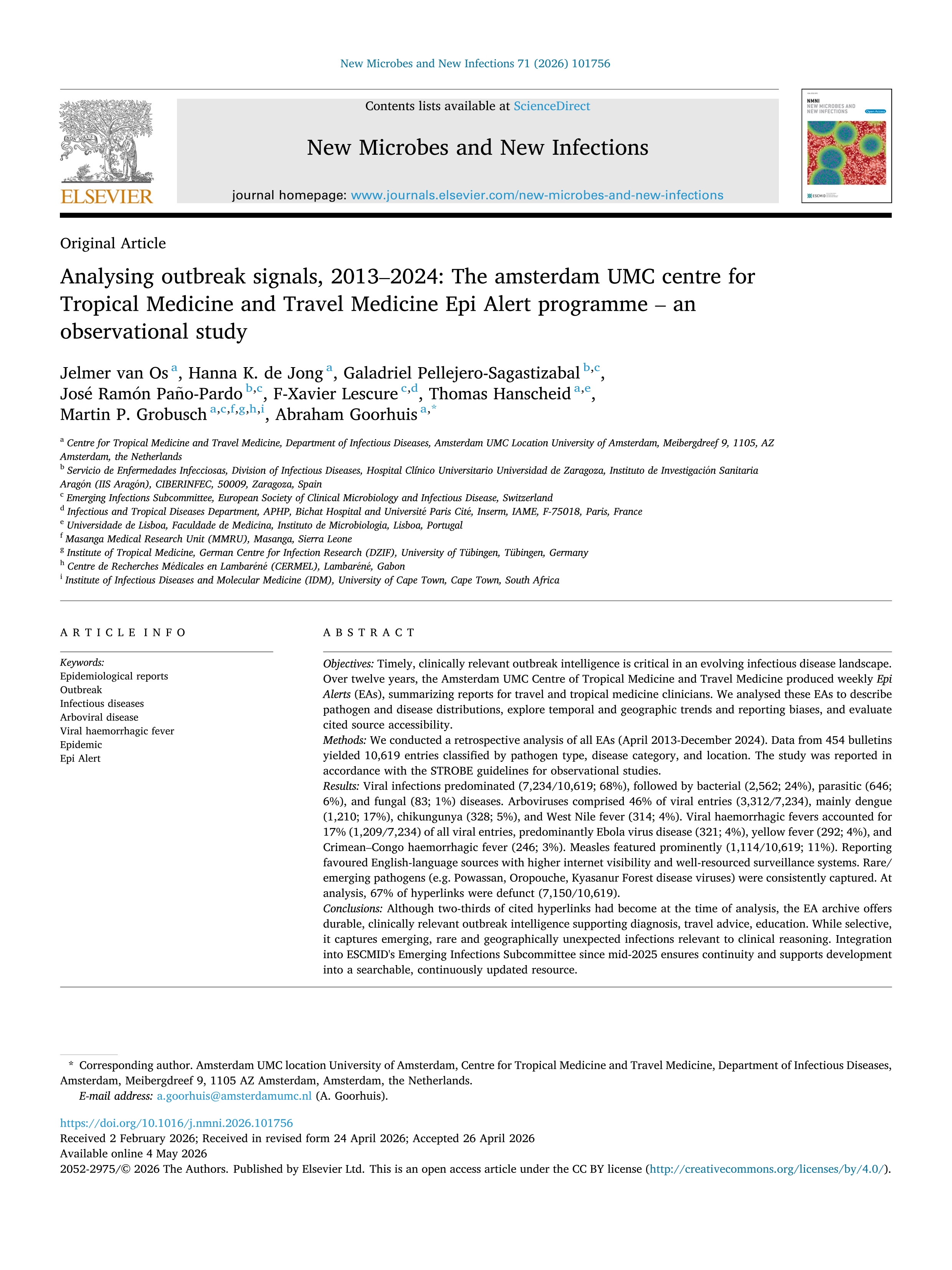
Resumen: Objectives
Timely, clinically relevant outbreak intelligence is critical in an evolving infectious disease landscape. Over twelve years, the Amsterdam UMC Centre of Tropical Medicine and Travel Medicine produced weekly Epi Alerts (EAs), summarizing reports for travel and tropical medicine clinicians. We analysed these EAs to describe pathogen and disease distributions, explore temporal and geographic trends and reporting biases, and evaluate cited source accessibility.
Methods
We conducted a retrospective analysis of all EAs (April 2013-December 2024). Data from 454 bulletins yielded 10,619 entries classified by pathogen type, disease category, and location. The study was reported in accordance with the STROBE guidelines for observational studies.
Results
Viral infections predominated (7,234/10,619; 68%), followed by bacterial (2,562; 24%), parasitic (646; 6%), and fungal (83; 1%) diseases. Arboviruses comprised 46% of viral entries (3,312/7,234), mainly dengue (1,210; 17%), chikungunya (328; 5%), and West Nile fever (314; 4%). Viral haemorrhagic fevers accounted for 17% (1,209/7,234) of all viral entries, predominantly Ebola virus disease (321; 4%), yellow fever (292; 4%), and Crimean–Congo haemorrhagic fever (246; 3%). Measles featured prominently (1,114/10,619; 11%). Reporting favoured English-language sources with higher internet visibility and well-resourced surveillance systems. Rare/emerging pathogens (e.g. Powassan, Oropouche, Kyasanur Forest disease viruses) were consistently captured. At analysis, 67% of hyperlinks were defunct (7,150/10,619).
Conclusions
Although two-thirds of cited hyperlinks had become at the time of analysis, the EA archive offers durable, clinically relevant outbreak intelligence supporting diagnosis, travel advice, education. While selective, it captures emerging, rare and geographically unexpected infections relevant to clinical reasoning. Integration into ESCMID's Emerging Infections Subcommittee since mid-2025 ensures continuity and supports development into a searchable, continuously updated resource.
Idioma: Inglés
DOI: 10.1016/j.nmni.2026.101756
Año: 2026
Publicado en: New Microbes and New Infections 71 (2026), 101756 [10 pp.]
ISSN: 2052-2975
Tipo y forma: Article (Published version)
Área (Departamento): Area Medicina (Dpto. Medicina, Psiqu. y Derm.)
Exportado de SIDERAL (2026-05-27-11:25:27)
Visitas y descargas
Timely, clinically relevant outbreak intelligence is critical in an evolving infectious disease landscape. Over twelve years, the Amsterdam UMC Centre of Tropical Medicine and Travel Medicine produced weekly Epi Alerts (EAs), summarizing reports for travel and tropical medicine clinicians. We analysed these EAs to describe pathogen and disease distributions, explore temporal and geographic trends and reporting biases, and evaluate cited source accessibility.
Methods
We conducted a retrospective analysis of all EAs (April 2013-December 2024). Data from 454 bulletins yielded 10,619 entries classified by pathogen type, disease category, and location. The study was reported in accordance with the STROBE guidelines for observational studies.
Results
Viral infections predominated (7,234/10,619; 68%), followed by bacterial (2,562; 24%), parasitic (646; 6%), and fungal (83; 1%) diseases. Arboviruses comprised 46% of viral entries (3,312/7,234), mainly dengue (1,210; 17%), chikungunya (328; 5%), and West Nile fever (314; 4%). Viral haemorrhagic fevers accounted for 17% (1,209/7,234) of all viral entries, predominantly Ebola virus disease (321; 4%), yellow fever (292; 4%), and Crimean–Congo haemorrhagic fever (246; 3%). Measles featured prominently (1,114/10,619; 11%). Reporting favoured English-language sources with higher internet visibility and well-resourced surveillance systems. Rare/emerging pathogens (e.g. Powassan, Oropouche, Kyasanur Forest disease viruses) were consistently captured. At analysis, 67% of hyperlinks were defunct (7,150/10,619).
Conclusions
Although two-thirds of cited hyperlinks had become at the time of analysis, the EA archive offers durable, clinically relevant outbreak intelligence supporting diagnosis, travel advice, education. While selective, it captures emerging, rare and geographically unexpected infections relevant to clinical reasoning. Integration into ESCMID's Emerging Infections Subcommittee since mid-2025 ensures continuity and supports development into a searchable, continuously updated resource.
Idioma: Inglés
DOI: 10.1016/j.nmni.2026.101756
Año: 2026
Publicado en: New Microbes and New Infections 71 (2026), 101756 [10 pp.]
ISSN: 2052-2975
Tipo y forma: Article (Published version)
Área (Departamento): Area Medicina (Dpto. Medicina, Psiqu. y Derm.)
Exportado de SIDERAL (2026-05-27-11:25:27)
Permalink:
Visitas y descargas
Este artículo se encuentra en las siguientes colecciones:
articulos > articulos-por-area > medicina
Notice créée le 2026-05-27, modifiée le 2026-05-27