Mitochondrial complex I activity signals antioxidant response through ERK5
Khan, A.U.H. ; Allende-Vega, N. ; Gitenay, D. ; Garaude, J. ; Vo, D.-N. ; Belkhala, S. ; Gerbal-Chaloin, S. ; Gondeau, C. ; Daujat-Chavanieu, M. ; Delettre, C. ; Orecchioni, S. ; Talarico, G. ; Bertolini, F. ; Anel, A. (Universidad de Zaragoza) ; Cuezva, J.M. ; Enriquez, J.A. ; Cartron, G. ; Lecellier, C.-H. ; Hernandez, J. ; Villalba, M.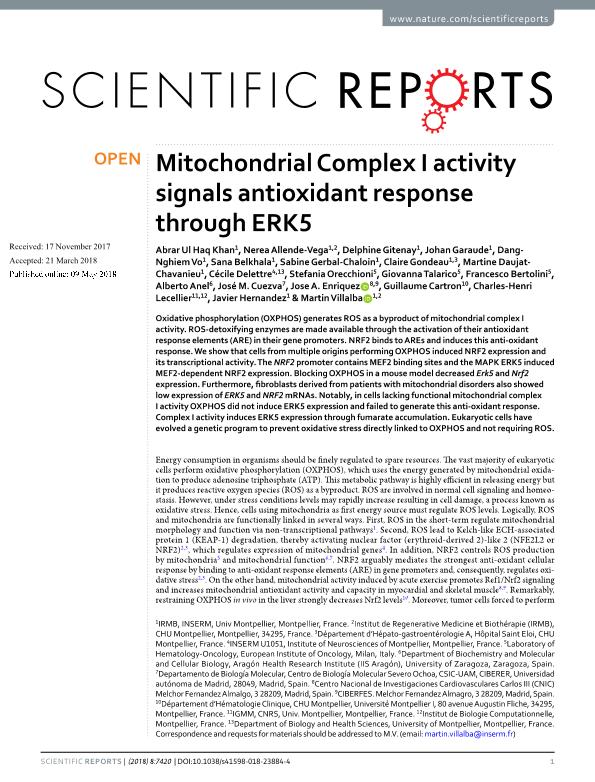
Resumen: Oxidative phosphorylation (OXPHOS) generates ROS as a byproduct of mitochondrial complex I activity. ROS-detoxifying enzymes are made available through the activation of their antioxidant response elements (ARE) in their gene promoters. NRF2 binds to AREs and induces this anti-oxidant response. We show that cells from multiple origins performing OXPHOS induced NRF2 expression and its transcriptional activity. The NRF2 promoter contains MEF2 binding sites and the MAPK ERK5 induced MEF2-dependent NRF2 expression. Blocking OXPHOS in a mouse model decreased Erk5 and Nrf2 expression. Furthermore, fibroblasts derived from patients with mitochondrial disorders also showed low expression of ERK5 and NRF2 mRNAs. Notably, in cells lacking functional mitochondrial complex I activity OXPHOS did not induce ERK5 expression and failed to generate this anti-oxidant response. Complex I activity induces ERK5 expression through fumarate accumulation. Eukaryotic cells have evolved a genetic program to prevent oxidative stress directly linked to OXPHOS and not requiring ROS.
Idioma: Inglés
DOI: 10.1038/s41598-018-23884-4
Año: 2018
Publicado en: SCIENTIFIC REPORTS 8, 1 (2018), 7420 [14 pp]
ISSN: 2045-2322
Factor impacto JCR: 4.011 (2018)
Categ. JCR: MULTIDISCIPLINARY SCIENCES rank: 14 / 69 = 0.203 (2018) - Q1 - T1
Factor impacto SCIMAGO: 1.414 - Multidisciplinary (Q1)
Tipo y forma: Article (Published version)
Área (Departamento): Área Bioquímica y Biolog.Mole. (Dpto. Bioq.Biolog.Mol. Celular)
 You must give appropriate credit, provide a link to the license, and indicate if changes were made. You may do so in any reasonable manner, but not in any way that suggests the licensor endorses you or your use.
Exportado de SIDERAL (2019-11-22-14:44:52)
Visitas y descargas
Idioma: Inglés
DOI: 10.1038/s41598-018-23884-4
Año: 2018
Publicado en: SCIENTIFIC REPORTS 8, 1 (2018), 7420 [14 pp]
ISSN: 2045-2322
Factor impacto JCR: 4.011 (2018)
Categ. JCR: MULTIDISCIPLINARY SCIENCES rank: 14 / 69 = 0.203 (2018) - Q1 - T1
Factor impacto SCIMAGO: 1.414 - Multidisciplinary (Q1)
Tipo y forma: Article (Published version)
Área (Departamento): Área Bioquímica y Biolog.Mole. (Dpto. Bioq.Biolog.Mol. Celular)
You must give appropriate credit, provide a link to the license, and indicate if changes were made. You may do so in any reasonable manner, but not in any way that suggests the licensor endorses you or your use. Exportado de SIDERAL (2019-11-22-14:44:52)
Permalink:
Visitas y descargas
Este artículo se encuentra en las siguientes colecciones:
Articles > Artículos por área > Bioquímica y Biología Molecular
Record created 2018-06-14, last modified 2019-11-22