PrevenBox: Evaluation of concomitant use of preventive medications with OnabotulinumtoxinA in migraine
Torres-Ferrus, M. ; Santos Lasaosa, S. (Universidad de Zaragoza) ; Peral, A.G. ; Lainez, J.M. ; Viguera Romero, J. ; gago Veiga, A.B. ; Irimia, P. ; Sanchez del Rio, M. ; Asskour, L. ; Gallardo, V.J. ; Pozo-Rosich, P.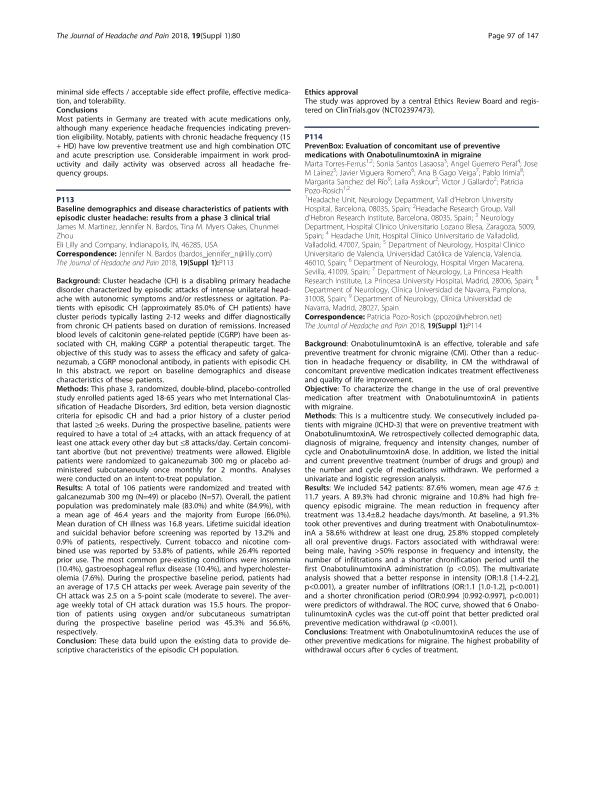
Resumen: P114
Background: OnabotulinumtoxinA is an effective, tolerable and safepreventive treatment for chronic migraine (CM). Other than a reduc-tion in headache frequency or disability, in CM the withdrawal ofconcomitant preventive medication indicates treatment effectivenessand quality of life improvement.
Objective: To characterize the change in the use of oral preventivemedication after treatment with OnabotulinumtoxinA in patientswith migraine.
Methods: This is a multicentre study. We consecutively included pa-tients with migraine (ICHD-3) that were on preventive treatment withOnabotulinumtoxinA. We retrospectively collected demographic data, diagnosis of migraine, frequency and intensity changes, number ofcycle and OnabotulinumtoxinA dose. In addition, we listed the initialand current preventive treatment (number of drugs and group) andthe number and cycle of medications withdrawn. We performed aunivariate and logistic regression analysis.
Results: We included 542 patients: 87.6% women, mean age 47.6 ±11.7 years. A 89.3% had chronic migraine and 10.8% had high fre-quency episodic migraine. The mean reduction in frequency aftertreatment was 13.4±8.2 headache days/month. At baseline, a 91.3%took other preventives and during treatment with Onabotulinumtox-inA a 58.6% withdrew at least one drug, 25.8% stopped completelyall oral preventive drugs. Factors associated with withdrawal were:being male, having >50% response in frequency and intensity, thenumber of infiltrations and a shorter chronification period until thefirst OnabotulinumtoxinA administration (p <0.05). The multivariateanalysis showed that a better response in intensity (OR:1.8 [1.4-2.2], p<0.001), a greater number of infiltrations (OR:1.1 [1.0-1.2], p<0.001)and a shorter chronification period (OR:0.994 [0.992-0.997], p<0.001)were predictors of withdrawal. The ROC curve, showed that 6 Onabo-tulinumtoxinA cycles was the cut-off point that better predicted oralpreventive medication withdrawal (p <0.001).
Conclusions: Treatment with OnabotulinumtoxinA reduces the use ofother preventive medications for migraine. The highest probability ofwithdrawal occurs after 6 cycles of treatment.
Idioma: Inglés
Año: 2018
Publicado en: The Journal of headache and pain 19, Suppl. 1 (2018), P114 [1 pp]
ISSN: 1129-2369
Originalmente disponible en: Texto completo de la revista
Factor impacto JCR: 3.918 (2018)
Categ. JCR: CLINICAL NEUROLOGY rank: 46 / 199 = 0.231 (2018) - Q1 - T1
Categ. JCR: NEUROSCIENCES rank: 79 / 266 = 0.297 (2018) - Q2 - T1
Factor impacto SCIMAGO: 1.106 - Anesthesiology and Pain Medicine (Q1) - Neurology (clinical) (Q1) - Medicine (miscellaneous) (Q1)
Tipo y forma: Comunicación congreso (Versión definitiva)
Área (Departamento): Area Medicina (Dpto. Medicina, Psiqu. y Derm.)
 Debe reconocer adecuadamente la autoría, proporcionar un enlace a la licencia e indicar si se han realizado cambios. Puede hacerlo de cualquier manera razonable, pero no de una manera que sugiera que tiene el apoyo del licenciador o lo recibe por el uso que hace. No puede utilizar el material para una finalidad comercial. Si remezcla, transforma o crea a partir del material, no puede difundir el material modificado.
Exportado de SIDERAL (2020-01-17-21:58:09)
Visitas y descargas
Background: OnabotulinumtoxinA is an effective, tolerable and safepreventive treatment for chronic migraine (CM). Other than a reduc-tion in headache frequency or disability, in CM the withdrawal ofconcomitant preventive medication indicates treatment effectivenessand quality of life improvement.
Objective: To characterize the change in the use of oral preventivemedication after treatment with OnabotulinumtoxinA in patientswith migraine.
Methods: This is a multicentre study. We consecutively included pa-tients with migraine (ICHD-3) that were on preventive treatment withOnabotulinumtoxinA. We retrospectively collected demographic data, diagnosis of migraine, frequency and intensity changes, number ofcycle and OnabotulinumtoxinA dose. In addition, we listed the initialand current preventive treatment (number of drugs and group) andthe number and cycle of medications withdrawn. We performed aunivariate and logistic regression analysis.
Results: We included 542 patients: 87.6% women, mean age 47.6 ±11.7 years. A 89.3% had chronic migraine and 10.8% had high fre-quency episodic migraine. The mean reduction in frequency aftertreatment was 13.4±8.2 headache days/month. At baseline, a 91.3%took other preventives and during treatment with Onabotulinumtox-inA a 58.6% withdrew at least one drug, 25.8% stopped completelyall oral preventive drugs. Factors associated with withdrawal were:being male, having >50% response in frequency and intensity, thenumber of infiltrations and a shorter chronification period until thefirst OnabotulinumtoxinA administration (p <0.05). The multivariateanalysis showed that a better response in intensity (OR:1.8 [1.4-2.2], p<0.001), a greater number of infiltrations (OR:1.1 [1.0-1.2], p<0.001)and a shorter chronification period (OR:0.994 [0.992-0.997], p<0.001)were predictors of withdrawal. The ROC curve, showed that 6 Onabo-tulinumtoxinA cycles was the cut-off point that better predicted oralpreventive medication withdrawal (p <0.001).
Conclusions: Treatment with OnabotulinumtoxinA reduces the use ofother preventive medications for migraine. The highest probability ofwithdrawal occurs after 6 cycles of treatment.
Idioma: Inglés
Año: 2018
Publicado en: The Journal of headache and pain 19, Suppl. 1 (2018), P114 [1 pp]
ISSN: 1129-2369
Originalmente disponible en: Texto completo de la revista
Factor impacto JCR: 3.918 (2018)
Categ. JCR: CLINICAL NEUROLOGY rank: 46 / 199 = 0.231 (2018) - Q1 - T1
Categ. JCR: NEUROSCIENCES rank: 79 / 266 = 0.297 (2018) - Q2 - T1
Factor impacto SCIMAGO: 1.106 - Anesthesiology and Pain Medicine (Q1) - Neurology (clinical) (Q1) - Medicine (miscellaneous) (Q1)
Tipo y forma: Comunicación congreso (Versión definitiva)
Área (Departamento): Area Medicina (Dpto. Medicina, Psiqu. y Derm.)
Debe reconocer adecuadamente la autoría, proporcionar un enlace a la licencia e indicar si se han realizado cambios. Puede hacerlo de cualquier manera razonable, pero no de una manera que sugiera que tiene el apoyo del licenciador o lo recibe por el uso que hace. No puede utilizar el material para una finalidad comercial. Si remezcla, transforma o crea a partir del material, no puede difundir el material modificado.Exportado de SIDERAL (2020-01-17-21:58:09)
Enlace permanente:
Visitas y descargas
Este artículo se encuentra en las siguientes colecciones:
Artículos > Artículos por área > Medicina
Registro creado el 2019-02-19, última modificación el 2020-01-17