Qualitative evaluation of a complex intervention to implement health promotion activities according to healthcare attendees and health professionals: EIRA study (phase II)
Pons-Vigués, Mariona ; Berenguera, Anna ; Coma-Auli, Núria ; March, Sebastià ; Pombo, Haizea ; Masluk, Barbara (Universidad de Zaragoza) ; Pulido-Fuentes, Montserrat ; Rodriguez, Carmela ; Bellón, Juan A ; Pujol-Ribera, Enriqueta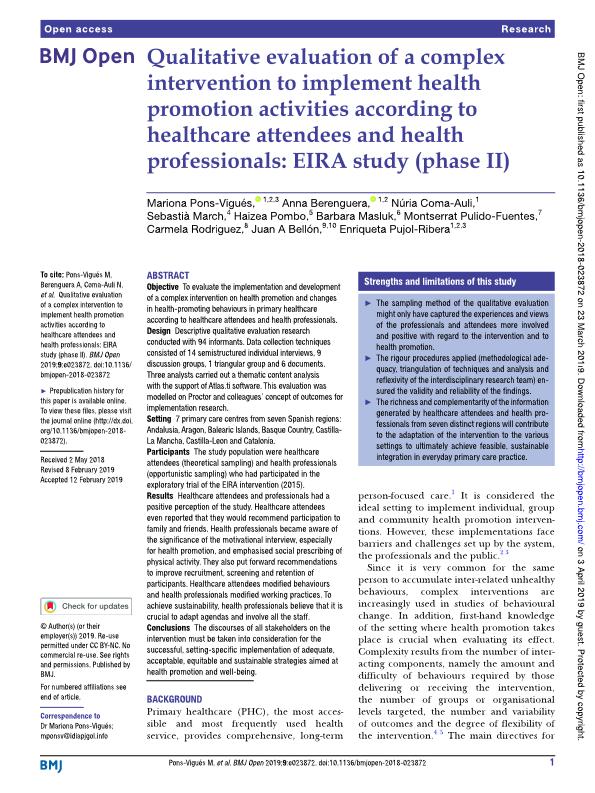
Resumen: Objective: To evaluate the implementation and development of a complex intervention on health promotion and changes in health-promoting behaviours in primary healthcare according to healthcare attendees and health professionals.
Design: Descriptive qualitative evaluation research conducted with 94 informants. Data collection techniques consisted of 14 semistructured individual interviews, 9 discussion groups, 1 triangular group and 6 documents. Three analysts carried out a thematic content analysis with the support of Atlas.ti software. This evaluation was modelled on Proctor and colleagues’ concept of outcomes for implementation research.
Setting: 7 primary care centres from seven Spanish regions: Andalusia, Aragon, Balearic Islands, Basque Country, Castilla-La Mancha, Castilla-Leon and Catalonia.
Participants: The study population were healthcare attendees (theoretical sampling) and health professionals (opportunistic sampling) who had participated in the exploratory trial of the EIRA intervention (2015).
Results: Healthcare attendees and professionals had a positive perception of the study. Healthcare attendees even reported that they would recommend participation to family and friends. Health professionals became aware of the significance of the motivational interview, especially for health promotion, and emphasised social prescribing of physical activity. They also put forward recommendations to improve recruitment, screening and retention of participants. Healthcare attendees modified behaviours and health professionals modified working practices. To achieve sustainability, health professionals believe that it is crucial to adapt agendas and involve all the staff.
Conclusions: The discourses of all stakeholders on the intervention must be taken into consideration for the successful, setting-specific implementation of adequate, acceptable, equitable and sustainable strategies aimed at health promotion and well-being.
Idioma: Inglés
DOI: 10.1136/bmjopen-2018-023872
Año: 2019
Publicado en: BMJ open 9, 3 (2019), e023872 [14 pp]
ISSN: 2044-6055
Factor impacto JCR: 2.496 (2019)
Categ. JCR: MEDICINE, GENERAL & INTERNAL rank: 52 / 165 = 0.315 (2019) - Q2 - T1
Factor impacto SCIMAGO: 1.247 - Medicine (miscellaneous) (Q1)
Financiación: info:eu-repo/grantAgreement/EUR/EC/ERDF-FEDER
Financiación: info:eu-repo/grantAgreement/ES/ISCIII/RD12-0005-0001
Financiación: info:eu-repo/grantAgreement/ES/ISCIII/RD16-0007-0001
Financiación: info:eu-repo/grantAgreement/ES/MINECO-ISCIII/PI12-001616
Financiación: info:eu-repo/grantAgreement/ES/MINECO-ISCIII/PI12-01914
Financiación: info:eu-repo/grantAgreement/ES/MINECO-ISCIII/PI12-01974
Financiación: info:eu-repo/grantAgreement/ES/MINECO-ISCIII/PI12-02379
Financiación: info:eu-repo/grantAgreement/ES/MINECO-ISCIII/PI12-02608
Financiación: info:eu-repo/grantAgreement/ES/MINECO-ISCIII/PI12-02635
Financiación: info:eu-repo/grantAgreement/ES/MINECO-ISCIII/PI12-02774
Financiación: info:eu-repo/grantAgreement/ES/MINECO/ISCIII/P15-00114
Tipo y forma: Article (Published version)
Área (Departamento): Área Psicolog.Evolut.Educac (Dpto. Psicología y Sociología)
 You must give appropriate credit, provide a link to the license, and indicate if changes were made. You may do so in any reasonable manner, but not in any way that suggests the licensor endorses you or your use. You may not use the material for commercial purposes.
Exportado de SIDERAL (2021-02-24-12:57:01)
Visitas y descargas
Design: Descriptive qualitative evaluation research conducted with 94 informants. Data collection techniques consisted of 14 semistructured individual interviews, 9 discussion groups, 1 triangular group and 6 documents. Three analysts carried out a thematic content analysis with the support of Atlas.ti software. This evaluation was modelled on Proctor and colleagues’ concept of outcomes for implementation research.
Setting: 7 primary care centres from seven Spanish regions: Andalusia, Aragon, Balearic Islands, Basque Country, Castilla-La Mancha, Castilla-Leon and Catalonia.
Participants: The study population were healthcare attendees (theoretical sampling) and health professionals (opportunistic sampling) who had participated in the exploratory trial of the EIRA intervention (2015).
Results: Healthcare attendees and professionals had a positive perception of the study. Healthcare attendees even reported that they would recommend participation to family and friends. Health professionals became aware of the significance of the motivational interview, especially for health promotion, and emphasised social prescribing of physical activity. They also put forward recommendations to improve recruitment, screening and retention of participants. Healthcare attendees modified behaviours and health professionals modified working practices. To achieve sustainability, health professionals believe that it is crucial to adapt agendas and involve all the staff.
Conclusions: The discourses of all stakeholders on the intervention must be taken into consideration for the successful, setting-specific implementation of adequate, acceptable, equitable and sustainable strategies aimed at health promotion and well-being.
Idioma: Inglés
DOI: 10.1136/bmjopen-2018-023872
Año: 2019
Publicado en: BMJ open 9, 3 (2019), e023872 [14 pp]
ISSN: 2044-6055
Factor impacto JCR: 2.496 (2019)
Categ. JCR: MEDICINE, GENERAL & INTERNAL rank: 52 / 165 = 0.315 (2019) - Q2 - T1
Factor impacto SCIMAGO: 1.247 - Medicine (miscellaneous) (Q1)
Financiación: info:eu-repo/grantAgreement/EUR/EC/ERDF-FEDER
Financiación: info:eu-repo/grantAgreement/ES/ISCIII/RD12-0005-0001
Financiación: info:eu-repo/grantAgreement/ES/ISCIII/RD16-0007-0001
Financiación: info:eu-repo/grantAgreement/ES/MINECO-ISCIII/PI12-001616
Financiación: info:eu-repo/grantAgreement/ES/MINECO-ISCIII/PI12-01914
Financiación: info:eu-repo/grantAgreement/ES/MINECO-ISCIII/PI12-01974
Financiación: info:eu-repo/grantAgreement/ES/MINECO-ISCIII/PI12-02379
Financiación: info:eu-repo/grantAgreement/ES/MINECO-ISCIII/PI12-02608
Financiación: info:eu-repo/grantAgreement/ES/MINECO-ISCIII/PI12-02635
Financiación: info:eu-repo/grantAgreement/ES/MINECO-ISCIII/PI12-02774
Financiación: info:eu-repo/grantAgreement/ES/MINECO/ISCIII/P15-00114
Tipo y forma: Article (Published version)
Área (Departamento): Área Psicolog.Evolut.Educac (Dpto. Psicología y Sociología)
You must give appropriate credit, provide a link to the license, and indicate if changes were made. You may do so in any reasonable manner, but not in any way that suggests the licensor endorses you or your use. You may not use the material for commercial purposes. Exportado de SIDERAL (2021-02-24-12:57:01)
Permalink:
Visitas y descargas
Este artículo se encuentra en las siguientes colecciones:
Articles > Artículos por área > Psicología Evolutiva y de la Educación
Record created 2019-04-12, last modified 2021-02-24