Use of Nutritional Supplements in Youth with Medicated and Unmedicated Attention-Deficit/Hyperactivity Disorder
Scholle, O. ; Jilani, H. ; Riedel, O. ; Banaschewski, T. ; Hadjigeorgiou, C. ; Hunsberger, M. ; Iguacel, I. (Universidad de Zaragoza) ; Molnar, D. ; Pala, V. ; Russo, P. ; Veidebaum, T. ; Zaqout, M. ; Pohlabeln, H.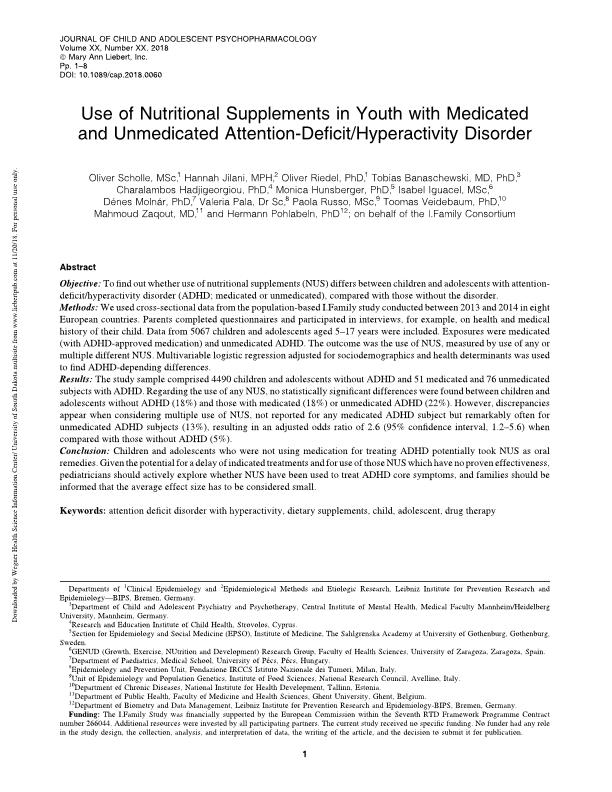

Resumen: Objective: To find out whether use of nutritional supplements (NUS) differs between children and adolescents with attention-deficit/hyperactivity disorder (ADHD; medicated or unmedicated), compared with those without the disorder.
Methods: We used cross-sectional data from the population-based I.Family study conducted between 2013 and 2014 in eight European countries. Parents completed questionnaires and participated in interviews, for example, on health and medical history of their child. Data from 5067 children and adolescents aged 5-17 years were included. Exposures were medicated (with ADHD-approved medication) and unmedicated ADHD. The outcome was the use of NUS, measured by use of any or multiple different NUS. Multivariable logistic regression adjusted for sociodemographics and health determinants was used to find ADHD-depending differences.
Results: The study sample comprised 4490 children and adolescents without ADHD and 51 medicated and 76 unmedicated subjects with ADHD. Regarding the use of any NUS, no statistically significant differences were found between children and adolescents without ADHD (18%) and those with medicated (18%) or unmedicated ADHD (22%). However, discrepancies appear when considering multiple use of NUS, not reported for any medicated ADHD subject but remarkably often for unmedicated ADHD subjects (13%), resulting in an adjusted odds ratio of 2.6 (95% confidence interval, 1.2-5.6) when compared with those without ADHD (5%).
Conclusion: Children and adolescents who were not using medication for treating ADHD potentially took NUS as oral remedies. Given the potential for a delay of indicated treatments and for use of those NUS which have no proven effectiveness, pediatricians should actively explore whether NUS have been used to treat ADHD core symptoms, and families should be informed that the average effect size has to be considered small.
Idioma: Inglés
DOI: 10.1089/cap.2018.0060
Año: 2018
Publicado en: JOURNAL OF CHILD AND ADOLESCENT PSYCHOPHARMACOLOGY 29, 1 (2018), 58-65
ISSN: 1044-5463
Factor impacto JCR: 2.16 (2018)
Categ. JCR: PEDIATRICS rank: 47 / 124 = 0.379 (2018) - Q2 - T2
Categ. JCR: PSYCHIATRY rank: 86 / 146 = 0.589 (2018) - Q3 - T2
Categ. JCR: PHARMACOLOGY & PHARMACY rank: 166 / 266 = 0.624 (2018) - Q3 - T2
Factor impacto SCIMAGO: 1.0 - Pediatrics, Perinatology and Child Health (Q1) - Psychiatry and Mental Health (Q1) - Pharmacology (medical) (Q1)
Financiación: info:eu-repo/grantAgreement/EC/FP7/266044/EU/Determinants of eating behaviour in European children, adolescents and their parents/I.FAMILY
Tipo y forma: Article (PostPrint)
Área (Departamento): Área Enfermería (Dpto. Fisiatría y Enfermería)
Exportado de SIDERAL (2020-11-13-14:09:55)
Visitas y descargas
Methods: We used cross-sectional data from the population-based I.Family study conducted between 2013 and 2014 in eight European countries. Parents completed questionnaires and participated in interviews, for example, on health and medical history of their child. Data from 5067 children and adolescents aged 5-17 years were included. Exposures were medicated (with ADHD-approved medication) and unmedicated ADHD. The outcome was the use of NUS, measured by use of any or multiple different NUS. Multivariable logistic regression adjusted for sociodemographics and health determinants was used to find ADHD-depending differences.
Results: The study sample comprised 4490 children and adolescents without ADHD and 51 medicated and 76 unmedicated subjects with ADHD. Regarding the use of any NUS, no statistically significant differences were found between children and adolescents without ADHD (18%) and those with medicated (18%) or unmedicated ADHD (22%). However, discrepancies appear when considering multiple use of NUS, not reported for any medicated ADHD subject but remarkably often for unmedicated ADHD subjects (13%), resulting in an adjusted odds ratio of 2.6 (95% confidence interval, 1.2-5.6) when compared with those without ADHD (5%).
Conclusion: Children and adolescents who were not using medication for treating ADHD potentially took NUS as oral remedies. Given the potential for a delay of indicated treatments and for use of those NUS which have no proven effectiveness, pediatricians should actively explore whether NUS have been used to treat ADHD core symptoms, and families should be informed that the average effect size has to be considered small.
Idioma: Inglés
DOI: 10.1089/cap.2018.0060
Año: 2018
Publicado en: JOURNAL OF CHILD AND ADOLESCENT PSYCHOPHARMACOLOGY 29, 1 (2018), 58-65
ISSN: 1044-5463
Factor impacto JCR: 2.16 (2018)
Categ. JCR: PEDIATRICS rank: 47 / 124 = 0.379 (2018) - Q2 - T2
Categ. JCR: PSYCHIATRY rank: 86 / 146 = 0.589 (2018) - Q3 - T2
Categ. JCR: PHARMACOLOGY & PHARMACY rank: 166 / 266 = 0.624 (2018) - Q3 - T2
Factor impacto SCIMAGO: 1.0 - Pediatrics, Perinatology and Child Health (Q1) - Psychiatry and Mental Health (Q1) - Pharmacology (medical) (Q1)
Financiación: info:eu-repo/grantAgreement/EC/FP7/266044/EU/Determinants of eating behaviour in European children, adolescents and their parents/I.FAMILY
Tipo y forma: Article (PostPrint)
Área (Departamento): Área Enfermería (Dpto. Fisiatría y Enfermería)
Exportado de SIDERAL (2020-11-13-14:09:55)
Permalink:
Visitas y descargas
Este artículo se encuentra en las siguientes colecciones:
articulos > articulos-por-area > enfermeria
Notice créée le 2019-11-18, modifiée le 2020-11-13