Impact of stress on health and final weight in fattening lambs
Navarro, Teresa ; González, José María (Universidad de Zaragoza) ; Ramos, Juan José (Universidad de Zaragoza) ; Marca, María Carmen (Universidad de Zaragoza) ; Figliola, Lucía ; Ruiz de Arcaute, Marta (Universidad de Zaragoza) ; Borobia, Marta (Universidad de Zaragoza) ; Ortín, Aurora (Universidad de Zaragoza)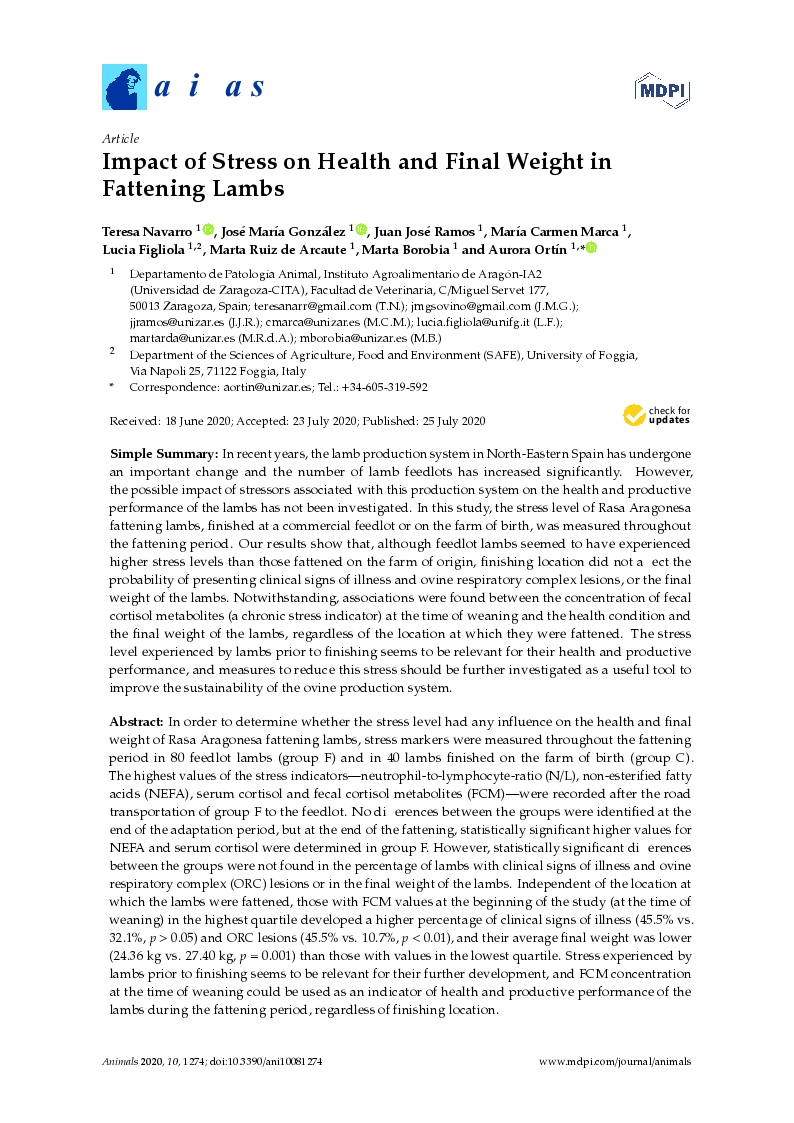
Resumen: In order to determine whether the stress level had any influence on the health and final weight of Rasa Aragonesa fattening lambs, stress markers were measured throughout the fattening period in 80 feedlot lambs (group F) and in 40 lambs finished on the farm of birth (group C). The highest values of the stress indicators—neutrophil-to-lymphocyte-ratio (N/L), non-esterified fatty acids (NEFA), serum cortisol and fecal cortisol metabolites (FCM)—were recorded after the road transportation of group F to the feedlot. No differences between the groups were identified at the end of the adaptation period, but at the end of the fattening, statistically significant higher values for NEFA and serum cortisol were determined in group F. However, statistically significant differences between the groups were not found in the percentage of lambs with clinical signs of illness and ovine respiratory complex (ORC) lesions or in the final weight of the lambs. Independent of the location at which the lambs were fattened, those with FCM values at the beginning of the study (at the time of weaning) in the highest quartile developed a higher percentage of clinical signs of illness (45.5% vs. 32.1%, p > 0.05) and ORC lesions (45.5% vs. 10.7%, p < 0.01), and their average final weight was lower (24.36 kg vs. 27.40 kg, p = 0.001) than those with values in the lowest quartile. Stress experienced by lambs prior to finishing seems to be relevant for their further development, and FCM concentration at the time of weaning could be used as an indicator of health and productive performance of the lambs during the fattening period, regardless of finishing location.
Idioma: Inglés
DOI: 10.3390/ani10081274
Año: 2020
Publicado en: Animals 10, 8 (2020), 1274 1-14
ISSN: 2076-2615
Factor impacto JCR: 2.752 (2020)
Categ. JCR: VETERINARY SCIENCES rank: 19 / 146 = 0.13 (2020) - Q1 - T1
Categ. JCR: AGRICULTURE, DAIRY & ANIMAL SCIENCE rank: 13 / 63 = 0.206 (2020) - Q1 - T1
Factor impacto SCIMAGO: 0.583 - Veterinary (miscellaneous) (Q1) - Animal Science and Zoology (Q1)
Financiación: info:eu-repo/grantAgreement/ES/DGA/A15-17R
Financiación: info:eu-repo/grantAgreement/ES/MINECO/AGL2015-67690-R
Tipo y forma: Article (Published version)
Área (Departamento): Área Medicina y Cirugía Animal (Dpto. Patología Animal)
 You must give appropriate credit, provide a link to the license, and indicate if changes were made. You may do so in any reasonable manner, but not in any way that suggests the licensor endorses you or your use.
Exportado de SIDERAL (2022-01-11-13:53:04)
Visitas y descargas
Idioma: Inglés
DOI: 10.3390/ani10081274
Año: 2020
Publicado en: Animals 10, 8 (2020), 1274 1-14
ISSN: 2076-2615
Factor impacto JCR: 2.752 (2020)
Categ. JCR: VETERINARY SCIENCES rank: 19 / 146 = 0.13 (2020) - Q1 - T1
Categ. JCR: AGRICULTURE, DAIRY & ANIMAL SCIENCE rank: 13 / 63 = 0.206 (2020) - Q1 - T1
Factor impacto SCIMAGO: 0.583 - Veterinary (miscellaneous) (Q1) - Animal Science and Zoology (Q1)
Financiación: info:eu-repo/grantAgreement/ES/DGA/A15-17R
Financiación: info:eu-repo/grantAgreement/ES/MINECO/AGL2015-67690-R
Tipo y forma: Article (Published version)
Área (Departamento): Área Medicina y Cirugía Animal (Dpto. Patología Animal)
You must give appropriate credit, provide a link to the license, and indicate if changes were made. You may do so in any reasonable manner, but not in any way that suggests the licensor endorses you or your use. Exportado de SIDERAL (2022-01-11-13:53:04)
Permalink:
Visitas y descargas
Este artículo se encuentra en las siguientes colecciones:
Articles > Artículos por área > Medicina y Cirugía Animal
Record created 2020-09-25, last modified 2022-01-11