Impact of COVID-19 pandemic on mental health: An international study
Gloster, A.T. ; Lamnisos, D. ; Lubenko, J. ; Presti, G. ; Squatrito, V. ; Constantinou, M. ; Nicolaou, C. ; Papacostas, S. ; Aydin, G. ; Chong, Y.Y. ; Chien, W.T. ; Cheng, H.Y. ; Ruiz, F.J. ; Garcia-Martin, M.B. ; Obando-Posada, D.P. ; Segura-Vargas, M.A. ; Vasiliou, V.S. ; McHugh, L. ; Höfer, S. ; Baban, A. ; Neto, D.D. ; da Silva, A.N. ; Monestès, J.L. ; Alvarez-Galvez, J. ; Paez-Blarrina, M. ; Montesinos, F. ; Valdivia-Salas, S. (Universidad de Zaragoza) ; Ori, D. ; Kleszcz, B. ; Lappalainen, R. ; Ivanovic, I. ; Gosar, D. ; Dionne, F. ; Merwin, R.M. ; Kassianos, A.P. ; Karekla, M.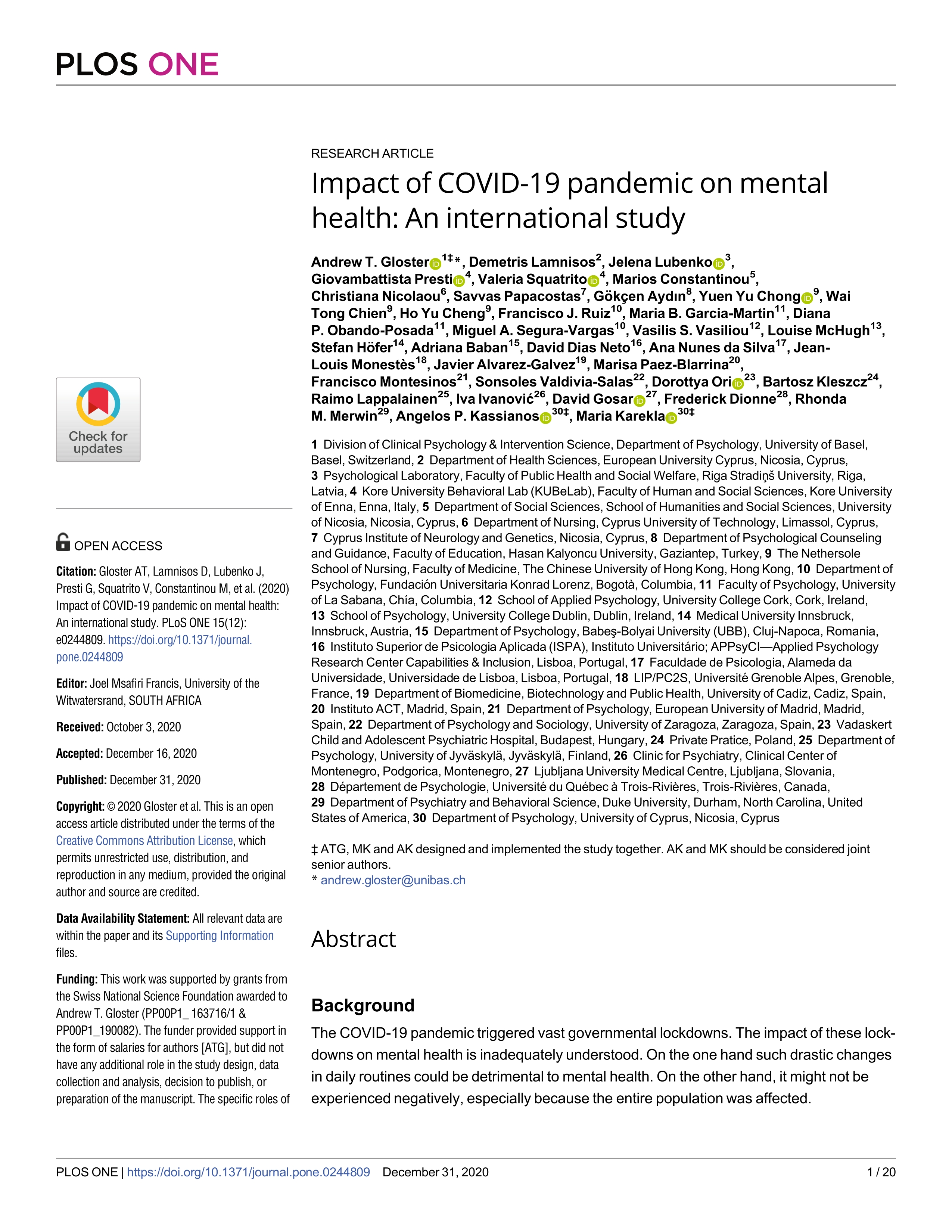
Resumen: Background
The COVID-19 pandemic triggered vast governmental lockdowns. The impact of these lockdowns on mental health is inadequately understood. On the one hand such drastic changes in daily routines could be detrimental to mental health. On the other hand, it might not be experienced negatively, especially because the entire population was affected.
Methods
The aim of this study was to determine mental health outcomes during pandemic induced lockdowns and to examine known predictors of mental health outcomes. We therefore surveyed n = 9, 565 people from 78 countries and 18 languages. Outcomes assessed were stress, depression, affect, and wellbeing. Predictors included country, sociodemographic factors, lockdown characteristics, social factors, and psychological factors.
Results
Results indicated that on average about 10% of the sample was languishing from low levels of mental health and about 50% had only moderate mental health. Importantly, three consistent predictors of mental health emerged: social support, education level, and psychologically flexible (vs. rigid) responding. Poorer outcomes were most strongly predicted by a worsening of finances and not having access to basic supplies.
Conclusions
These results suggest that on whole, respondents were moderately mentally healthy at the time of a population-wide lockdown. The highest level of mental health difficulties were found in approximately 10% of the population. Findings suggest that public health initiatives should target people without social support and those whose finances worsen as a result of the lockdown. Interventions that promote psychological flexibility may mitigate the impact of the pandemic.
Idioma: Inglés
DOI: 10.1371/journal.pone.0244809
Año: 2020
Publicado en: PLoS ONE 15, 12 December (2020), e0244809 [20 pp]
ISSN: 1932-6203
Factor impacto JCR: 3.24 (2020)
Categ. JCR: MULTIDISCIPLINARY SCIENCES rank: 26 / 73 = 0.356 (2020) - Q2 - T2
Factor impacto SCIMAGO: 0.99 - Multidisciplinary (Q1)
Tipo y forma: Article (Published version)
Área (Departamento): Área Person.Eval.Trat.Psicoló. (Dpto. Psicología y Sociología)
 You must give appropriate credit, provide a link to the license, and indicate if changes were made. You may do so in any reasonable manner, but not in any way that suggests the licensor endorses you or your use.
Exportado de SIDERAL (2022-02-08-11:25:35)
Visitas y descargas
The COVID-19 pandemic triggered vast governmental lockdowns. The impact of these lockdowns on mental health is inadequately understood. On the one hand such drastic changes in daily routines could be detrimental to mental health. On the other hand, it might not be experienced negatively, especially because the entire population was affected.
Methods
The aim of this study was to determine mental health outcomes during pandemic induced lockdowns and to examine known predictors of mental health outcomes. We therefore surveyed n = 9, 565 people from 78 countries and 18 languages. Outcomes assessed were stress, depression, affect, and wellbeing. Predictors included country, sociodemographic factors, lockdown characteristics, social factors, and psychological factors.
Results
Results indicated that on average about 10% of the sample was languishing from low levels of mental health and about 50% had only moderate mental health. Importantly, three consistent predictors of mental health emerged: social support, education level, and psychologically flexible (vs. rigid) responding. Poorer outcomes were most strongly predicted by a worsening of finances and not having access to basic supplies.
Conclusions
These results suggest that on whole, respondents were moderately mentally healthy at the time of a population-wide lockdown. The highest level of mental health difficulties were found in approximately 10% of the population. Findings suggest that public health initiatives should target people without social support and those whose finances worsen as a result of the lockdown. Interventions that promote psychological flexibility may mitigate the impact of the pandemic.
Idioma: Inglés
DOI: 10.1371/journal.pone.0244809
Año: 2020
Publicado en: PLoS ONE 15, 12 December (2020), e0244809 [20 pp]
ISSN: 1932-6203
Factor impacto JCR: 3.24 (2020)
Categ. JCR: MULTIDISCIPLINARY SCIENCES rank: 26 / 73 = 0.356 (2020) - Q2 - T2
Factor impacto SCIMAGO: 0.99 - Multidisciplinary (Q1)
Tipo y forma: Article (Published version)
Área (Departamento): Área Person.Eval.Trat.Psicoló. (Dpto. Psicología y Sociología)
You must give appropriate credit, provide a link to the license, and indicate if changes were made. You may do so in any reasonable manner, but not in any way that suggests the licensor endorses you or your use. Exportado de SIDERAL (2022-02-08-11:25:35)
Permalink:
Visitas y descargas
Este artículo se encuentra en las siguientes colecciones:
Articles > Artículos por área > Personalidad,Evaluación y Tratamiento Psicológicos
Record created 2021-02-12, last modified 2022-02-08