Biomechanical Behavior of an Hydroxyapatite-Coated Traditional Hip Stem and a Short One of Similar Design: Comparative Study Using Finite Element Analysis
Gómez-Vallejo, J. (Universidad de Zaragoza) ; Roces-García, J. ; Moreta, J. ; Donaire-Hoyas, D. ; Gayoso, Ó. ; Marqués-López, F. ; Albareda, J. (Universidad de Zaragoza)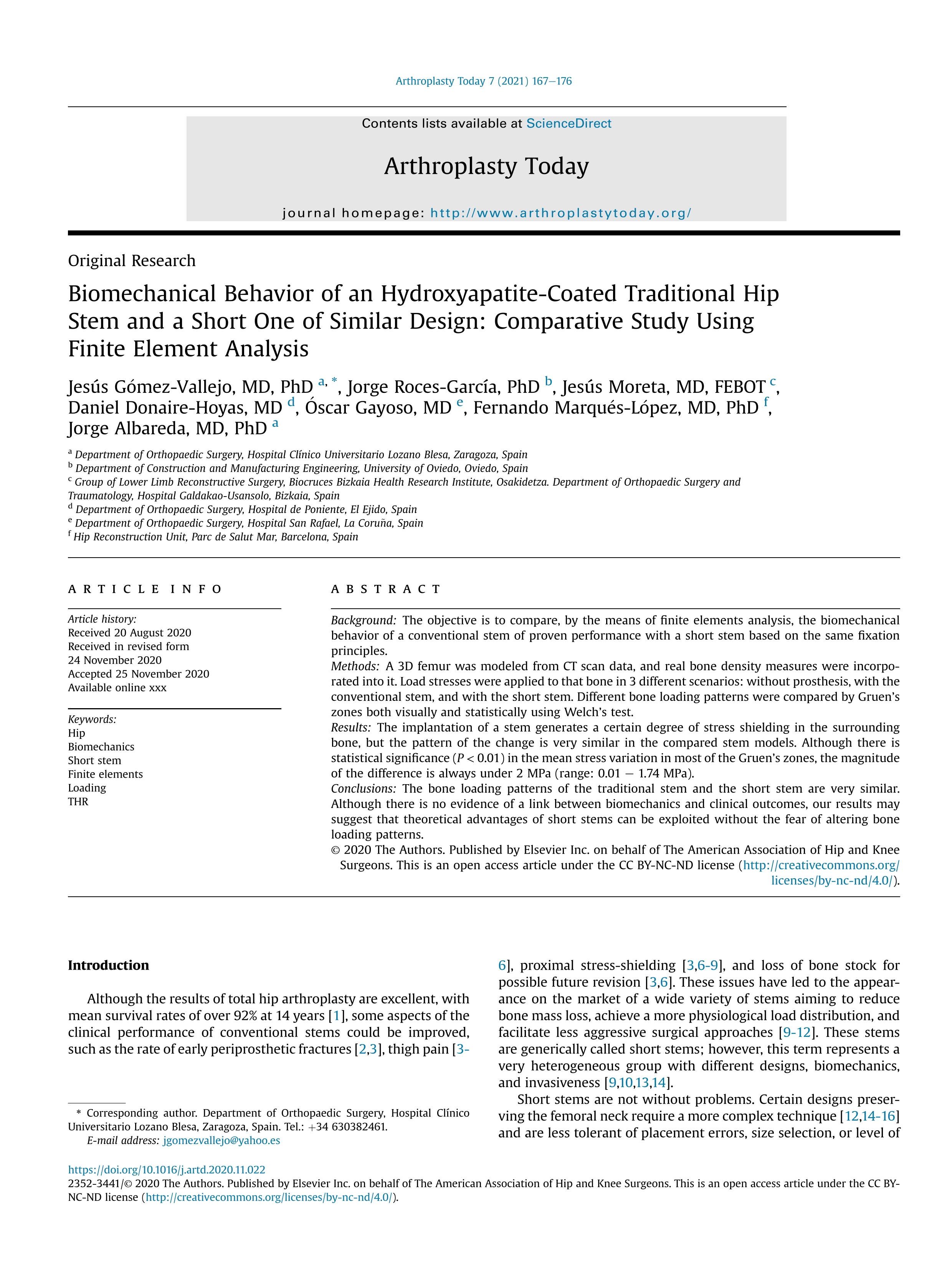
Resumen: Background: The objective is to compare, by the means of finite elements analysis, the biomechanical behavior of a conventional stem of proven performance with a short stem based on the same fixation principles.
Methods: A 3D femur was modeled from CT scan data, and real bone density measures were incorporated into it. Load stresses were applied to that bone in 3 different scenarios: without prosthesis, with the conventional stem, and with the short stem. Different bone loading patterns were compared by Gruen''s zones both visually and statistically using Welch''s test.
Results: The implantation of a stem generates a certain degree of stress shielding in the surrounding bone, but the pattern of the change is very similar in the compared stem models. Although there is statistical significance (P < 0.01) in the mean stress variation in most of the Gruen''s zones, the magnitude of the difference is always under 2 MPa (range: 0.01 – 1.74 MPa).
Conclusions: The bone loading patterns of the traditional stem and the short stem are very similar. Although there is no evidence of a link between biomechanics and clinical outcomes, our results may suggest that theoretical advantages of short stems can be exploited without the fear of altering bone loading patterns.
Idioma: Inglés
DOI: 10.1016/j.artd.2020.11.022
Año: 2021
Publicado en: Arthroplasty Today 7 (2021), 167-176
ISSN: 2352-3441
Factor impacto CITESCORE: 2.0 - Medicine (Q3)
Factor impacto SCIMAGO: 0.809 - Surgery (Q1) - Orthopedics and Sports Medicine (Q1)
Tipo y forma: Artículo (Versión definitiva)
Área (Departamento): Área Traumatología y Ortopedia (Dpto. Cirugía)
 Debe reconocer adecuadamente la autoría, proporcionar un enlace a la licencia e indicar si se han realizado cambios. Puede hacerlo de cualquier manera razonable, pero no de una manera que sugiera que tiene el apoyo del licenciador o lo recibe por el uso que hace. No puede utilizar el material para una finalidad comercial. Si remezcla, transforma o crea a partir del material, no puede difundir el material modificado.
Exportado de SIDERAL (2026-01-26-14:59:50)
Visitas y descargas
Methods: A 3D femur was modeled from CT scan data, and real bone density measures were incorporated into it. Load stresses were applied to that bone in 3 different scenarios: without prosthesis, with the conventional stem, and with the short stem. Different bone loading patterns were compared by Gruen''s zones both visually and statistically using Welch''s test.
Results: The implantation of a stem generates a certain degree of stress shielding in the surrounding bone, but the pattern of the change is very similar in the compared stem models. Although there is statistical significance (P < 0.01) in the mean stress variation in most of the Gruen''s zones, the magnitude of the difference is always under 2 MPa (range: 0.01 – 1.74 MPa).
Conclusions: The bone loading patterns of the traditional stem and the short stem are very similar. Although there is no evidence of a link between biomechanics and clinical outcomes, our results may suggest that theoretical advantages of short stems can be exploited without the fear of altering bone loading patterns.
Idioma: Inglés
DOI: 10.1016/j.artd.2020.11.022
Año: 2021
Publicado en: Arthroplasty Today 7 (2021), 167-176
ISSN: 2352-3441
Factor impacto CITESCORE: 2.0 - Medicine (Q3)
Factor impacto SCIMAGO: 0.809 - Surgery (Q1) - Orthopedics and Sports Medicine (Q1)
Tipo y forma: Artículo (Versión definitiva)
Área (Departamento): Área Traumatología y Ortopedia (Dpto. Cirugía)
Debe reconocer adecuadamente la autoría, proporcionar un enlace a la licencia e indicar si se han realizado cambios. Puede hacerlo de cualquier manera razonable, pero no de una manera que sugiera que tiene el apoyo del licenciador o lo recibe por el uso que hace. No puede utilizar el material para una finalidad comercial. Si remezcla, transforma o crea a partir del material, no puede difundir el material modificado.Exportado de SIDERAL (2026-01-26-14:59:50)
Enlace permanente:
Visitas y descargas
Este artículo se encuentra en las siguientes colecciones:
Artículos > Artículos por área > Traumatología y Ortopedia
Registro creado el 2021-03-09, última modificación el 2026-01-26