Relaxation Mechanisms and Strain-Controlled Oxygen Vacancies in Epitaxial SrMnO3 Films
Langenberg, Eric ; Maurel, Laura ; Antorrena, Guillermo ; Algarabel, Pedro A. ; Magén, César (Universidad de Zaragoza) ; Pardo, José A. (Universidad de Zaragoza)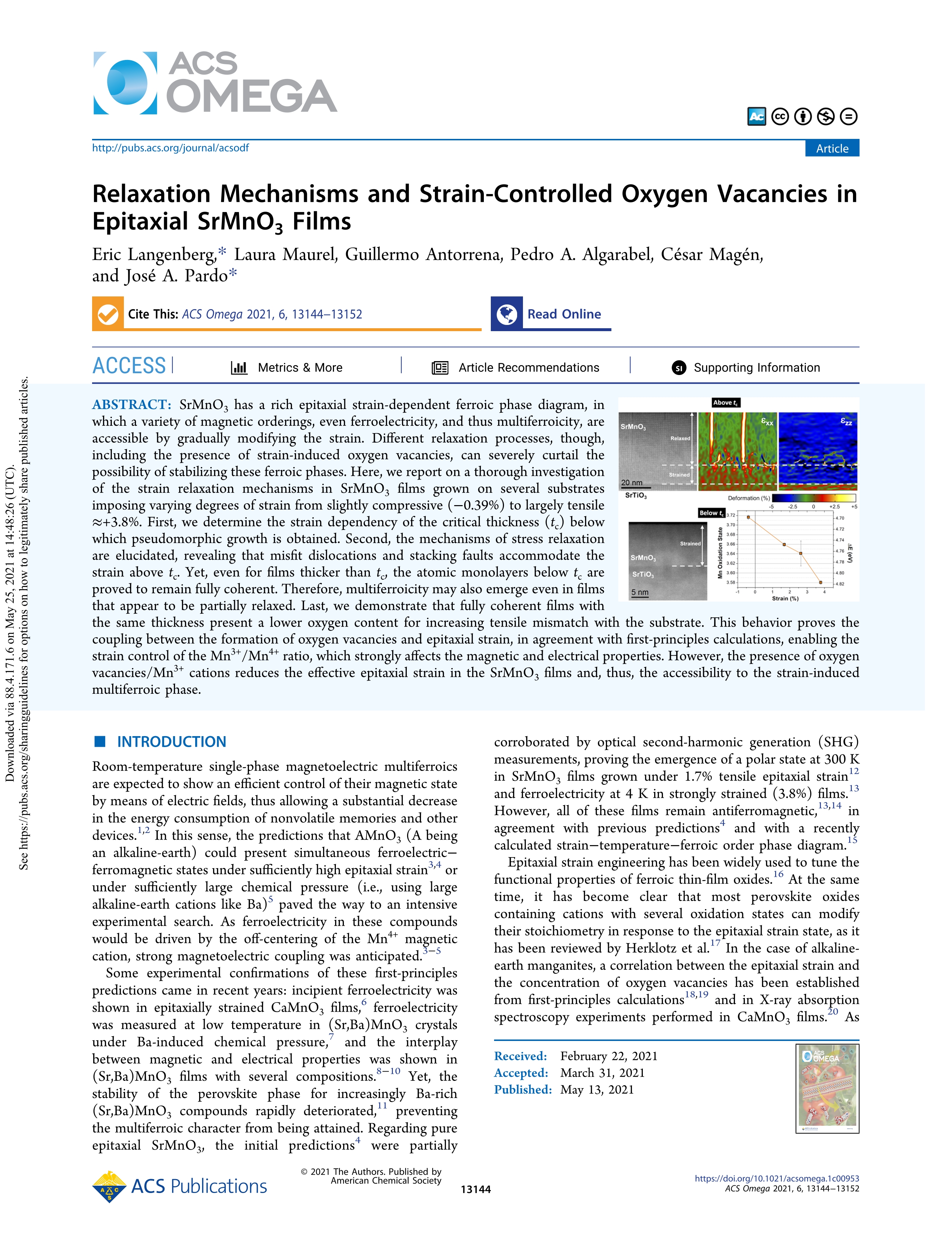

Resumen: : SrMnO3 has a rich epitaxial strain-dependent ferroic phase diagram, in which a variety of magnetic orderings, even ferroelectricity, and thus multiferroicity, are accessible by gradually modifying the strain. Different relaxation processes, though, including the presence of strain-induced oxygen vacancies, can severely curtail the possibility of stabilizing these ferroic phases. Here, we report on a thorough investigation of the strain relaxation mechanisms in SrMnO3 films grown on several substrates imposing varying degrees of strain from slightly compressive (−0.39%) to largely tensile ≈+3.8%. First, we determine the strain dependency of the critical thickness (tc) below which pseudomorphic growth is obtained. Second, the mechanisms of stress relaxation are elucidated, revealing that misfit dislocations and stacking faults accommodate the strain above tc. Yet, even for films thicker than tc, the atomic monolayers below tc are proved to remain fully coherent. Therefore, multiferroicity may also emerge even in films that appear to be partially relaxed. Last, we demonstrate that fully coherent films with the same thickness present a lower oxygen content for increasing tensile mismatch with the substrate. This behavior proves the coupling between the formation of oxygen vacancies and epitaxial strain, in agreement with first-principles calculations, enabling the
strain control of the Mn3+/Mn4+ ratio, which strongly affects the magnetic and electrical properties. However, the presence of oxygen vacancies/Mn3+ cations reduces the effective epitaxial strain in the SrMnO3 films and, thus, the accessibility to the strain-induced multiferroic phase.
Idioma: Inglés
DOI: 10.1021/acsomega.1c00953
Año: 2021
Publicado en: ACS OMEGA 6, 20 (2021), 13144–13152
ISSN: 2470-1343
Factor impacto JCR: 4.132 (2021)
Categ. JCR: CHEMISTRY, MULTIDISCIPLINARY rank: 73 / 180 = 0.406 (2021) - Q2 - T2
Factor impacto CITESCORE: 5.2 - Chemical Engineering (Q2)
Factor impacto SCIMAGO: 0.708 - Chemistry (miscellaneous) (Q1) - Chemical Engineering (miscellaneous) (Q1)
Financiación: info:eu-repo/grantAgreement/ES/DGA/E13-20R
Financiación: info:eu-repo/grantAgreement/ES/DGA/E28-20R
Financiación: info:eu-repo/grantAgreement/EC/H2020/823717/EU/Enabling Science and Technology through European Electron Microscopy/ESTEEM3
Financiación: info:eu-repo/grantAgreement/ES/MICINN/MAT2017-82970-C2-1-R
Financiación: info:eu-repo/grantAgreement/ES/MICINN/MAT2017-82970-C2-2-R
Tipo y forma: Artículo (Versión definitiva)
Área (Departamento): Área Física Materia Condensada (Dpto. Física Materia Condensa.)
Área (Departamento): Área Cienc.Mater. Ingen.Metal. (Dpto. Ciencia Tecnol.Mater.Fl.)
 Debe reconocer adecuadamente la autoría, proporcionar un enlace a la licencia e indicar si se han realizado cambios. Puede hacerlo de cualquier manera razonable, pero no de una manera que sugiera que tiene el apoyo del licenciador o lo recibe por el uso que hace.
Exportado de SIDERAL (2023-05-18-13:51:55)
Visitas y descargas
strain control of the Mn3+/Mn4+ ratio, which strongly affects the magnetic and electrical properties. However, the presence of oxygen vacancies/Mn3+ cations reduces the effective epitaxial strain in the SrMnO3 films and, thus, the accessibility to the strain-induced multiferroic phase.
Idioma: Inglés
DOI: 10.1021/acsomega.1c00953
Año: 2021
Publicado en: ACS OMEGA 6, 20 (2021), 13144–13152
ISSN: 2470-1343
Factor impacto JCR: 4.132 (2021)
Categ. JCR: CHEMISTRY, MULTIDISCIPLINARY rank: 73 / 180 = 0.406 (2021) - Q2 - T2
Factor impacto CITESCORE: 5.2 - Chemical Engineering (Q2)
Factor impacto SCIMAGO: 0.708 - Chemistry (miscellaneous) (Q1) - Chemical Engineering (miscellaneous) (Q1)
Financiación: info:eu-repo/grantAgreement/ES/DGA/E13-20R
Financiación: info:eu-repo/grantAgreement/ES/DGA/E28-20R
Financiación: info:eu-repo/grantAgreement/EC/H2020/823717/EU/Enabling Science and Technology through European Electron Microscopy/ESTEEM3
Financiación: info:eu-repo/grantAgreement/ES/MICINN/MAT2017-82970-C2-1-R
Financiación: info:eu-repo/grantAgreement/ES/MICINN/MAT2017-82970-C2-2-R
Tipo y forma: Artículo (Versión definitiva)
Área (Departamento): Área Física Materia Condensada (Dpto. Física Materia Condensa.)
Área (Departamento): Área Cienc.Mater. Ingen.Metal. (Dpto. Ciencia Tecnol.Mater.Fl.)
Debe reconocer adecuadamente la autoría, proporcionar un enlace a la licencia e indicar si se han realizado cambios. Puede hacerlo de cualquier manera razonable, pero no de una manera que sugiera que tiene el apoyo del licenciador o lo recibe por el uso que hace. Exportado de SIDERAL (2023-05-18-13:51:55)
Enlace permanente:
Visitas y descargas
Este artículo se encuentra en las siguientes colecciones:
Artículos > Artículos por área > Ciencia de los Materiales e Ingeniería Metalúrgica
Artículos > Artículos por área > Física de la Materia Condensada
Registro creado el 2021-08-20, última modificación el 2023-05-19