Hybrid thermoresponsive nanoparticles containing drug nanocrystals for NIR-triggered remote release
Alejo, Teresa (Universidad de Zaragoza) ; Sebastian, Victor (Universidad de Zaragoza) ; Mendoza, Gracia ; Arruebo, Manuel (Universidad de Zaragoza)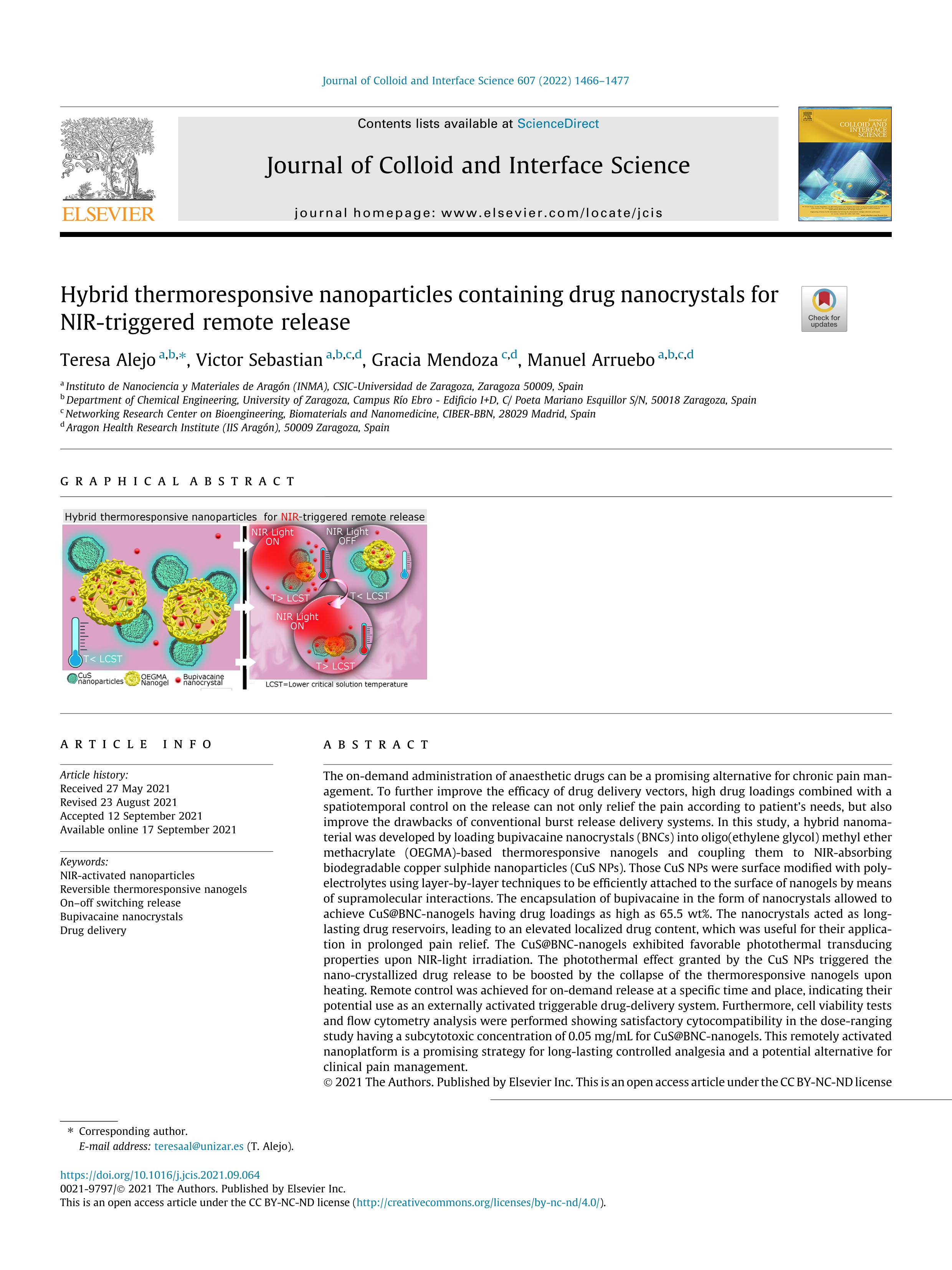
Resumen: The on-demand administration of anaesthetic drugs can be a promising alternative for chronic pain management. To further improve the efficacy of drug delivery vectors, high drug loadings combined with a spatiotemporal control on the release can not only relief the pain according to patient''s needs, but also improve the drawbacks of conventional burst release delivery systems. In this study, a hybrid nanomaterial was developed by loading bupivacaine nanocrystals (BNCs) into oligo(ethylene glycol) methyl ether methacrylate (OEGMA)-based thermoresponsive nanogels and coupling them to NIR-absorbing biodegradable copper sulphide nanoparticles (CuS NPs). Those CuS NPs were surface modified with polyelectrolytes using layer-by-layer techniques to be efficiently attached to the surface of nanogels by means of supramolecular interactions. The encapsulation of bupivacaine in the form of nanocrystals allowed to achieve CuS@BNC-nanogels having drug loadings as high as 65.5 wt%. The nanocrystals acted as longlasting drug reservoirs, leading to an elevated localized drug content, which was useful for their application in prolonged pain relief. The CuS@BNC-nanogels exhibited favorable photothermal transducing properties upon NIR-light irradiation. The photothermal effect granted by the CuS NPs triggered the nano-crystallized drug release to be boosted by the collapse of the thermoresponsive nanogels upon heating. Remote control was achieved for on-demand release at a specific time and place, indicating their potential use as an externally activated triggerable drug-delivery system. Furthermore, cell viability tests and flow cytometry analysis were performed showing satisfactory cytocompatibility in the dose-ranging study having a subcytotoxic concentration of 0.05 mg/mL for CuS@BNC-nanogels. This remotely activated nanoplatform is a promising strategy for long-lasting controlled analgesia and a potential alternative for clinical pain management. (c) 2021 The Authors. Published by Elsevier Inc. This is an open access article under the CC BY-NC-ND license
Idioma: Inglés
DOI: 10.1016/j.jcis.2021.09.064
Año: 2022
Publicado en: Journal of Colloid and Interface Science 607, Part 2 (2022), 1466-1477
ISSN: 0021-9797
Factor impacto JCR: 9.9 (2022)
Categ. JCR: CHEMISTRY, PHYSICAL rank: 29 / 161 = 0.18 (2022) - Q1 - T1
Factor impacto CITESCORE: 15.5 - Chemical Engineering (Q1) - Materials Science (Q1)
Factor impacto SCIMAGO: 1.604 - Biomaterials (Q1) - Surfaces, Coatings and Films (Q1) - Electronic, Optical and Magnetic Materials (Q1) - Colloid and Surface Chemistry (Q1)
Financiación: info:eu-repo/grantAgreement/EUR/ERC-2013-CoG-614715
Financiación: info:eu-repo/grantAgreement/ES/ISCIII-IIS/MS19-00092
Financiación: info:eu-repo/grantAgreement/ES/MCIU/RTI2018-099019-A-I00
Tipo y forma: Article (Published version)
Área (Departamento): Área Ingeniería Química (Dpto. Ing.Quím.Tecnol.Med.Amb.)
 You must give appropriate credit, provide a link to the license, and indicate if changes were made. You may do so in any reasonable manner, but not in any way that suggests the licensor endorses you or your use. You may not use the material for commercial purposes. If you remix, transform, or build upon the material, you may not distribute the modified material.
Exportado de SIDERAL (2024-03-18-13:24:19)
Visitas y descargas
Idioma: Inglés
DOI: 10.1016/j.jcis.2021.09.064
Año: 2022
Publicado en: Journal of Colloid and Interface Science 607, Part 2 (2022), 1466-1477
ISSN: 0021-9797
Factor impacto JCR: 9.9 (2022)
Categ. JCR: CHEMISTRY, PHYSICAL rank: 29 / 161 = 0.18 (2022) - Q1 - T1
Factor impacto CITESCORE: 15.5 - Chemical Engineering (Q1) - Materials Science (Q1)
Factor impacto SCIMAGO: 1.604 - Biomaterials (Q1) - Surfaces, Coatings and Films (Q1) - Electronic, Optical and Magnetic Materials (Q1) - Colloid and Surface Chemistry (Q1)
Financiación: info:eu-repo/grantAgreement/EUR/ERC-2013-CoG-614715
Financiación: info:eu-repo/grantAgreement/ES/ISCIII-IIS/MS19-00092
Financiación: info:eu-repo/grantAgreement/ES/MCIU/RTI2018-099019-A-I00
Tipo y forma: Article (Published version)
Área (Departamento): Área Ingeniería Química (Dpto. Ing.Quím.Tecnol.Med.Amb.)
You must give appropriate credit, provide a link to the license, and indicate if changes were made. You may do so in any reasonable manner, but not in any way that suggests the licensor endorses you or your use. You may not use the material for commercial purposes. If you remix, transform, or build upon the material, you may not distribute the modified material. Exportado de SIDERAL (2024-03-18-13:24:19)
Permalink:
Visitas y descargas
Este artículo se encuentra en las siguientes colecciones:
Articles > Artículos por área > Ingeniería Química
Record created 2022-06-01, last modified 2024-03-19