Hybrid thermoresponsive nanoparticles containing drug nanocrystals for NIR-triggered remote release
Alejo, Teresa (Universidad de Zaragoza) ; Sebastian, Victor (Universidad de Zaragoza) ; Mendoza, Gracia ; Arruebo, Manuel (Universidad de Zaragoza)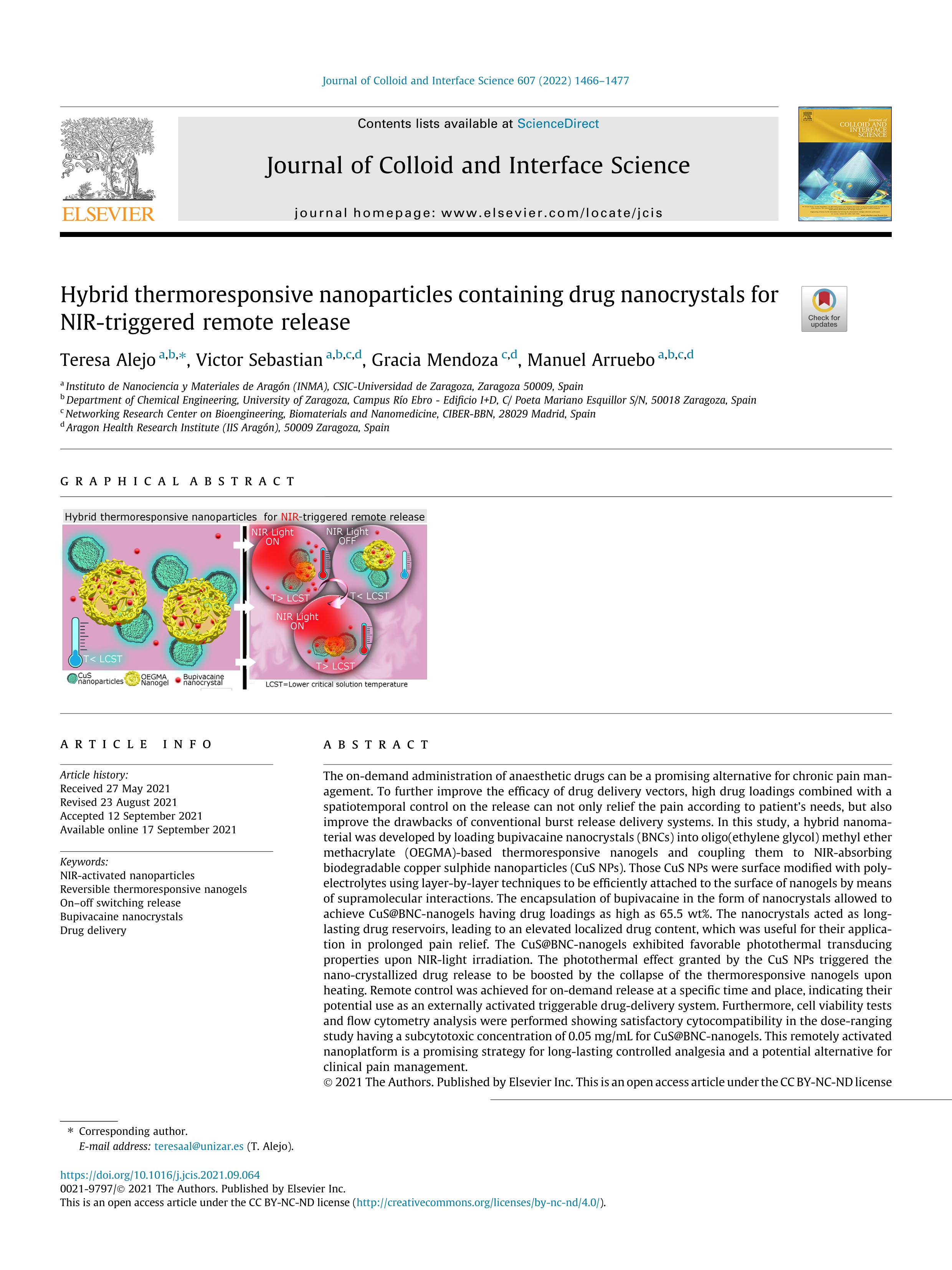
Resumen: The on-demand administration of anaesthetic drugs can be a promising alternative for chronic pain management. To further improve the efficacy of drug delivery vectors, high drug loadings combined with a spatiotemporal control on the release can not only relief the pain according to patient''s needs, but also improve the drawbacks of conventional burst release delivery systems. In this study, a hybrid nanomaterial was developed by loading bupivacaine nanocrystals (BNCs) into oligo(ethylene glycol) methyl ether methacrylate (OEGMA)-based thermoresponsive nanogels and coupling them to NIR-absorbing biodegradable copper sulphide nanoparticles (CuS NPs). Those CuS NPs were surface modified with polyelectrolytes using layer-by-layer techniques to be efficiently attached to the surface of nanogels by means of supramolecular interactions. The encapsulation of bupivacaine in the form of nanocrystals allowed to achieve CuS@BNC-nanogels having drug loadings as high as 65.5 wt%. The nanocrystals acted as longlasting drug reservoirs, leading to an elevated localized drug content, which was useful for their application in prolonged pain relief. The CuS@BNC-nanogels exhibited favorable photothermal transducing properties upon NIR-light irradiation. The photothermal effect granted by the CuS NPs triggered the nano-crystallized drug release to be boosted by the collapse of the thermoresponsive nanogels upon heating. Remote control was achieved for on-demand release at a specific time and place, indicating their potential use as an externally activated triggerable drug-delivery system. Furthermore, cell viability tests and flow cytometry analysis were performed showing satisfactory cytocompatibility in the dose-ranging study having a subcytotoxic concentration of 0.05 mg/mL for CuS@BNC-nanogels. This remotely activated nanoplatform is a promising strategy for long-lasting controlled analgesia and a potential alternative for clinical pain management. (c) 2021 The Authors. Published by Elsevier Inc. This is an open access article under the CC BY-NC-ND license
Idioma: Inglés
DOI: 10.1016/j.jcis.2021.09.064
Año: 2022
Publicado en: Journal of Colloid and Interface Science 607, Part 2 (2022), 1466-1477
ISSN: 0021-9797
Factor impacto JCR: 9.9 (2022)
Categ. JCR: CHEMISTRY, PHYSICAL rank: 29 / 161 = 0.18 (2022) - Q1 - T1
Factor impacto CITESCORE: 15.5 - Chemical Engineering (Q1) - Materials Science (Q1)
Factor impacto SCIMAGO: 1.604 - Biomaterials (Q1) - Surfaces, Coatings and Films (Q1) - Electronic, Optical and Magnetic Materials (Q1) - Colloid and Surface Chemistry (Q1)
Financiación: info:eu-repo/grantAgreement/EUR/ERC-2013-CoG-614715
Financiación: info:eu-repo/grantAgreement/ES/ISCIII-IIS/MS19-00092
Financiación: info:eu-repo/grantAgreement/ES/MCIU/RTI2018-099019-A-I00
Tipo y forma: Article (Published version)
Área (Departamento): Área Ingeniería Química (Dpto. Ing.Quím.Tecnol.Med.Amb.)
Exportado de SIDERAL (2024-03-18-13:24:19)
Visitas y descargas
Idioma: Inglés
DOI: 10.1016/j.jcis.2021.09.064
Año: 2022
Publicado en: Journal of Colloid and Interface Science 607, Part 2 (2022), 1466-1477
ISSN: 0021-9797
Factor impacto JCR: 9.9 (2022)
Categ. JCR: CHEMISTRY, PHYSICAL rank: 29 / 161 = 0.18 (2022) - Q1 - T1
Factor impacto CITESCORE: 15.5 - Chemical Engineering (Q1) - Materials Science (Q1)
Factor impacto SCIMAGO: 1.604 - Biomaterials (Q1) - Surfaces, Coatings and Films (Q1) - Electronic, Optical and Magnetic Materials (Q1) - Colloid and Surface Chemistry (Q1)
Financiación: info:eu-repo/grantAgreement/EUR/ERC-2013-CoG-614715
Financiación: info:eu-repo/grantAgreement/ES/ISCIII-IIS/MS19-00092
Financiación: info:eu-repo/grantAgreement/ES/MCIU/RTI2018-099019-A-I00
Tipo y forma: Article (Published version)
Área (Departamento): Área Ingeniería Química (Dpto. Ing.Quím.Tecnol.Med.Amb.)
Exportado de SIDERAL (2024-03-18-13:24:19)
Permalink:
Visitas y descargas
Este artículo se encuentra en las siguientes colecciones:
articulos > articulos-por-area > ingenieria_quimica
Notice créée le 2022-06-01, modifiée le 2024-03-19